by Ida Renzicchi

The Art
TEkHNE (Τέχνη). Divine personification of Art, with the name of πότνια, as opposed to Physis (Anth. Pal., 9, 738). It is represented as a winged girl who, in a Pompeian painting in the House of Sirico, indicates to Teti the shield for Achilles, prepared for her by Hephaestus, god of fire, forges, engineering, sculpture and metallurgy.
The Greek etymology of the word Art means technique, craft. More precisely, it communicates the secrets of the trade: Art is the mystery of the artist, the secret of his technique, of his know-how, which he reveals in the creation of his work.
``Art, in the broad sense of the word, for me, is making and transmitting culture. I would define Art as a sort of evolution of man himself, the awareness of creating something useful to humanity for knowledge and for the good taste of life, the aesthetic expression of interiority and of the human soul.``(Gianni Quaranta)
In ancient Greece, the arts and sciences were held in great esteem, so much so they placed them under the protection of particular divinities, unsurpassed teachers: the Muses.
Of the nine Muses, CLIO, goddess of history, was the most important;
CALLIOPE of epic poetry;
ERATO of the amorous verses;
TERPSICHORE protected the dance;
TALIA the comedy;
MELPOMENE the tragedy;
EUTERPE the music.
POLINNIA and URANIA were the foster protectresses of eloquence and astronomy, considered the two most relevant sciences.
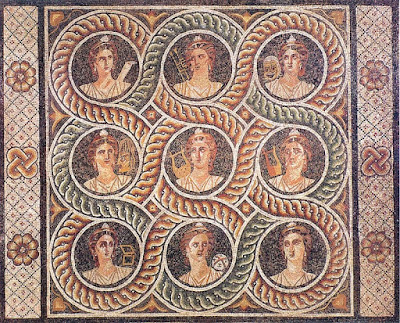
(Palace of Grand Masters Rhodes Greece, Mosaic depicting the nine Muses)
``To escape the world there is nothing safer than Art and nothing is better than Art to keep in touch with the world.`` (Johann Wolfgang Goethe)
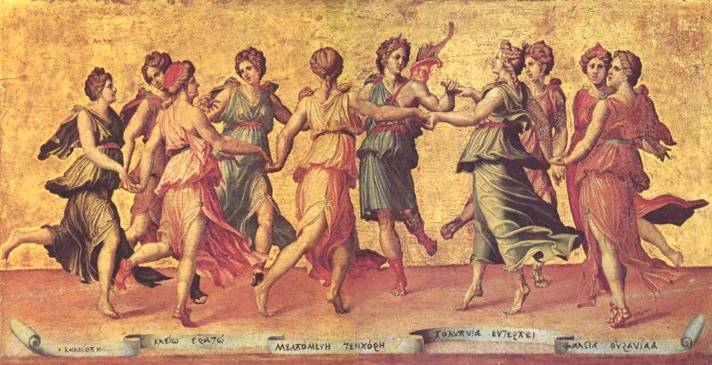
Baldassarre Peruzzi, Apollo and the Muses. Galleria Palatina (Palazzo Pitti), Florence
The Muses, portrayed by Renaissance artists, hold hands, underlining how the sciences and the arts are connected to each other.
After its advent, Cinematography (from the Greek κίνημα that is “movement and from the root γράϕω that is” to describe “), was called “the seventh Art” even if in reality it should be the tenth one since, as already mentioned, the Muses are nine. An Art, that of Cinema, which can include many others. “Cinema encompasses many other arts; just as it has characteristics of literature, it also has characteristics of theater, a philosophical aspect and attributes marked by painting, sculpture, to music. ” (Akira Kurosawa).
In China, the ideogram to indicate the word technique means at the same time, art, mystery and process. Its origin is the symbol of the crossroads to signify journey, road, communication. “To escape the world there is nothing safer than Art and nothing is better than Art to keep in touch with the world.” (Johann Wolfgang Goethe).
CREATIVITY IS THE ENGINE OF ART
Creativity is the engine of Art. It is the attempt to transcend reality as it is, pushing the artist to transform his idea into a work and it is the will to live that pushes man towards creativity.
Art is representation in the representation of the reality of each one according to one’s will: it is show within show, scene within scene. The passage from creativity to art, finds itself having to answer many questions and overcome many obstacles that both the artist himself and the viewer face once the work has been created.
What is Art? Instinctively, we would all say Art is that activity producing beauty, but what is meant beauty and who can define it as such? And what is art and what is not?
This is the question we ask ourselves when, out of tradition and history, with the sole intention of surprising by doing “other” someones arrive at the reproduction of nothing.
Lev Nikolaevicˇ Tolstoy (1828-1910), one of the greatest artistic and moral figures of the modern world in his treatise “What is Art?”, Published in 1897, through concrete examples, but without sparing peremptory judgments and slating on the work of many consecrated talents, reviews the evolution of basic concepts such as beauty, profit, taste, truth, right through philosophy, aesthetics, art criticism, literature, time. Art for Tolstoy is popular. It promotes peaceful coexistence between peoples by stimulating feelings of brotherhood and spiritual communion between the artist and those who contemplate the same work. “Art is a human activity having as its own purpose the transmission to other people of the highest and best feelings man has ever reached.” (Lev Tolstoi).
“Art means: showing God within everything.” (Hermann Hesse)
The greatest artist is God in his Creation. “God is above all an artist. He invented the giraffe, the elephant, the ant. In truth, he never tried to follow a style: he simply did everything he wanted to do. ” (Pablo Picasso).
The perfection of nature and of all the beings that inhabit it deserve the same attention as works of art. “A bird, a beetle or a butterfly deserve the same fervent attention as a painting by Titian or Tintoretto, but we have forgotten how to look” (Claude Lévi-Strauss).
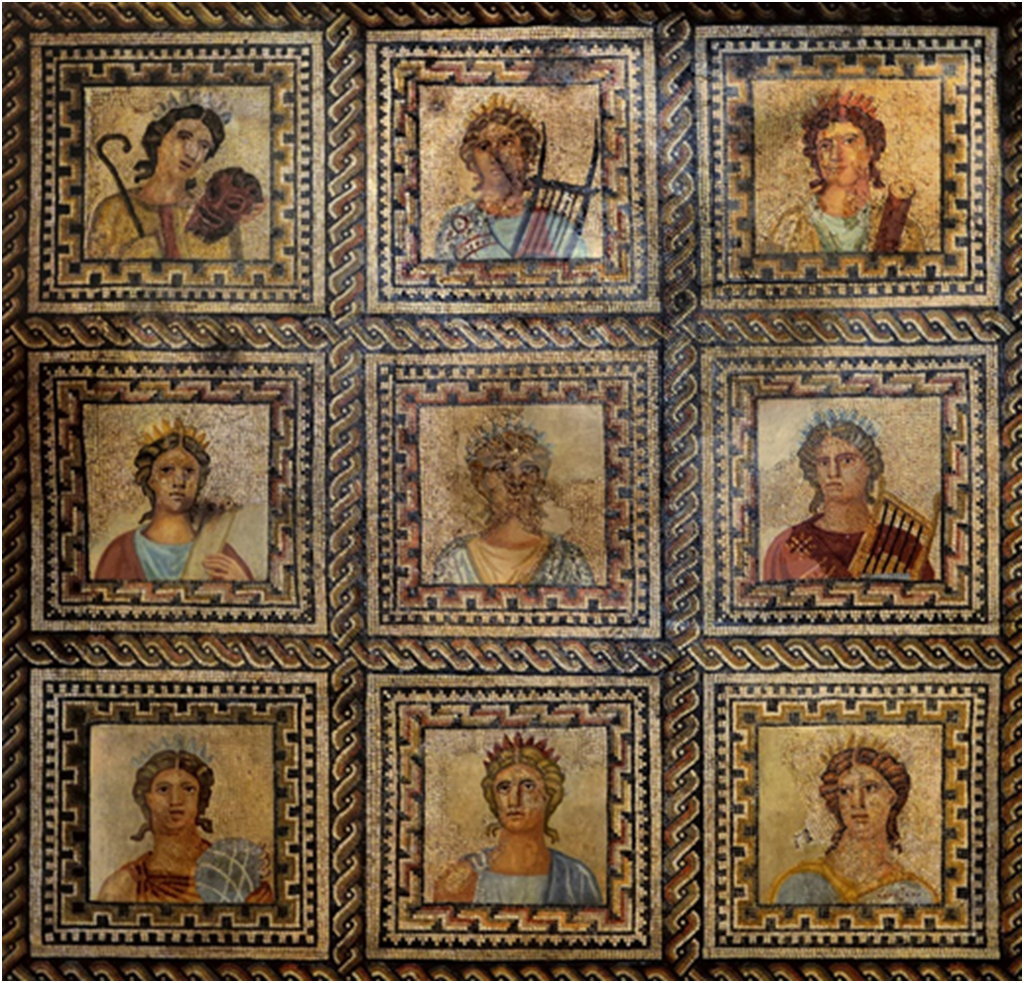
Nine Muses, Roman floor mosaic, Anonymous, 220 d.C. – Rheinische Landesmuseum Trier (Archaeological Museum of Trier, Germany). Nine Muses, Roman floor mosaic, Anonymous, 220 d.C. – Rheinische Landesmuseum Trier (Archaeological Museum of Trier, Germany). From the left Thalia, Tersicore, Calliope, Clio, Polimnia, Erato, Urania, Melpomene ed Euterpe.

Ida Renzicchi met Maestro Gianni Quaranta and a conversation ensued that the Geapolis web community, in tune with the love for all that is and that has to do with Art in all its forms, has the pleasure to convey.