Ida Renzicchi (Translated by the author)

“THE ART of acting while singing”
Music is the voice of the soul and Opera is its maximum artistic expression. Bel Canto and the Opera were born in Italy and they are an integral part of the intangible cultural heritage of our country. The musical tradition, pride of our nation, is universally recognized as one of the most important in the world and the Italian language, considered the “language of music”, is used in many musical terms and certainly in those related to Opera.
Many assert that the success of Italians in this art is explained precisely by the peculiarities of their language, which is at the basis of the expressive means of Bel Canto style. The best known opera singers from all over the world know Italian and not only the most famous arias, but also traditional folk songs which are performed in all repertoires. The most important Opera composers and librettists are Italian and many illustrious foreign authors have used our language for their compositions. The Italian Opera Foundations are the most requested to stage Operas and it is in Italy that there are the most important Opera Houses in the world and also the oldest one: the San Carlo in Naples.
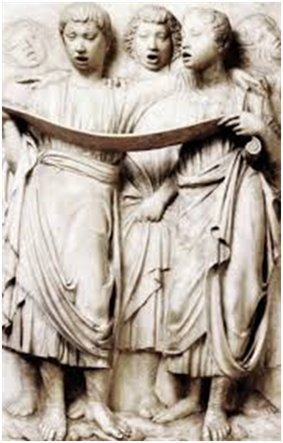
``I have always thought that the Opera is a planet where the Muses work together, clap their hands and celebrate all the arts.`` (Franco Zeffirelli)
There are many foreign students who, recognizing ours, as the homeland of Bel Canto, attend its music conservatories, spreading the Opera culture all over the world.
The Italian candidacy has been presented for years, signed by many personalities who have launched appeals on several occasions, for the identification of Bel Canto and Opera as an Intangible Cultural Heritage of Humanity.
Bel Canto, is therefore a musical term of Italian origin to define the art and science of vocal technique that was born in the late 1500s in Florence by the Camerata de’ Bardi: a cenacle of humanists, passionate about poetry and music who, first, theorized the “acting while singing”, from which the operatic melodrama would be born. It, developing further in the following years, reached its maximum splendor in the following three centuries, ‘600,’ 700 and ‘800. An Italian style, typical of the Opera, a virtuosity singing technique characterized by the smooth transition from low to high notes, agility in ornamentation and phrasing and by the conception of the human voice as an instrument.

Polypytic of the mystical lamb 1426-32 – Jan Van Eyck and Hubert Van Eyck- Cathedral of San Bavone – Ghent- Belgium
We tiptoe into the particular world of the “musici” of the Baroque period and of the countertenors of our time, approaching in silence and with respect, this mysterious universe made of thousand shades and unique sensations.
Towards the middle of the 16th century, with the affirmation of polyphonic singing, it became really difficult to find male voices both acute and powerful at the same time.
Since the Church had given a totally restrictive interpretation to what Paul of Tarsus affirmed in the first letter to the Corinthians, “mulier taceat in ecclesia” (the woman must be silent in church) and women were therefore inhibited from both the presence in the ecclesiastical choirs and the participation at the theatrical performances, “mulier taceat in theatro”, in Rome, the barbaric custom of castrating (from the Sanskrit çastrám, knife) the young singers began to be introduced to preserve the purity and melodious magic of the voices. (This uncivil practice was already exercised by the ancient Sumerian people on the human beings assigned to the surveillance of the Harem, the Eunuchs).
In the mid-sixteenth century, entering an ecclesiastical choir was a blessing for the castrato and for his family. Becoming a liturgical cantor was one of the very few ways the humblest had to raise themselves socially and, above all, to live almost like the nobles and high clergy. The families of the children who showed particular ability in singing competed to propose their children to the prelates for the “sacred” castration. Only the best, however, could aspire to become singers.
In the sixteenth and seventeenth centuries, the soprano singers, contraltists or natural falsettists, also called “musici” or “emasculated singers”, enchanted the audiences of theaters all over Europe. These young people, almost exclusively of clerical extraction and castrated already in prepubertal age, thanks to this terrible bloody custom, acquired very rich vocal timbres, abnormal extensions, expanding lung capacity and fullness, sweetness and expressive flexibility, interpreting with amazing virtuosity, indiscriminately idealized, exotic, mythological, allegorical characters, without predetermined male or female scores.
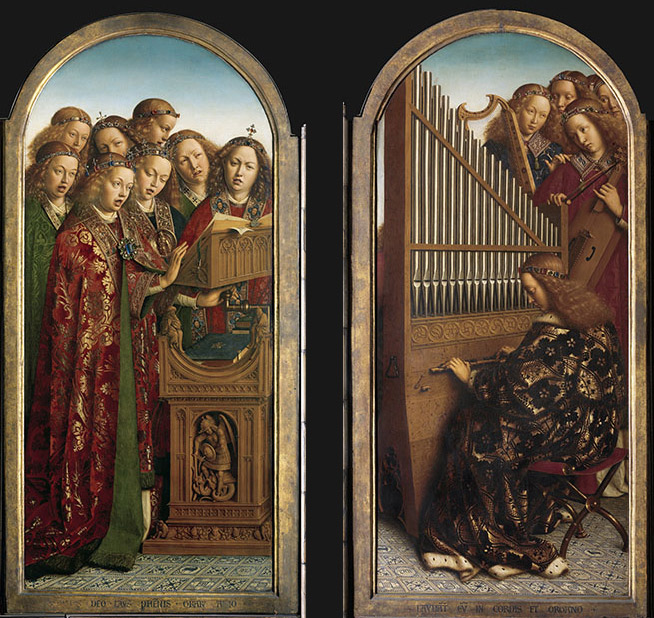
Detail Polypytic of the mystical lamb 1426-32 – Jan Van Eyck and Hubert Van Eyck- Cathedral of San Bavone – Ghent- Belgium
The use of castrati, banned in France but widely practiced in Italy, Spain, Germany and England, replaced that of white voices, which remain so for only a few years, and artificial falsettists (those we now call countertenors) who, thanks to the greater lung capacity prerogative of the male sex and to an appropriately educated voice, were able to move on female tonal textures, managing to acquire the characteristic modulations of the weaker and less reliable voices of the women, by nature, endowed with a thoracic capacity lower than men.
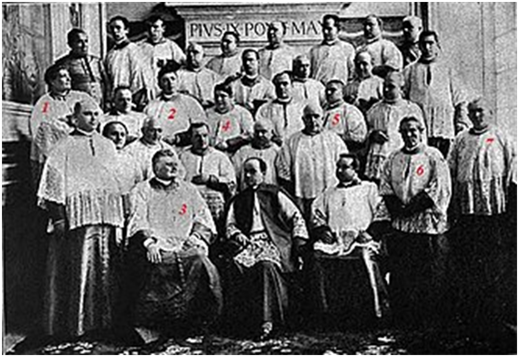
The Choir of the Sistine Chapel- Vatican – March 4, 1898 Present the castrated singers: Giovanni Cesari (1), Domenico Salvatori (2), Domenico Mustafà (3) Alessandro Moreschi (4), Vincenzo Sebastianelli (5), Gustavo Pesci (6) , Giuseppe Ritarossi (7).
In 1599 the emasculated musicians officially entered the choir of the Sistine Chapel, the Pontiff’s private chapel: the first two singers, strongly desired by Pope Clement VII for their “angelic” voices, were Girolamo Rossini and Pietro Paolo Folignato.
In 1878 Leo XIII, restoring the ancient tradition that wanted children to be part of the ecclesiastical choirs, prohibited the Church from continuing to hire castrati. They continued to be used for a few more years, but only “ad Honorem Dei” in the Sistine Chapel and in other Roman basilicas.
In 1903, Pius X, with the motu proprio on sacred music “Between the Sollecitudes”, expressed himself in this regard: “.. From the same principle it follows that the cantors have a true liturgical office in the church and that, however, women, being incapable of this office, cannot be admitted to be part of the choir or the musical chapel. Therefore, if the acute voices of sopranos and altos are to be used, these must be supported by children, according to the very ancient custom of the Church. “.
Alessandro Moreschi, the last castrato to achieve success, retired from the business in 1913. A German music critic wrote about him: “I did not believe that the human voice could be the most extraordinary of all musical instruments, until I listened to Moreschi “.
Carlo Maria Michelangelo Nicola Broschi, who lived in 1700 was the greatest exponent of emasculated singers become symbols of a stylized vocal aesthetic far from the canons of theatrical realism. Known as Farinelli, he was capable of holding two or three hundred notes with one breath.
The beauty of his tall and slender young figure and the incredible extension of his voice allowed Farinelli to interpret female parts during the years of his stay in Rome.
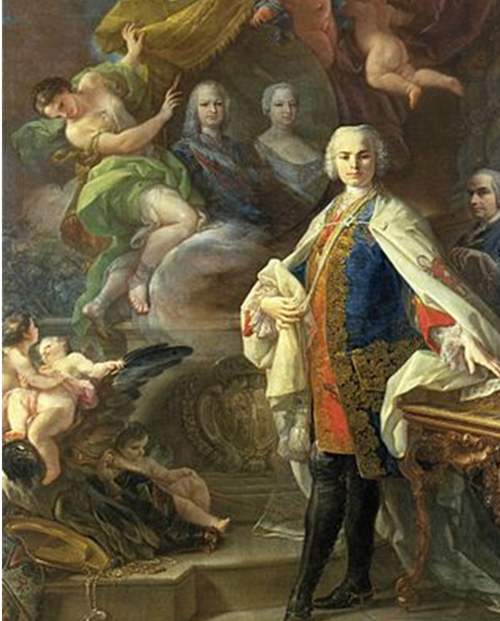
Portrait of Carlo Boschi known as Farinelli – Corrado Giaquinto – 1753 – International Museum and Music Library – Bologna – Italy
Charles Burney, composer, organist, historian of English music, in his “Musical Journey to Italy”, of 1771, described how the famous artist performed and won, competing with a trumpet player to the sound of breaths and warbling. In this regard, he wrote: “Farinelli, on the other hand, showing that up to that moment he had only joked with his opponent, with a smile on his lips, without catching his breath and with intact vigor, not only issued a note, reinforced it and trilled it, but performed the most rapid and difficult warbling, and was silenced only by the cheers of the audience. It can be said that from that moment that superiority was born which he then kept undisputed over his contemporaries “.
Farinelli, the God of Belcanto, delighted all the courts and theaters of Europe with his extraordinary performances. “… in 1737 the great Farinelli was offered by the king of Spain an annual salary of 50,000 francs: he remained in his service for twenty-five years with the task of singing the same four arias every evening” (Cappelletto, 1995, p. 62).
….
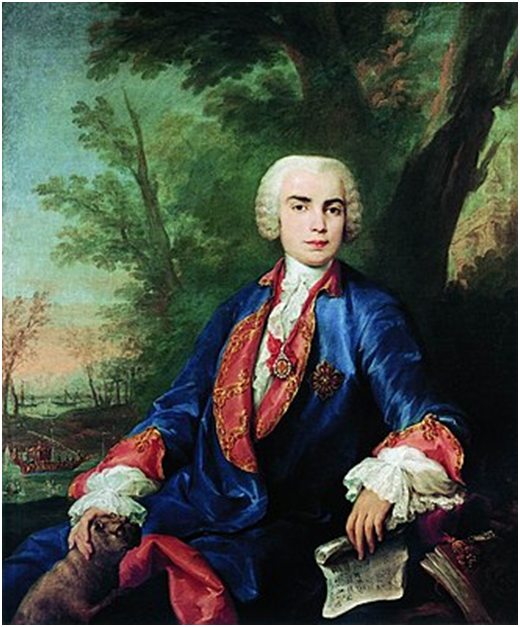
Jacopo Amigoni, Portrait of Farinelli – Staatsgalerie Stuttgart (Stoccarda)
The cultured and refined singer knew French, English, German and Spanish very well. A popularizer of Italian culture, he generously helped his fellow artists to establish themselves wherever his abroad commitments led him. The very complex of his exceptional qualities as a man and artist made him a unique and unrepeatable phenomenon.
Dwelling on a detail that speaks volumes about the infatuation the whole artistic world, especially the London public, had for Farinelli, Johann Nicolaus Forkel, German musicologist, organist and musician, in his quotation on the table of the famous cycle of engravings made by William Hogarth, painter, engraver, author of satirical prints, in 1735, wrote: “In the same panel, which represents a room, on the floor we see a portrait of Farinelli placed on a pedestal in front of an altar, on which several candles are burning; next to the altar a crowd of people stretch their arms towards him and offer him gifts. At the foot of the altar a lady is kneeling, offering him her heart: a note hangs from her mouth with the inscription: “One God, one Farinelli!”: allusion to a lady who, delighted by a musical passage from Farinelli, shouted this phrase aloud from her box ”. (Musikalisch-Kritische Bibliothek).
Nowadays, castrated singers no longer exist: castration has been abolished by law.
The role of the “musici” of the Baroque period is currently played by the countertenors, previously called artificial falsettists: people with uncommon natural gifts, who, by subjecting themselves to great study and exercise, acquire an extraordinary vocality that is not an imitation of female singing and that actually tries to emphasize the male base, despite the more acute and superimposable register, in many cases, to that of the alto.
“Countertenors are curious creatures: men with the approximate range of mezzo-sopranos.” (Margalit Fox – The NewYork Times-April 23, 2016).
I remember the Japanese-American countertenor Brian Asawa’ s the wonderful voice in the interpretation of an important part, that of the member of the band headed by the son of the female protagonist, in the drama Gogo no Eiko inspired by “The taste of glory” by the Japanese author Yukio Mishima, set to music by Maestro Hans Werner Henze, staged on 17 June 2010 at the Festival dei Due Mondi in Spoleto, Italy, directed by Giorgio Ferrara, sets by Gianni Quaranta, costumes by Maurizio Galante, lights by AJ Weissbard, conductor Johannes Debus.
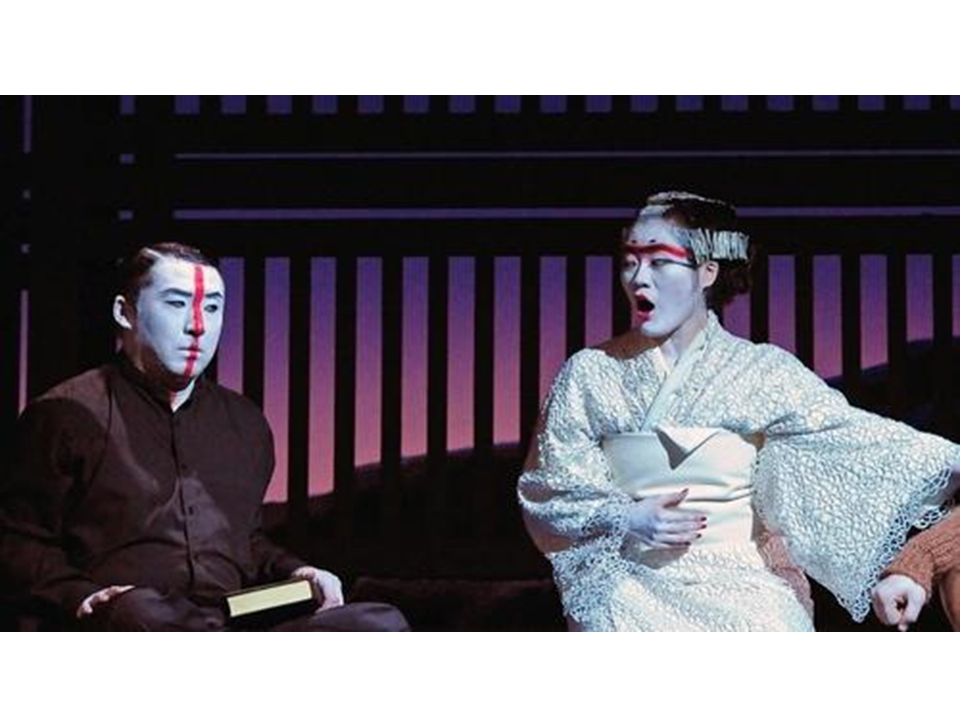
BRIAN ASAWA – Gogo no Eiko – Spoleto – Italy
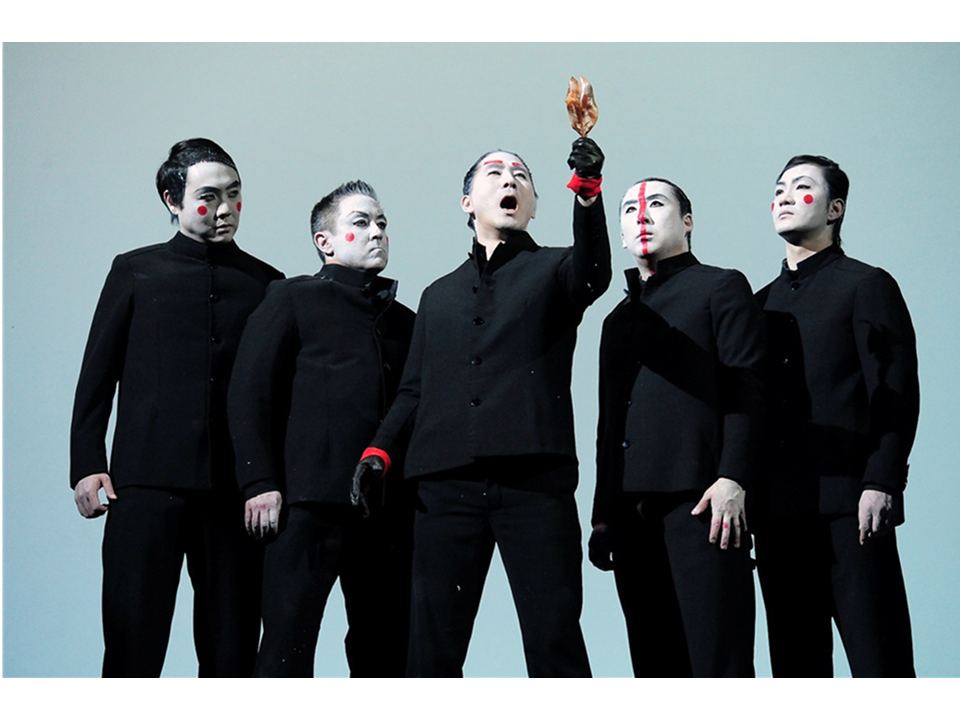
BRIAN ASAWA (second from right) – Gogo no Eiko – Spoleto – Italy
Brian Asawa, who passed away at the age of 49, was one of the most famous countertenors in the world. He had performed in all the major theaters obtaining sensational successes everywhere. ” Mister Asawa was one of the few to enjoy international fame.” (Margalit Fox – The NewYork Times-April 23, 2016).
Philippe Jaroussky, Raffaele Pe, Angelo Fernando Galeano, Michael Maniaci, Francesco Divito, Adonà Mamo, Alessandro Carmignani, Filippo Mineccia are just some of the modern “angels”: contemporary countertenors, who continue to offer musical culture to the whole world, moving elegantly ease between Baroque Opera and refined modern executions.

I take advantage of the kindness of Maestro Gianni Quaranta who created the wonderful scenography of “Farinelli Voce Regina” and who, by allowing me to publish the photos of his personal archive relating to the film, made precisely on the life of the famous “musico”, offers me the opportunity to present the dramatic, biographical and musical film realized in 1994 directed by Belgian director Gérard Corbiau to the Geapolis‘ web-users.
Read more click here