.
INVITATION TO READ
.

.
INVITATION TO READ
.
.

.
.
THE OLD WOMAN
by Ida RENZICCHI
(Written and translated from Italian by the author)
.

.
All rights reserved by the author. Reproduction and any other use, even partial, not authorized by the author are prohibited. Publication of the text is permitted for educational and cultural, non-profit purposes upon concession and authorization by the author. For any contact with the author: idarenzicchi@gmail.com
.
.
.
.
«Teach us to number our days,
that we may gain a heart of wisdom.»
— Prayer of Moses, Psalm 90:12
.
.
PART ONE
.
.

Swans Reflecting Elephants, 1937, Salvador Dalí (1904-1989), private collection of Cavalière Holding, Co., Inc., Geneva, Switzerland
.
.
Seated on a faded green bench to the left of the building’s entrance, the old woman seemed to be mumbling prayers.
She opened and closed her mouth, muttering something that some might have called litanies, yet in her hands she held no rosary to bead.
To say she was thin is not exact: she was withered. Even her soul must have grown parched… Only her eyes, from which nothing escaped from her fixed post, possessed sharp, piercing flickers.
Her face, parchment-dried by the years and by living much in the open air, was wrinkled and dry, her body bony, her hands long and skeletal, her fingers tapered. Yet her clean, well-kept nails denoted attention to personal hygiene.
She arrived at dawn and left in the evening when very few people were moving about that part of the city. No one knew where she came from, nor had anyone ever asked her where she spent her nights.
During the day, like a queen, she sat at the center of her throne. To her right, in front, to block access to it by other people, she placed a shopping trolley, and to her left, resting right on the bench, she kept a roomy, semi-rigid tote bag made of brown-and-beige checked waxed cotton fabric, a sad imitation of a luxury brand. On sunny days, she seemed to doze off, only to open her eyes immediately whenever anyone approached “her” bench.
When had she arrived for the first time? And why had she chosen that particular place?
A little further on, on the opposite side of the street, there was a lovely open space where, right behind the city bus stop and beneath a few majestic centuries-old oak trees, a green area had been created. It was furnished with comfortable wooden benches mainly serving local residents… a young woman with her baby in a stroller, a few elderly people, or simply someone who, in that little oasis, sat facing the street waiting for the coach that would take them to the city center.
The old woman could very well have settled on one of the somewhat more secluded seats placed here and there under the large trees, where she would have been in the shade during the hot summer days and enjoyed a few hours of sunshine during the winter… she wouldn’t have bothered anyone and, surely, no one would have said anything to her. But no. She had taken possession of the bench below the building and hadn’t moved from that spot since… almost as if she considered it her own property.
When the residents realized that the old woman had settled there on a permanent basis, someone started to complain.
“Now what is this old woman doing always on our bench? Who gave her permission?”
A gentleman who lived on the first floor had raised the issue at the condo meeting.
Obviously no one had given her permission, but how could they tell her she wasn’t welcome? Who was going to go and tell her that the bench was private property? In the end, since no one wanted to take on the task, and because it wouldn’t have been possible to remove the bench—which was cemented to the ground—someone suggested solving the problem by placing a few pots on the seat to prevent its unauthorized occupation.
Given the woman’s constant presence, the operation took place at night. Those who had pots on their balconies slid them into the elevator and carried them outside the building, placing some in front of and others right on top of the seat itself. They could have done a better job, but the goal wasn’t embellishment, but rather a deterrent against the unwanted tenant.
The following morning, with unpredictable energy, the old woman had removed them all, one by one, and showing an unsuspected aesthetic sense, had arranged them at the sides of the front entrance and along the side wall of the building.
“Excuse me, ma’am, who gave you the order to move those pots? This is private property! Has anyone ever told you that?”
The woman didn’t answer. She looked the man straight in the eye.
“Well? Why did you remove the pots? May we know?… So?… Who gave you permission?… You can’t stay here, this is private property!”
In the end, he had said it to her!
The old woman kept staring at him with a strange smile. Then, after moments during which the two seemed to challenge each other with their eyes, she finally spoke.
She didn’t answer, but instead asked a question of her own: “How am I bothering you?”
The man was taken aback… he hadn’t expected a counter-question. In fact, the woman wasn’t bothering anyone. Perhaps it was just the presence of an old woman that disturbed him and the other residents.
“The fact is, ma’am, that you can’t expect to spend all your days here. Why don’t you make yourself comfortable in the park over there? It’s a public place, you’d have more space, and no one would bother you.”
“How am I bothering you?” The old woman repeated her question.
The arrival of the resident’s wife put an end to that clash of words and glances.
“What’s going on? You’re not going to start competing with an elderly person, are you?…”
The man, struggling to repress the anger that had built up inside him, let out a sigh and, with clenched fists, followed his wife toward the front door. He would never admit that the old woman had won the showdown.
“This story doesn’t end here… the property manager will take care of it. After all, what are we paying him for?”
Although quite annoyed by the request, the manager nevertheless agreed to resolve what he considered an irrelevant matter: “It’s an assignment that doesn’t fall under my duties; however, I’ll try to talk to the lady.”
.
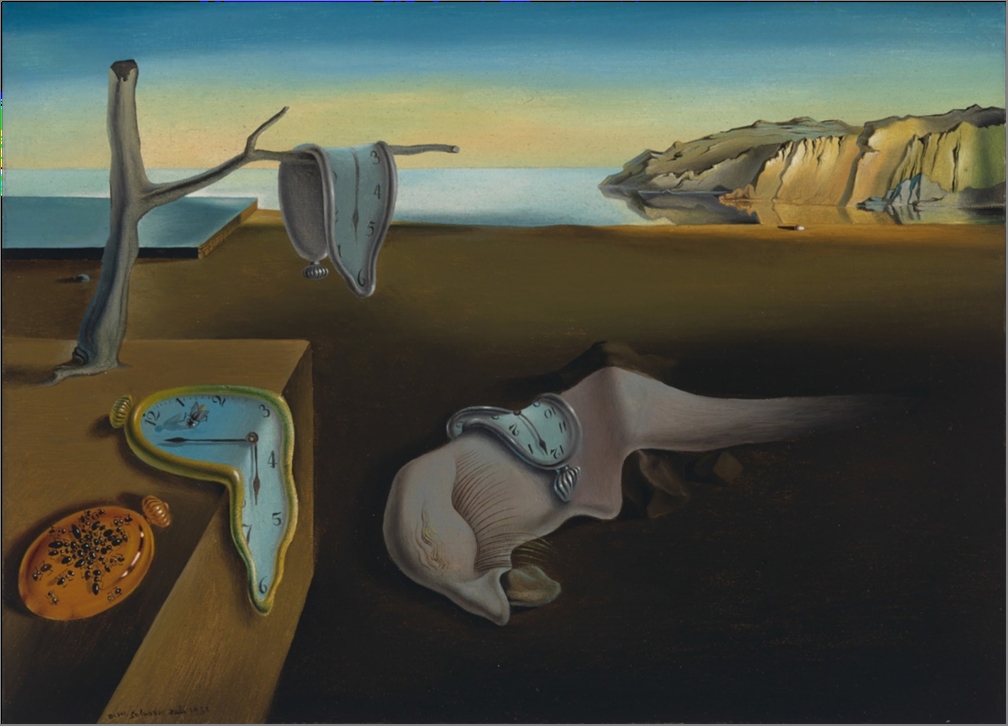
The Persistence of Memory, 1931, Salvador Dalí (1904-1989), Museum of Modern Art (MoMA), New York City
.
In the end, it turned out that the bench wasn’t even on condominium ground—so not on private property—but on public land, and that it had been arbitrarily and illegally placed there without any permit. In fact, the residents would have been better off keeping quiet because, given the violation, they could have faced a fine for unauthorized occupation of public space.
It was the old woman herself who had told him when he, cloaked in authority, had peremptorily ordered her to clear out. At that point, he had no choice but to check: the woman was right. The property manager had been in charge of that condominium for just a few months and hadn’t yet had the time or the opportunity—to tell the truth, it hadn’t even crossed his mind—to deal with such a trivial matter… when he took over, the bench was already there, and he certainly had never thought to verify whether it had been placed legally and within the property boundaries. How and from whom had the woman come by this information? What to do? The manager immediately called an extraordinary meeting to warn the residents of the situation’s development. No one could chase the old woman off public land, nor place pots or anything else there to block her access.
“The bench is ours, though. No doubt anyone can stop us from taking it away from there… in fact… seeing as it’s said to have been placed there illegally…”
It was always the first-floor resident who spoke.
No one remembered who had decided to put the bench outside the building, or when. The problem that now arose was its removal and subsequent disposal. Who would take charge of it? Who would pay?
The building manager clarified that it did not fall under his duties. In the end, the first-floor gentleman said he would take care of it, provided that any expenses were paid by all the residents in equal parts.
To this end, he contacted a bricklayer, a young lad of foreign origin who, so he had been told, would turn his hand to just about anything on a budget.
However, as the latter set about removing the bench, a local traffic cop passing by immediately stopped him, telling him he could not operate on public property.
The first-floor gentleman’s heated protests were followed by a first fine issued to the condominium—which the man claimed to represent—for carrying out work on public land without authorization, followed in turn, when the same first-floor gentleman claimed ownership of the bench for the condominium and thus the right to remove it, by a second fine for the unauthorized occupation of public space.
Someone in the building wasn’t happy about having to resort to a lawyer and pay up…
The bench stayed right where it was, and the old woman continued to occupy it after a municipal worker had repaired the concrete around it and firmly anchored it to the ground.
At that point, in the subsequent condominium meeting, they discussed whether and how to oppose it, and consequently how to act since they now had to deal with a local government body.
Most of the owners were of the opinion to drop the matter: pitting themselves against the local authority would mean facing expenses with no certainty of victory.
“Lawyers cost money… and lawsuits do too… plus the fact that they never end, and even when you’ve won them, it’s as if you’ve lost… In the end, we citizens pay the City’s legal fees too, not the Mayor or the administrators out of their own pockets…”
“After all, the old woman sits on this blessed bench, she’s not eating it or carrying it away…”
The person who spoke was a rather calm gentleman, a retired professor, a widower, who disliked controversy and who, from the very beginning, had shown himself opposed to raising the issue of the bench. He considered the dispute more a matter of petty stubbornness on the part of the first-floor resident than a matter to be settled in a court of law…
“If you want to go ahead, though… be my guest. But I don’t want to be involved and, above all, I’m telling you clearly, I do not intend to pay even a single cent for such an absurd controversy. It’s true, the elderly lady’s presence may not be welcome… but resorting to a legal battle because she sits on a bench, which furthermore was even placed illegally and on public land… seems a bit much… don’t you think?”
The plain speaking of the “professor”—as they called him—had given all the other residents the courage to express their thoughts as well, which, while maintaining the fact of the lady’s unwelcome presence, were identical to those expressed by the old teacher.
“And well… we surely can’t shoot a fly with a cannon… Are we really going to start competing with an old woman just because she’s sitting on a bench… what crime has she ever committed anyway?”
This time the speaker was a worker in his fifties.
“In the end, this old woman is bound to die too… sooner or later…”
And, in the end, the old woman really had died… several weeks later.
She looked as though she were dozing in the late afternoon sun, but instead she had passed away forever… her gaze glassy and inscrutable like that of Countess Anna Fedotovna in Alexander Pushkin’s “The Queen of Spades”.
The bench had been cleared.
The funeral home attendants had taken care of the body, and a person belonging to a religious congregation had come to collect the late old lady’s shopping trolley and checked waxed bag.
The operation had been carried out in silence and so quickly that some of the residents hadn’t even noticed anything and only found out about the death the next morning when, on that spot which the elderly lady would certainly no longer occupy, someone had laid a small bunch of wildflowers.
After a couple of weeks, the first-floor resident had personally repainted the bench a lovely, bright green color.
.
.
PART TWO
.
.
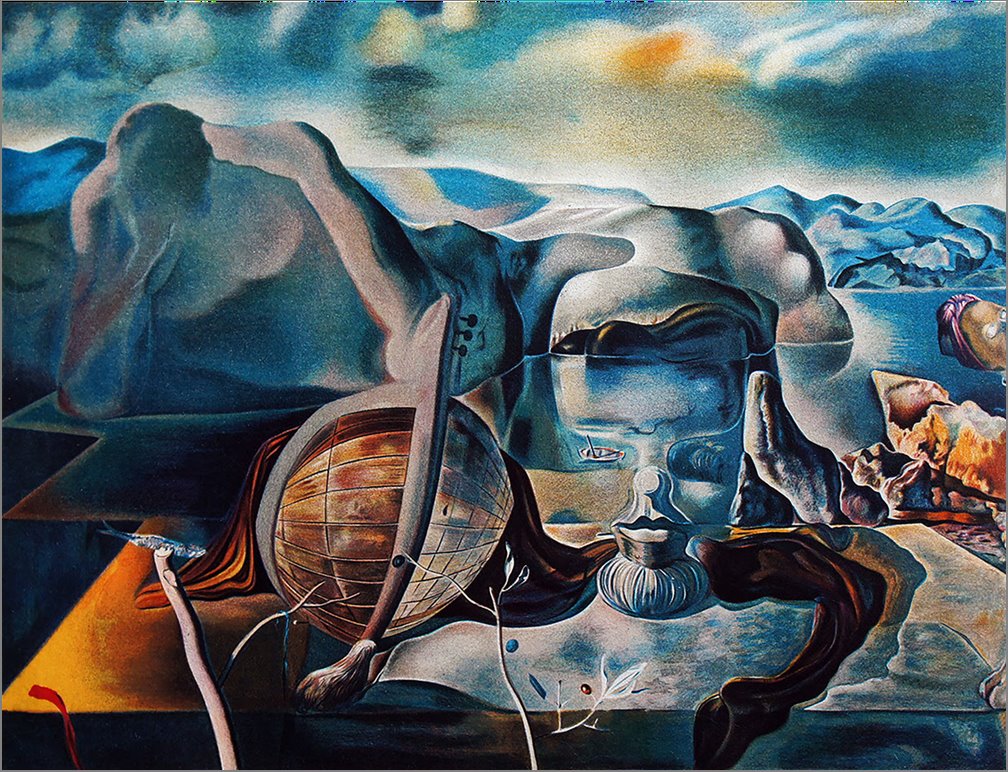
The Endless Enigma, 1938, Salvador Dalí (1904–1989), Museo Nacional Centro de Arte Reina Sofía, Madrid, Spain
.
Time had passed.
The teacher, following a bad fall that had forced him to undergo surgery and consequently use crutches which he never gave up, went out very little and only when accompanied.
A couple of the building’s apartments had been put up for sale after the tenants living in them had passed away.
Another one, on the first floor, had remained empty since the children of the lady who lived there had placed her in a nursing home.
Yet another had been put up for auction by the court, so before having to forcibly leave the home, the couple living there had preferred to move to a village in the province into a small house one of them had inherited.
The first-floor resident had been left alone. Not that his wife had died, no. She had left. Tired, after years of arguments and harassment, the woman had left him.
After dusting off her nursing diploma, in secret, with the help of an association, she had found a job at a major hospital on the other side of the city. She had rented a small studio apartment nearby and, without saying anything to anyone, for several days while her husband was at work, she had begun moving, transporting her personal belongings in roomy shopping bags. Back and forth, changing as many as three buses and carefully checking the timetables so she could be home in time for her husband’s return.
One day, finally, she had moved out and was living alone. Not that she was happy now, but at least she was at peace.
Shortly before dying, it had been the old woman who, from down below, heard the continuous arguments between that poor woman and her husband, advising her to make that decision: “What are you still doing there, my child? Leave him! Leave him now… while you’re still young. You said you have a nursing diploma, didn’t you? You rent a small apartment… You work and make a living.”
Wife and husband had argued fiercely over her as well: “Don’t you think it’s better to put an end to this bench business? She’s a poor soul… leave her alone… how is she bothering you?” she had told him, trying to dissuade him from his obsession toward that elderly woman. The man had flown into a rage: “Ah, there it is, I knew I was harboring a viper in my bosom… now I’m in the wrong too, huh?… Leave her alone? And who touched her! You, you and that cursed old woman… but I’ll make you both pay dearly…”
And it was the old woman, after much reluctance on the young woman’s part, who had given her the money: a large and unexpected sum that would solve all her problems. She had pulled from the bottom of the beige checked waxed bag a leather pouch of an indefinable golden-orange color worn by time, placed it in her hand, and, tightly closing her fingers around it, looked her straight in the eye, fixing her with that sharp, piercing flicker that ill-suited her old and battered appearance.
“Don’t have any scruples… take this money… I don’t need it… and besides… if you really must make a problem out of it, consider it a loan… but don’t worry… I don’t need it… I’m glad that you have it, my dear child…”
And she had further helped her by giving her a list of people to contact for any kind of help.
When the woman finally decided to take the big step, the elderly woman had already died, but the money and the contacts she had received proved to be of vital importance.
It hadn’t been easy.
.
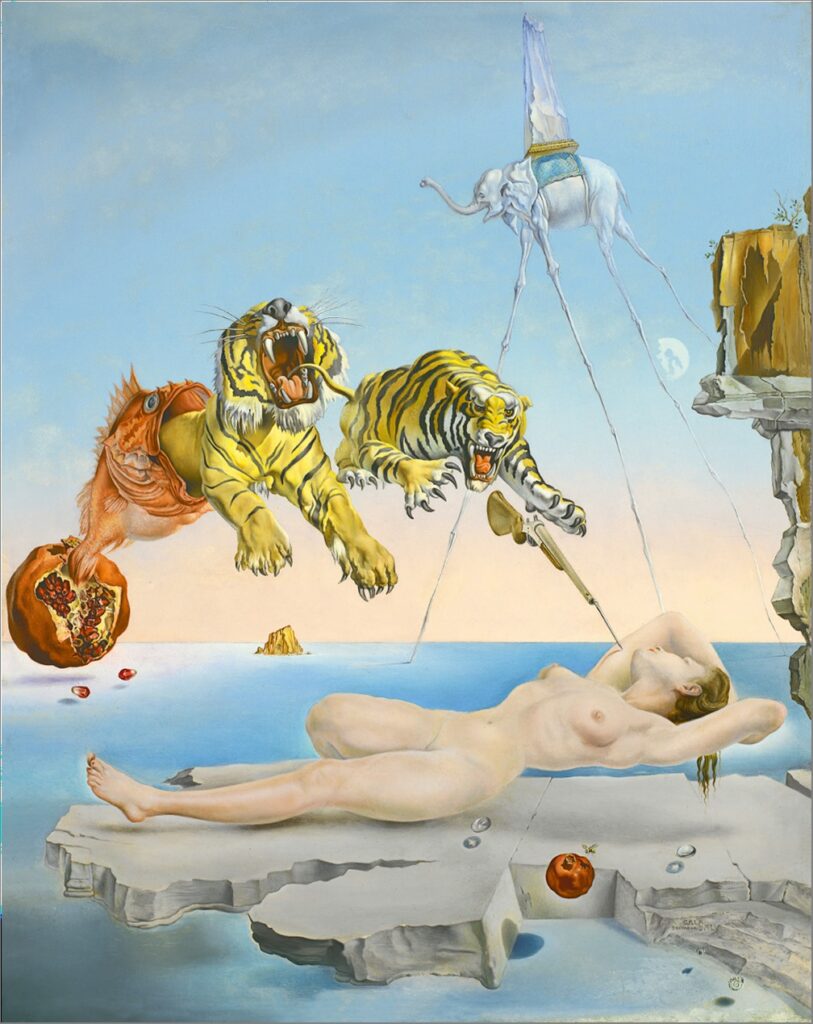
Dream Caused by the Flight of a Bee Around a Pomegranate a Second Before Awakening, 1944, Salvador Dalí (1904–1989), Museo Nacional Thyssen-Bornemisza, Madrid, Spain
.
The man would never have imagined that his wife would find the strength to take such a step. Not that she hadn’t always threatened to leave… but he was sure she would never do it…
Irascible and overbearing, he was left stunned… he certainly hadn’t expected such sudden boldness and determination.
“The bastard… she must have gone off to be a whore… what else?”
He knew he was speaking nonsense: his wife had always been a most decent person… but the man couldn’t stand the fact that she had finally rebelled… above all, he couldn’t understand how he, who always kept everything under control, hadn’t noticed a thing. Now he found himself alone, with no one to vent his rage on.
“In the end, you know what I say? I’m even better off like this… I do whatever I please… the first hooker I find, I’ll take her and bring her upstairs… She thinks I’m old, does she? I’ll show her… she’ll realize who she’s dealing with! And she better not think of coming back home…”
He found himself talking to himself because, in fact, he hadn’t even had the courage to tell anyone that his wife had vanished… He knew full well why she had left: obviously, she had left him because she didn’t want to be with him anymore… because she was miserable with him.
The idea that his wife could face any other situation and that, in any case, she would be better off had never even crossed his mind.
At first, he had thought of going to the Police to report her missing, but then, at the thought that someone might testify about their frequent arguments, and for fear of… he didn’t even know what himself, perhaps of having to leave the house, he had let the days go by.
Besides, they had no social life. Adopted, an only child, orphaned of both parents, she only had two or three cousins scattered around the world with whom she had very little contact.
He too had lost his parents. He had a brother, but they hadn’t spoken in many years, and, in truth, he didn’t even know where he lived anymore.
He worked as a bus driver, and partly because of his shift hours, but largely due to his awful temper, he had no relationships even with his colleagues, whom he rarely met. Arriving by car at his workplace, he would get on the vehicle, do his shift, and, once his designated route was completed, return the bus to headquarters and go back home.
Now, he found himself wandering around the city. He would never have admitted it even to himself, but he hoped to find his wife somewhere. What would he have done? What would he have said to her?
His wife, on her part, prayed to God never to meet him again. She had cut her long hair and had lost a little weight. She looked like a different person. She worked shifts too. She would leave work and rush home, always looking over her shoulder for fear of seeing him pop up in front of her one day or another. She was also worried that, working in a hospital, some acquaintance might end up being admitted there. Fortunately, they had virtually no friends and even less of a social life.
It hadn’t been easy to change her life so radically, but slowly, bit by bit, she had settled into her new job and was greatly appreciated by her colleagues, as well as by the doctors and patients.
After some time, the chief of medicine in the ward where she worked—a highly respected professional close to retirement, an attentive and sensitive man who had noticed the woman’s skills and potential—suggested that she resume studying and get her degree.
He advised her to enroll in and attend courses at the faculty of medicine, which was located in a building that was part of the same hospital complex.
After all, why not give it a try?
It had been a very tough period! Studying and, at the same time, working as a nurse had involved more than a few sacrifices. At the same time, getting to know the hospital doctors had been a great help and, in particular, had given her the opportunity to gain experience in almost all the wards.
Doctor!
.
.
PART THREE
.
.
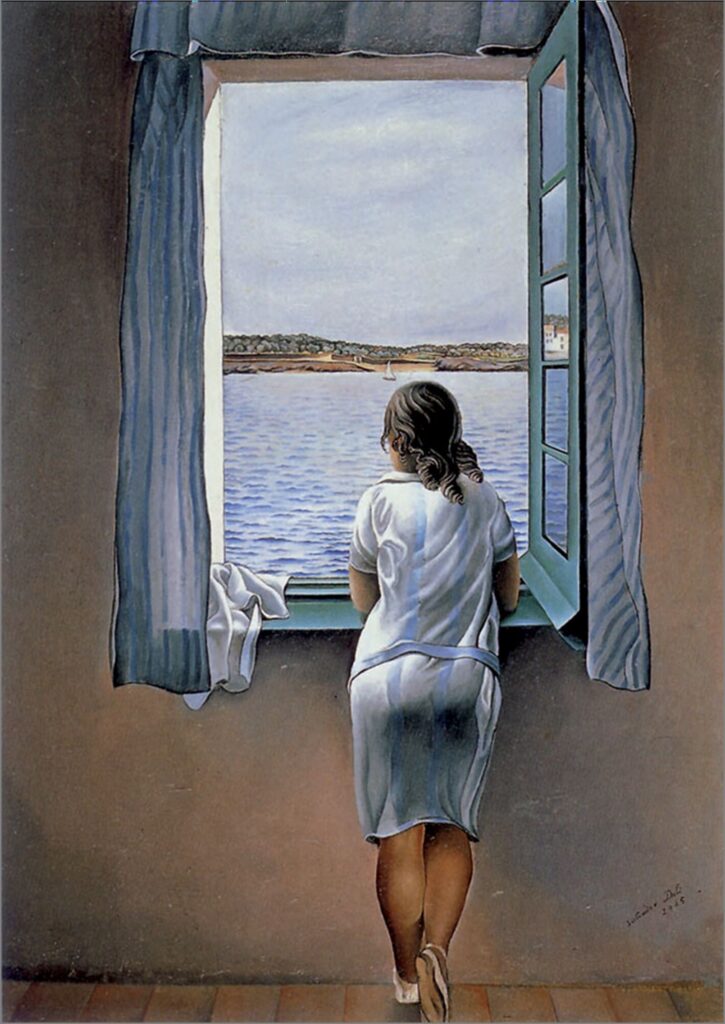
Figure at a Window, 1925, Salvador Dalí (1904-1989), Reina Sofía Museum, Madrid, Spain
.
Why was she there after all that time? She didn’t even know herself. Years had passed. In fact, there was a reason—or perhaps an excuse: she had run out of her perfume. She hadn’t been able to find it anymore after the shop where she used to buy it had permanently closed its doors. Searching all the perfume shops in the area had been useless… the item was now out of production. She had even thought of ordering it online, but she had never bought anything online and was afraid that someone might scam her.
That was the reason why, after calling to make sure she would find that fragrance, she had decided to go to the historic little shop in the neighborhood where she had previously lived and where, back then, she had always found her favorite perfume available.
The management had changed; she had gathered that much from the phone call. All the better.
Walking on the sidewalk opposite the building where she used to live, she had reached the open space and sat under the large oak trees of the little park to observe that place which, by now, was no longer even so familiar to her.
The green bench was still there. The paint, once bright, had cracked and peeled under the weather, revealing the rust corroding the metal underneath.
The shutters on the first floor were drawn slightly open… someone was living there. Was her husband still there? By now, the man had to have been retired for a few years.
So many new people had moved into the neighborhood.
She realized she had changed—and quite a lot—from the fact that none of the old residents had recognized her… not even her husband. Going in to buy something to eat, she had found him standing right in front of her while queuing at the checkout of the supermarket almost opposite the building; sooner or later it was bound to happen. He too had changed! Damn, had he changed! She had identified him by his habit, a bit 1960s style, of wearing his small shoulder bag, slung across his body.
The man, preoccupied with the bill for the purchased goods, had barely noticed and thanked the fine lady who had picked up the ten-euro note for him that, due to that annoying hand tremor that had been afflicting him for some time, had fallen to the ground.
Once outside, she had seen him cross the street with short steps… an old man’s gait… and after setting his shopping bag down on it, sit heavily on the green bench.
For a moment she had felt sorry for him.
Then, like a flash, she had seen the old woman again, seated like a queen on her green throne with the semi-rigid beige checked waxed cotton bag next to her on her left and the shopping trolley in front, to her right.
She hadn’t made it in time to give her back the money…
Suddenly that “my child” came back to her mind, which, in those days past, she had thought of as a catchphrase in the old woman’s way of speaking… Like a mosaic, she tried to fit piece after piece together, attempting to give an answer to the many questions that, over time, had come to crowd her mind: the money jealousy guarded and then given with such generosity… “…I’m glad that you have it,” but above all that “my child” that she seemed to hear continuously and that she herself repeated to herself.
Instinctively, she too had crossed the street.
As she slowly passed in front of him, she felt, almost physically, the man’s gaze observing her intently. He, perhaps recognizing in her the lady who had picked up his money at the checkout, had offered her a smile and a small nod of greeting, inhaling deeply as if wanting to capture that pleasant scent of a woman. She had barely returned the gesture.
Then the woman had crossed paths with a very distinguished gentleman: “Good morning, Doctor! What brings you to these parts?”. The lady had stopped for a moment and answered something, then the two had walked off in opposite directions.
The man on the bench had stroked his chin, muttering something.
She had caught only the first word: “Doctor…”.
Without looking back, she had walked straight on, serene… her confident stride was that of a queen.
She would be working the night shift.
.
.
.
.

.
.
.
.

