.
INVITATION TO READ by Ida Renzicchi
.

.
INVITATION TO READ by Ida Renzicchi
.
.

.
.
.
LUCREZIA BORGIA
by Ida RENZICCHI
(Written and translated from Italian by the author)

.
.
All rights are reserved to the author. Reproduction and any other use, even partial, not authorized by the author is prohibited. Publication of the text is permitted for non-profit educational and cultural purposes upon concession and authorization of the author. For any contact with the author: idarenzicchi@katamail.com idarenzicchi@gmail.com
.
.
.
BASSANELLO AND LUCRETIA. Introduction by Ida Renzicchi
.
.
.
.
Those who come to Vasanello (formerly Bassanello), from whatever street they come, cannot fail to notice the splendid castle, whose imposing mass dominates the town’s main square in every sense, since this is its most representative monument.
Since I was a child, this manor, steeped in history, has fascinated me, evoking not so much images of the beautiful and carefree life certainly lived in those rooms by nobles and courtiers, but rather dark visions of mysterious events that must have occurred within those dark walls. Contributing significantly to all this was the local gossip regarding the presence of a mysterious trapdoor into which, it was said, Lucrezia Borgia would throw her lovers after nights of love. More likely, such a trap may have been used against enemies in times of war or, simply, as a freight elevator for transporting goods from the lower floors to the one where the nobles lived and ate their meals.
Thus, a childhood curiosity led me to the idea of writing a short study of this controversial protagonist of the story, shrouded in a defamatory legend of murders, lovers, and horrific incest.
Of course, I’m not the first person interested in Lucrezia Borgia’s life; qualified writers have written about this 16th-century noblewoman who has not gone unnoticed by history and literature.
My short essay aims to tell her life as simply and truthfully as possible, avoiding all those fictionalized forms that do not fully reflect the character’s documented truth and that have distorted her image over the centuries.
The historical context surrounding Lucrezia’s life, which decisively influenced her, is of fundamental importance and therefore absolutely not to be overlooked. My short text, with the precise aim of being easy and accessible to read, therefore also outlines the historical/political situation of the period, but concisely and only to the extent necessary for understanding it.
The protagonist’s presence in our country is not clearly documented, however, it can be deduced from the close friendship that bound Lucrezia Borgia to Giulia Farnese, known as “La Bella,” lover of the Borgia Pope and wife of Orsino Orsini, owner of the castle of Bassanello. A letter exists in which Alexander VI recalls his beautiful lover, who had gone to Bassanello to see her husband, and urges her, under penalty of excommunication, not to return to his castle. Although there is no certain information, we can imagine that Lucrezia may have occasionally accompanied her best friend to her husband’s country, and it is easy to assume that, given Alexander VI’s great jealousy, Lucrezia may have been sent to Bassanello by her father to make his presence felt at all times to the beautiful Giulia, thus controlling her friendships and acquaintances, even if from a distance.
Lucrezia is a complex figure… beautiful, refined, elegant, and highly cultured, a trait reserved for noblewomen of the 16th-century Italian aristocracy—the only women to receive an education in all of Europe—but above all, she is a sensitive and loving woman who, rather than a tormentor, is a victim of the ambitions and power games of her family and history.
She is first and foremost the daughter of a pope, Alexander VI Borgia, and sister of Cesare Borgia, known as “Valentino,” Machiavelli’s famous “Prince.” These characters cast a dark shadow over the Italian political and religious landscape of the time, remaining in history as sad figures of terrible and corrupt power, and who would be instrumental in the life of this young woman, completely influencing her choices.
Lucrezia’s life is a succession of twists and turns, radical changes… from an exemplary childhood to a tumultuous youth, to a wise maturity… from unimaginable luxury and pomp to a mysticism and an almost monastic simplicity that will lead her to choose to be buried in the habit of a Franciscan tertiary… from “gonfalonier of the courtesans” in Rome to “mother of the people” in Ferrara.
.
.
.
.
.
.
.
.
.
PART ONE
.
.
.
…I am the prostitute and the saint
I am the bride and the virgin…
The Thunder, perfect mind – HYMN TO ISIS
(Nag i Hammadi Codices, NHC VI,2:13,1-21,32; Egypt; 2nd, 3rd century AD)
.
.
.
.
.
.
Lucrezia Borgia was born in Rome in April 1480, although some historians claim she was born in Subiaco. News of her birth in this town actually comes from the “Storia Sublacense”, written by Don Alessandro Tummolini, a reliable scholar, who, in the same, also reports the birth of Cesare, Lucrezia’s brother, which also took place in Subiaco, almost apologizing to his fellow citizens for having divulged such news that would have brought dishonor to the city.
Before dealing directly with this controversial female figure, however, it is essential to take a quick look at the historical context of her birth.
Lucrezia was the daughter of a Cardinal, who later became Pope, but this did not surprise anyone. In fact, fifteenth-century Italy had a very liberal conception of the morality of men of the Church and their role. They openly kept concubines in the luxury of their residences, raised their children there and provided for their future. Religious offices were sold and honorability was bought. The great Machiavelli observed: “Italy is more corrupt than other countries, we Italians are profoundly irreligious and evil because the Church gives the most disastrous example in the very persons of its ministers”.
On the threshold of the sixteenth century, Italian society was an incredible mixture of barbarism, impiety and licentiousness, accompanied by an extraordinary development of the arts. In this Italy in turmoil, Beato Angelico and Raphael, the Medici and Petrarch, Ariosto and Boccaccio grew. It was a bloody and carnal era and the Renaissance phenomenon did not remain indifferent and extraneous to the life of the century: Michelangelo himself painted his “Last Judgement”, but at the same time the libertine sonnets of Aretino.
It was in this scenario that the Borgias made their appearance. But who were the Borgias?
.
.
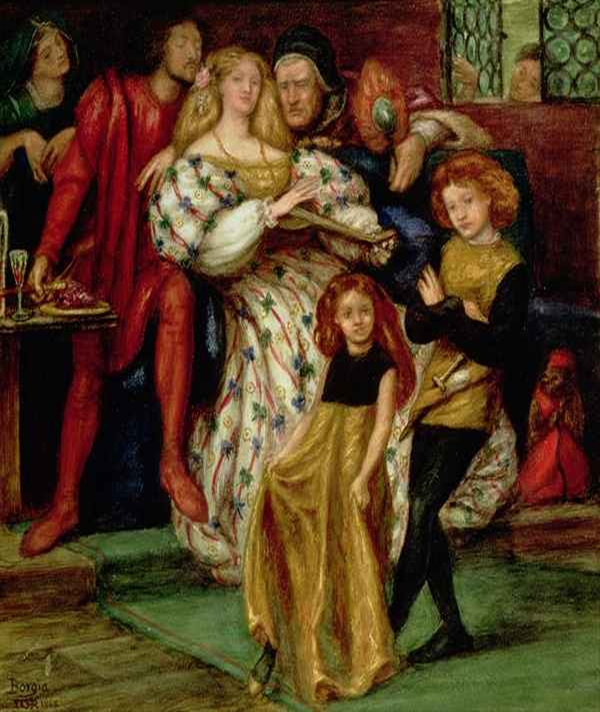
The Borgia Family; Dante Gabriele Rossetti, 1863.
.
.
The Borja (this was their ancient name) were Spanish by origin and precisely from Yativa (or Xativa) in the province of Valencia, where in the twelfth century their ancestors had particularly distinguished themselves in the fight against the Moors. They settled in Rome towards the middle of the fifteenth century.
The first Borja, whose reputation went beyond the borders of Spain was Alonso, a man more devoted to studies than to chivalry, who, later, with a master stroke, even managed to become Pope.
Advisor to the King of Aragon and Bishop of Valencia, when the King settled in Naples, Alonso followed him and his name was Italianized to Alfonso Borgia.
From here began the unstoppable climb of this new dynasty that remained sadly famous in history and that also involved our territory of Tuscia in its events.
In 1433 the then Pope Eugene IV invested the lord Gentile Migliorati with the castle of Bassanello with the transfer of the fiefdom, upon his death, to his wife Elena Orsini and her children.
In 1444, the same Eugene IV appointed Alfonso Borgia as Cardinal, praising his talent and diplomatic ability when, as advisor to the King of Aragon, he managed to reconcile the latter with the Holy See.
Soon, Cardinal Borgia was known throughout Rome: his emaciated face, his large and deep dark eyes… his prestigious savoir faire were the talk of the entire city.
In that period, among the powers that divided Italy (Alfonso I in Naples, the Medici in Florence, the Sforza in Milan and the Serenissima Republic in Venice), the peace of a truce, begun under Pope Eugene IV and continued with his successor Nicholas V, reigned.
When the latter died, in order not to disturb the fragile balance between the Orsini and the Colonna, two great Roman families, rivals for centuries, who at the time competed for the Papacy, it became necessary to nominate a foreigner to the Papal Throne.
On 8 April 1455, as a compromise candidate, Alfonso Borgia was elected, at a very advanced age, 77 years old, who took the name of Callixtus III.
The new Pontiff, although austere and reserved, did not shy away from the use of nepotism, quietly practiced and accepted at the time.
He found himself in a foreign city that, although always tolerant and cosmopolitan, showed a genuine contempt for the Spanish.
The contrast between the new Italian Renaissance culture that exalted the taste for beauty and refinement in the arts, but even in dressing and even in walking and eating and these rough Spaniards was evident, to the point that in Rome there was heavy irony about a presumed lack of familiarity of those people with soap saying that “If the wind blew hard, the stench of an advancing company of Spaniards could be smelled a mile away.”
From the moment the bells of the churches of Valencia announced that a son of Aragon had become Pope, all the Borgias, sisters, cousins, nephews and relatives of every order and degree, threw themselves on Rome, greedy for the benefits and riches that they could derive from such an illustrious kinship.
It is not certain that Pope Callixtus III had a son: perhaps Francis, canon of St. Peter in Rome and later Bishop of Cosenza, portrayed by Pinturicchio. But, if it were true, the Pope did not care much about him, while instead he supported and protected without limits his two favorite nephews: Pier Luigi (Pedro) and Rodrigo, sons of his sister Isabella, who went down in history as the only woman who had a Pope as a brother and another Pope as a son.
Pier Luigi was very rich and powerful: Captain of the Church, Governor of Sant’Angelo (title taken from the Orsini who would not forget this wrong), Duke of Spoleto, Governor of Terni, Narni, Todi, Rieti Orvieto, Administrator of the assets of the Holy See, Prefect of Rome and Gonfaloniere of the Church.

The Virgin Commending Siena to Callixtus III; Sano di Pietro, 1455. National Art Gallery of Siena, Italy.
Rodrigo, who studied canon law in Bologna, took only sixteen months, instead of the five years expected, to become a doctor in this subject.
His uncle Pontiff, Callixtus III, appointed him Prince of the Church (Cardinal) even before being ordained a priest.
At only twenty-six years old, Cardinal Rodrigo Borgia became the holder of the position of Vice-Chancellor, or “right eye of the Pontiff”, as this very important appointment of enormous prestige and power was called, which allowed him to build his fortune, but which at the same time created numerous enmities for him since this invasion of Spaniards, with boundless ambition and masters at exploiting others, aroused no small amount of discontent in wealthy Roman society.
In truth, the uncle Pontiff did not exercise any authority or control over his nephews. Taken up by the duties of his office and the thought of organizing a Crusade, Callixtus III, after having granted them significant power, took no further interest in their work. The Pontiff, in rather poor health, directed the affairs of the Church more from his bedroom than from the sumptuous audience hall and dismissed the frequent complaints about Pedro’s conduct as simple expressions of hostility towards the Spaniards.
Pier Luigi, arrogant and convinced that he exercised an indisputable authority over the Romans, was considered a usurper with the sole merit of being the Pope’s nephew and aroused deep hatred around him.
On the contrary, Rodrigo, of a brilliant and affable nature, knew how to make himself well-liked. Here is how the ambassador of Ferrara, following a visit in 1493, described him in a letter sent to Duke Ercole: “…He is a person of great and excellent intelligence and exquisite nature; his manners are those of the son of a great prince; in particular, his mood is serene and cheerful and full of celebration….His behavior is much more impressive and preferable than that of his brother, the Duke of Gandia…”.
When Callixtus III, become old, began to show signs of weakness, the first symptoms of hostility towards the Borgias also appeared and, in Rome, the old ladies of the family, aware of the new situation, did everything to go unnoticed by hiding under their black veils…
Pier Luigi was forced to flee and died in exile in a fortress that he was preparing to defend.
Rodrigo, a great strategist and by far the most skilled of the family, was not overly concerned that his sumptuous palace was sacked by the mob… he owned many others… but, with enormous wisdom and prudence, he instead got ready for the imminent succession to his uncle the Pope. Given the obvious hostility of the Orsini who, having never forgiven Pier Luigi for having taken the Governorship of Sant’Angelo from them, were at the moment the most aggressive against the Catalans, he supported on the Colonna family.
On August 6, 1458, Callixtus III died. At his bedside there was only his beloved nephew Rodrigo.
History is very harsh with the first of the Borgia Popes: the day after his death, the “Liber Pontificalis” wrote: “Incapable of the Pontificate, he was only concerned with accumulating money and raising his nephews…”.
Rodrigo, however, recognized his uncle’s merit in having founded the Borgia dynasty of Italy and with gratitude and courage took care of the funeral of this Pontiff, whose existence his peers wanted to forget.
For the young Cardinal these were adverse times: his uncle, Callixtus III, the first Borgia Pope was dead, as had Pier Luigi Borgia, his brother, and there was a palpable hostility of the Romans towards these parvenus Spaniards who, until then considered beggars and people of low culture, had made a clean sweep of honors and riches by establishing themselves in the positions of greatest power.
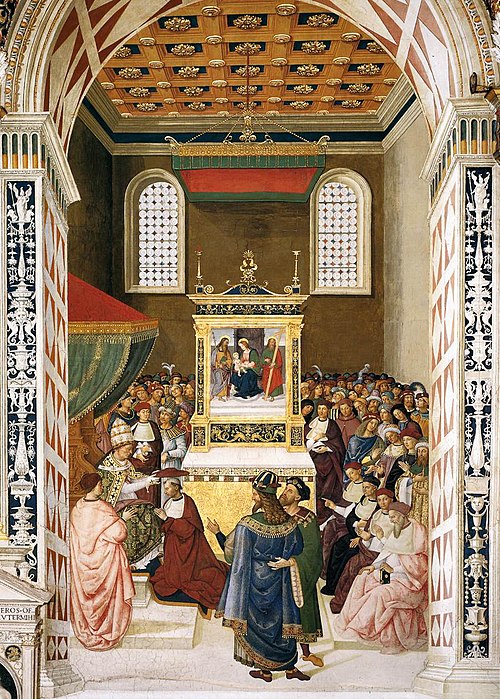
Callixtus III Appoints Enea Silvio Piccolomini as Cardinal; Pinturicchio. Siena Cathedral, Italy.
Rodrigo faced with courage and overcame with insolence the difficulties of this unfavorable period. He even gave the impression of wanting to help in the choice of the best man to be elected pope.
Two opposing factions were fighting over the title: one part of the Cardinals supported the very rich French Cardinal d’Estouteville while another maintained that the pope should be an Italian and that the choice should be between the Cardinal of Siena, Piccolomini, or the Cardinal of Bologna. And so the diplomatic genius of the Borgias managed, with a master stroke, to turn things in his favor again.
After four days of intrigue, the conclave decided to elect the pope by acclamation rather than by secret ballot.
By virtue of the title of Vice-Chancellor that Callixtus III had conferred on him, the first to speak was Rodrigo Borgia and with his phrase “I take the side of the Cardinal of Siena”, he persuaded all Italians to vote for Enea Silvio Piccolomini who was immediately elected pope with the name of Pius II and who did not forget the decisive support of Borgia to whom, as a tacit reward, he allowed to keep intact all his positions and privileges for four pontificates.
An intense collaboration was immediately established between the new Pontiff and the young Cardinal. Pius II considered Rodrigo an “exceptionally skilled” man and always wanted him at his side.
For his part, Rodrigo repaid him with absolute loyalty and obedience and followed the monastic and puritan rules of this new Head of the Church, a man of culture, frugal in eating and indifferent to worldliness but, on the other hand, very sensitive to the pomp of religious ceremonies of which Rodrigo was a true master. A Corpus Christi procession organized by the faithful Cardinal remained famous in history.
Rodrigo could therefore rest easy: he was still, and perhaps even more, rich, powerful and corrupt.
Only once, Pius II was forced to give a heavy reprimand to the young and exuberant Spanish Cardinal because of a small orgy in which he was said to have participated during his trip to Siena. As a further demonstration of the amorality and duplicity that permeated the ecclesiastical world of that time, the papal reprimand was not so much for the carnal sin, but for the gossip that had arisen from it.
In 1474, the notary Camillo Beneimbene celebrated the marriage between Messer Domenico d’Arignano and Vannozza Cattanei at Palazzo Borgia, a marriage that intended to give legal cover to the love affair, known throughout Rome, between the young Cardinal and this bourgeois, of Lombard origin, daughter of merchants who gave birth to Juan (Giovanni) in 1474 and Cesare in 1476.
When Lucrezia was born in 1480, the annual income of Rodrigo Borgia, of his archbishoprics of Valencia, Porto and Carthage and of the Spanish and Italian abbeys he owned, was estimated at eighteen thousand gold florins, an exorbitant sum worthy of a small monarch.
Two years later Lucrezia, Goffredo was born. For the record, we must say that before meeting Vannozza (short for Giovanna), Rodrigo had already had three other children: two girls and a boy, whom we will not discuss.
His lover, Vannozza, enjoyed a certain honorability, she lived in a palace near his in Piazza di Pizzo di Merlo and, having become a widow, it was even procured a new husband for her, Giorgio della Croce, from Milan, who even received a salary to allow the Borgia children to be considered, in all respects, “legitimate” children.
Vannozza was a discreet and submissive companion, certainly intelligent and very beautiful but, above all, capable of keeping at her side, for about fifteen years, the most fascinating of the cardinals in a relationship known throughout Rome that ended up taking on the appearance of a morganatic marriage.
She was a prudent woman who had the intelligence to be content with the fortune of her children, living outside of public affairs so much so that her name was never linked, not even by the most bitter enemies, to the misdeeds of the family.
Vannozza was also very shrewd and knew how to manage well the riches she had received as a gift from the Borgia who was very generous. She stood out from the other courtesans who almost always, after a life of unbridled luxury, ended their lives in solitude and misery.
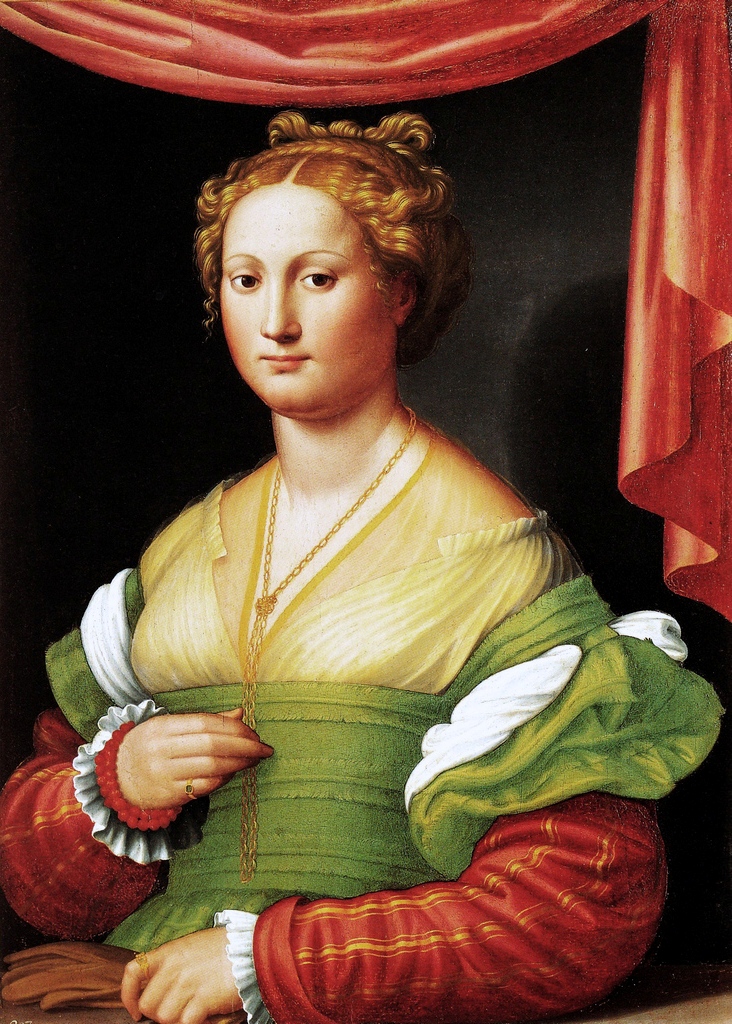
Portrait of a Woman (presumed portrait of Vannozza Cattanei); Innocent of Imola. Borghese Gallery, Rome, Italy.
Lucrezia, born in her mother’s Roman palace, the only female child, was much loved by Rodrigo Borgia from birth. The little girl had eyes of an indefinable gray-blue color and the same receding chin as her father. Her hair was blond and her figure slim, in contrast with Rodrigo’s dark hair and robust build. The girl had Spanish blood in her veins, a passionate character and a great self-confidence that would prove invaluable to her on more than one occasion.
She spent her happy childhood in the house in Piazza di Pizzo di Merlo where she lived with her brothers and her mother Vannozza who remarried when Lucrezia was a few months old.
Seven years later, again without a husband, but still under the powerful protection of the Borgia, her mother married a certain Carlo Canale of Mantova.
After the birth of her fourth child, Rodrigo began to reduce his visits to his concubine and when she moved to a new house with her third husband, he decided to entrust his children to a niece who enjoyed his trust and whom he judged to be more cultured and refined than Vannozza.
This was Adriana de Mila, wife and widow of Lodovico Orsini, heir to the Castle of Bassanello, a refined woman of the world who would have a decisive influence on the education of little Lucrezia.
Adriana de Mila, born in Rome, was of Spanish origin. Her father had in fact come to Italy with the first wave of Catalans after the election of Pope Callixtus III.
The woman hired French, Latin, Spanish and music teachers and entrusted the religious education of the child to the nuns of San Sisto.
At ten years old, Lucrezia in her first brocade dresses was the joy of her father and Cesare, the second son, his pride.
In 1489, Adriana de Mila, a very ambitious woman, arranged the marriage of her son Orsino Orsini, then sixteen years old, with Giulia Farnese, a fifteen-year-old girl that the Romans called “Giulia La Bella“, daughter of Pier Luigi of the Dukes of Parma and Piacenza and Giovannella Caetani, as well as sister of Alessandro Farnese who would ascend to the papal throne with the name of Paul III.
The young bride, in addition to her beauty, brought with her a significant dowry and, for the castle of Bassanello, this was the period of maximum splendor.
Giulia Farnese certainly did not go unnoticed, her beauty that already inspired the most famous painters did not escape the attention of Cardinal Borgia who fell in love with her and, at fifty-eight years old, strong in his power and his riches, found a second youth and took the splendid girl away from her husband.
All of Rome was aware of the love affair between “the Beautiful” Giulia and the Cardinal – the girl was also called “Bride of Christ” – when Rodrigo ascended to the papal throne.
It is true that Orso Orsini was completely insignificant, unpleasant in appearance, suffering from a disfiguring furunculosis and blind in one eye, and that Adriana de Mila, foreseeing all the advantages that could have derived from complicity with the Borgia, agreed to her son remaining in the castle of Bassanello while her daughter-in-law, lover of the Borgia, remained in Rome and became the lady of honor of the twelve-year-old Lucrezia who, daughter of the vice-Chancellor of the Church and with Pope Callixtus III among her ascendants, was at the top of the Roman social hierarchy.
Rodrigo, about forty years older than Giulia, was extremely jealous of his beautiful and young lover.
He did not care about making a fool of himself in front of all of Rome, he did not worry about the river of gossip that flooded the Borgia family, he wrote her fiery letters and even reproacheed her when the young bride went to Bassanello to her husband Orsino Orsini:
“…We have heard that you have again refused to return to us without Orsino’s consent. We know the wickedness of your soul and of the man who guides you, but we had not thought for a single moment that you would be capable of breaking your solemn oath not to approach Orsino.
But you have done so by risking your very life to go to Bassanello and give in once again to the desires of that stallion. Therefore we hereby order you, under pain of excommunication and eternal damnation, to never go to Bassanello again”.
Orsino Orsini died tragically in Bassanello, on July 31, 1500, surprised in his sleep by the collapse of the attic.
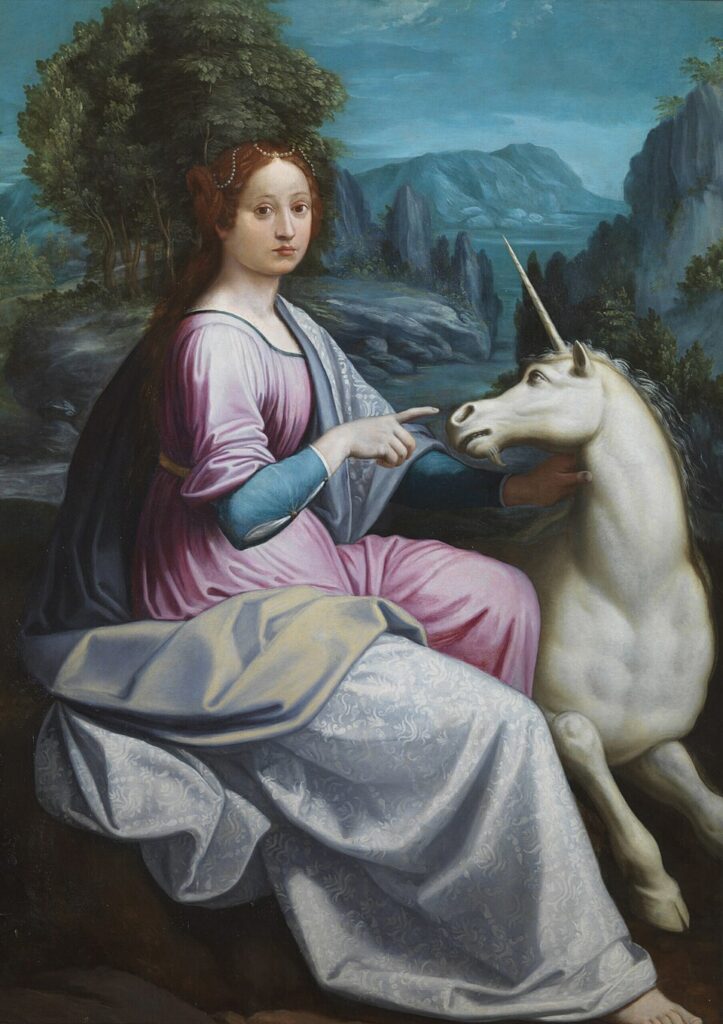
The Lady and the Unicorn (presumed portrait of Giulia Farnese); Luca Longhi.
.
It was 1492. On July 25, Innocent VIII died and, at the age of 62, Rodrigo Borgia, who had brought many popes to the throne, finally took possession of the Keys of St. Peter.
This conclave also saw two powerful families compete for the papacy: on one side Ascanio Sforza, on the other Giuliano della Rovere strong in the support of Charles VIII of France, King Ferrante of Naples and the Republic of Genoa.
But Rodrigo Borgia, who had patiently waited his moment, defeated them both by shamelessly buying the votes of the cardinals both with large sums of money and with donations of castles, churches and abbeys, as reported by Stefano Infessura, reader at the University of Rome, in his chronicle of the time.
To support this theory about the purchase of votes in the conclave by Borgia, we have the writings of the Florentine historian Francesco Guicciardini, although, in all fairness, it must be said that Guicciardini had a clear animosity towards the Spanish and that the then master of ceremonies Johannes Burchard, an arid but extremely scrupulous official, impeccably ensured that the iron rule of secrecy, violated only many years before by Piccolomini, was respected to the letter.
However, there is further testimony, confirming Guicciardini’s theory, and it is that of the Milanese historian Corio, a moderate scholar, who claimed that the Milanese Cardinal Ascanio Sforza had withdrawn from the competition after a generous donation of gold coins.
Alexander VI, this was his new name, exclaimed that morning in 1492: “Here I am, become Pope, sovereign Pontiff, Vicar of Christ”.
The “possessio”, or the procession, from St. Peter’s to the Lateran, and the coronation of Alexander VI, were the most brilliant ceremonies that Rome had ever seen.
On August 26, the splendor of the show was indisputable. Michele Fermo, a writer of the time, accurately described the pomp of the ceremony. The streets along which the procession passed were profusely decorated with vestments, altars, statues, signs with pagan writings: “Rome was great under Caesar, now it is greater! Now Alexander VI reigns! Caesar was a man, this one is a God!”.
The bull of the Borgia coat of arms was represented everywhere, in front of the palace of San Marco a papier-mâché bull was erected that continuously poured water from its mouth and wine from its forehead.
When the Pope, riding a white horse, after long hours of procession reached the Lateran, he had a slight faint from which he quickly recovered. This was the first of a series of syncopations that cheered the spirits of his enemies.
If his uncle Callistus III had already surrounded himself with friends and relatives, Alexander VI was even more so, to the point that his name would become synonymous with nepotism.
Here then was a real invasion of Catalans once again frowned upon by the Romans and Italians, but the new Pope did not care at all about the criticism and hostility… he, skillfully respecting the forms, bestowed positions and favors and surrounded himself with people who owed him everything.
However, the ascension to the papal throne, the celebrations that followed as well as the various rewards, had drained the papal coffers and therefore made it necessary and urgent to find new income given that the proceeds derived from the almost-monopoly on the production of rock alum from the Tolfa mines and indispensable for dyeing fabrics were no longer able to cover the expenses incurred.
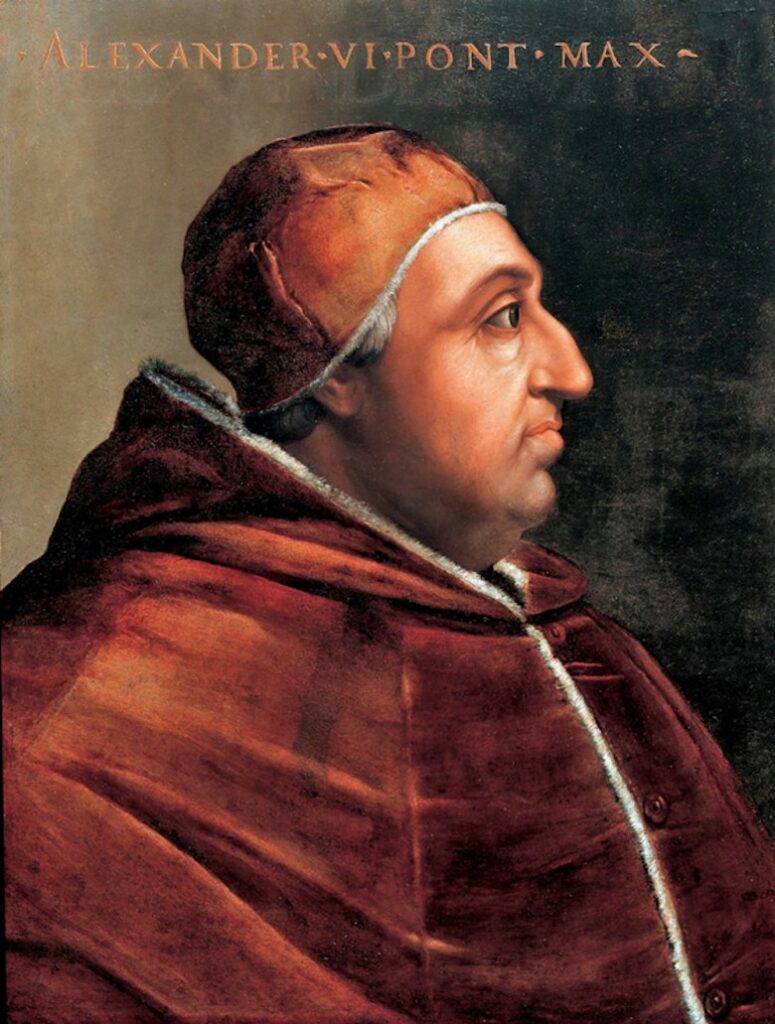
Portrait of Pope Alexander VI; Cristofano dell’Altissimo, oil on canvas cm.59×44. Vasari Corridor, Florence, Italy.
Thus it was that the sale of indulgences and offices had such a notable development that it caused scandal even in that society already so corrupt as to seem capable of accepting any infamy.
For this purpose, a special office was even established, the “Datarìa” whose funds the Pope could access directly, thus avoiding embarrassing bureaucracy.
During this period, Lucrezia and Giulia Farnese her lady-in-waiting and her father’s lover, lived together. Giulia, although already married, was only four years older than Lucrezia and the two young girls were practically like sisters.
Lucrezia was a young girl and her family were beginning to think seriously about her marriage, which was supposed to be an investment and therefore bring riches and honours to the Borgias, forming alliances and strengthening ties.
Prior to his election as Pope, Alexander VI had promised his daughter first to a young Catalan, Don Juan Cherubino de Centelles, then to Don Gasparo da Procida, son of the Count of Alversa.
But shortly after the ascension to the papal throne, the “reason of state” erased the names of the two men and it was decided that Giovanni Sforza, a young widower of 26, nephew of Ludovico, a bastard, but heir of Costanzo di Pesaro, would marry Lucrezia.
In the meantime, her father was busy pushing away the two previous engaged young men.
Gasparo da Procida, who had arrived in Rome accompanied by his father, threatened a massacre, but in the end, for three thousand ducats, he remained quiet.
As for Centelles, who was in Spain and had never seen Lucrezia, he was far away, on the other side of the Mediterranean and could not do any harm.
This is how thirteen-year-old Lucrezia Borgia married Giovanni Sforza, Count of Cotignola and Lord of Pesaro and Gradara, on Wednesday, June 12, 1493
It would take a lot to describe the pomp of the wedding ceremony and the sumptuous celebrations that followed.
Burchard and Infessura spoke of it extensively in their chronicles of the time, while no precise report had come down to us on what happened on the evening of June 12. Some historians of the time maintained that the young Lucrezia did not show sufficient maturity and that the marriage was consummated only after six months of patient waiting on the part of her husband Giovanni Sforza.
.
.
.
PART TWO
.
.
.
.
.
.
.
.
.
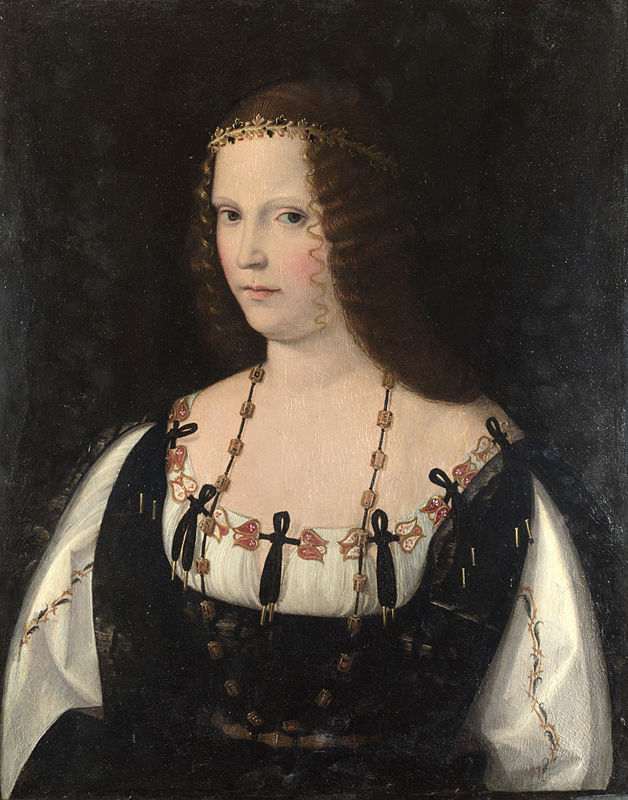
Portrait of a Woman (presumed portrait of Lucrezia Borgia); Bartolomeo Veneto, 1500-1510. National Gallery, London, United Kingdom.
Lucrezia, now a bride, slowly learnt to become a countess.
She imitated the ladies of her environment and, aware of her father’s great affection, began to use her influence on him. A chronicler of the time reported in this regard: “… the majority of those who want to obtain a favour from the Pope must pass through her door”.
All of Rome knew that anyone who wanted to obtain something from Alexander VI had to turn to the three women: Adriana the accomplice, Giulia the undisputed lover and Lucrezia the beloved daughter.
While her husband, in the middle of the summer, went back to Pesaro from where he would return only at the beginning of November to fulfill his marital duties and to collect his bride’s fabulous dowry of o thirty-five thousand ducats, Lucrezia was happy in Rome, in Santa Maria in Portico, where she spent her time on beauty treatments. She washed her hair every day and perhaps lightened it, invented creams and powders and dyed her eyebrows black to further highlight her very pale complexion.
Her wardrobe was worthy of a princess. The chronicles of the time dwelled extensively on the richness of her clothes, a splendor admired and envied by all the Roman nobility and which had no equal in all the courts of Europe.
In the meantime Giulia had given birth to a baby girl, Laura who in 1505 would marry Nicola della Rovere, nephew of Julius II. At the time, many believed, mistakenly, that the little girl was the daughter of the Pope, whom she nevertheless resembled very much.
We find the name of Laura Orsini engraved above the architrave of the door on the second floor of the castle of Bassanello, while the “Statute of Bassanello” signed by Nicola, Laura and Giulio della Rovere is preserved in the Municipality.
But let’s get back to our character.
Lucrezia, busy with taking care of herself, with her social life and with the birth of little Laura Orsini whom she adored, had not missed her husband that much but she was happy when he returned and their agreement was perfect.
In the meantime, however, the power games had changed: the Sforzas in Milan sided with the arrival of Charles VIII and, Alexander VI, under the threat of an invasion by the French intending to attack Naples, distanced himself ipso facto from the Milanese and got closer to the Neapolitans.
All this did not play in favor of Lucrezia’s husband: the Sforzas were his relatives and the Borgias were those of his wife. Here is what Giovanni, surely in great anxiety due to the uncertainty of his situation, wrote to his uncle, Ludovico il Moro: “Last night the Pope asked me: «Giovanni, what do you want to say to me?». «Holy Father, everyone in Rome thinks that you have made an agreement with the King of Naples, enemy of the Duke of Milan. Is it true? I would find myself in a difficult position: in the service of Your Holiness I would be forced to serve the Neapolitan against the Milanese. My anguish would be great! Naples or Milan? I beg Your Holiness not to force me to become an adversary of my own blood and to break the duties to which I am bound towards Your Holiness and towards the Milanese state. » ….”
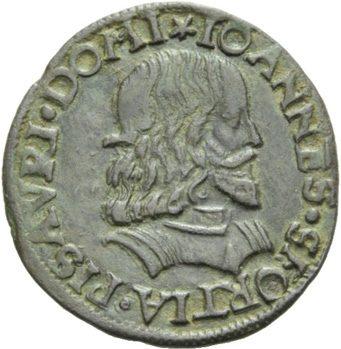
Giovanni Sforza, Count of Cotignola and Lord of Pesaro and Gradara.
Giovanni then decided to leave Rome before the situation worsened and took the pretext of introducing his wife to his subjects in Pesaro.
Alexander VI willingly accepted his daughter’s departure, especially because malaria was raging in Rome and the Pope feared for her health. He even recommended bringing Giulia and Adriana. Vannozza, Lucrezia’s mother, also followed them.
The procession advanced slowly along the peninsula, followed by men-at-arms and servants. At each stop, in each village or town, the lords of the place offered to host the ladies and knights in a manner appropriate to their rank and the people cheered as they passed.
Only a sudden storm dispersed the crowd and forced the procession to hurry towards the castle of Pesaro where they could have found refuge.
In her new home, fourteen-year-old Lucrezia spent happy days, she could have continued her studies but she preferred music and painting and learned to paint on ceramics: after all, Faenza was not far away and the people of Pesaro were masters in the art of majolica.
The domain of Pesaro was small but to Lucrezia it seemed immense and even Giulia in the first days of her stay appreciated this quiet life but full of small satisfactions.
Thus she wrote to the Pope: “Here we continue to celebrate, to dance, to sing, we recite eclogues in Latin and in the vernacular as best as one could in Rome. Signora Lucrezia and I went to dance at the party and it was wonderful to see so many people in such a place. We were all three magnificently dressed and it seemed that we had stripped Florence of its brocades…..”
Giulia, however, after the enthusiasm of the novelty and of all the celebrations given in their honor, began to get bored, to miss the splendor of Rome where her power was great and, thanks to it, she could make her own fortunes and those of others.
Her letter to Alexander VI continued: “Perhaps Your Holiness will believe that we are all joy and happiness. But this is false, because I am far from Your Holiness on whom all my well-being and happiness depend and therefore I cannot enjoy all these joys with pleasure at ease and, even if they were greater, I would enjoy them with regret, because where my treasure is, there is my heart. Be sure that I am counting the days that remain for us to spend here, because in the end if one is not at the feet of Your Holiness, everything is just appearance.”
Giulia therefore wanted to leave Pesaro and when her brother Alessandro Farnese requested her presence in Capodimonte, the cradle of the family, she left accompanied by Adriana de Mila, who was also bored by the quiet of the province.
The journey, unfortunately, ended tragically. Upon her arrival, Giulia found that her younger brother Angiolo had died. No one could in fact save him from a sudden illness and Giulia, arriving too late at the family castle, was so deeply upset that she had a fever.
The Pope wrote to his daughter Lucrezia, harshly reproaching her and her husband for not consulting him about Giulia’s departure: “… In the future try to be more careful and diligent. Madonna Adriana and Madonna Giulia have arrived at Capodimonte where they found Giulia’s brother dead. In truth, Lord Giovanni and yourself have had very little regard for Us … “.
Giovanni Sforza certainly had demonstrated a lack of intuition and diplomacy, something that the Pope would not forget and which would have had unpleasant consequences for both him and the beautiful Farnese.
The summer of 1494, with the arrival of the French led by Charles VIII, saw a series of upheavals.
Milan opened its doors to the invaders and sumptuously received the small, frail, ugly and, it was said, disproportionate king who seemed like a monster in command of a horde “terrifying to see, full of prison remnants, bad guys who had escaped justice and above all people with the brand of the lily of France stamped on their shoulder… A vigorous but ill-disciplined company”. This was how Pierre de Bourdelles, abbé and Seigneur de Brantome, a skilled French storyteller, described the troops of the king of France.
The barbarians, heirs of the Gauls, meanwhile arrived in Florence where Savonarola thundered against the licentiousness and impiety of the clergy and were welcomed by the light of torches brandished by the Tuscans who had chased away Piero de’ Medici who instead wanted to fight the French.
Alexander VI was worried, he sent word to Charles VIII that there was plague and famine in Rome, that he would support him in a future crusade…
But the king of France feared nothing and the Pope, especially following an episode involving the beautiful Giulia, was forced to welcome the invaders without putting up any resistance and even to provide them with a papal bull that would allow them to pass, with his permission, on the lands of the Church.
What happened in fact to the beautiful Giulia Farnese?
Returning from Capodimonte, where she had buried her brother Angiolo, Giulia passed through Viterbo where the small procession fell into the hands of a French patrol under the command of Yves de Tourzel d’Alègre. Realizing that he had captured the Pope’s lover, D’Alègre asked for three thousand ducats for her ransom.
The Pope, shocked, accepted and immediately sent the requested sum. In Rome people gossiped that he would have paid even more to have his lover back, who then returned to Rome accompanied by four hundred French soldiers: “Giulia’s escort”, they said.
The Pope went to welcome the procession at the gates of Rome and had to go through a long series of humiliations by the invaders.
Charles VIII arrived in Naples without difficulty, offered the Neapolitans a new king and brought them the “French disease”, syphilis from which they had more difficulty freeing themselves than from the invader himself.
The arrival of the Frenchs who, with a few but bloody battles, had traveled the peninsula and invaded the Kingdom of Naples, crumbled that Italian mosaic of small states. However, it was precisely the discontent and humiliations caused by this situation that reunited the former King of Naples, the Doge of Venice, Maximilian of Germany the Genoese, and, after much fighting, Ludovico Sforza and the Holy Father.
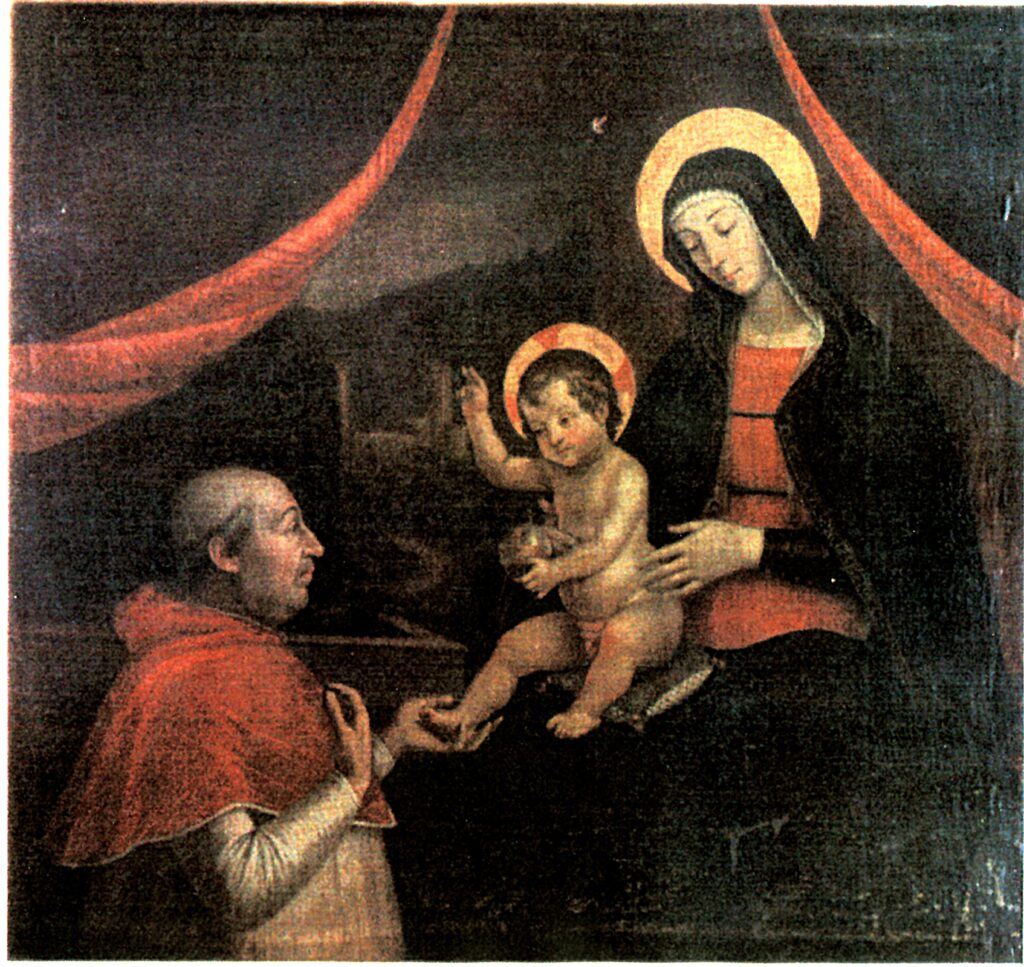
Alexander VI Adoring the Madonna and Child (the Madonna’s face may be that of Giulia Farnese); copy of Pinturicchio’s fresco by Pietro Facchetti.
The Romans, with subtle and heartbreaking irony, coined the term “ludovicheggiare”, which means to cheat, precisely to define these political games, drawing inspiration from the name of the Milanese lord who with great ease switched from one side to the other according to his own advantage. Ludovico Sforza, who had previously called the French to Italy, realizing his mistake, made a radical about-face that began with a horrendous, macabre procession: the corpses of the soldiers of the French army, preserved in salt, were transported on the backs of mules through the streets of Milan. Instead of funeral orations, the Moor mockingly said: “They arrived fresh, they leave in brine”.
Commines, Charles VIII’s observer, worried by this coalition, advised the King to return to France since Savonarola was their only remaining ally.
Charles VIII then decided to leave Italy. Now it was he who was humiliated.
In the North, the King was almost taken prisoner.
He was be forced to abandon his baggage: tapestries, gold seals, religious relics from his mobile altar containing a piece of the Cross of Christ, a piece of the Virgin’s cloak, an album of female portraits…
Finally, with the French having left, the Pope, who had spent the winter in Orvieto, returned to the Vatican and took control of the fate of Rome and his family.
Lucrezia, alone, far from Rome and her relatives, had fallen ill and her father was very worried.
When she finally recovered, accompanied by her husband and eighty knights, she returned to the Eternal City where she resumed her place and where all the pleasures of worldly life were offered to her: balls, masquerades, tournaments…
Rome experienced the most brilliant period in its history.
All the sovereigns of Europe turned pale with envy at the riches, the pomp and the celebrations of the Papal Court of which the young woman was a part.
Her conduct was exemplary: not a single scandal in her life, indeed she faithfully followed her husband in family affairs. But Alexander VI and his sons had decided that Giovanni was no longer a worthy husband for Lucrezia and that it was time to think of a better one. Without consulting her, her brother Cesare made a first move to get Giovanni to agree to the annulment of their marriage.
This man, a mediocre captain and bad diplomat, could not make up his mind. In an atmosphere that was increasingly unfavorable to him, he left for Pesaro and returned still uncertain about what to do. He was nervous, in a bad mood, and Lucrezia, unaware of everything, accused him of “not keeping her good company”, a phrase that would soon be interpreted by the Borgias.
The family decided to kill Giovanni.
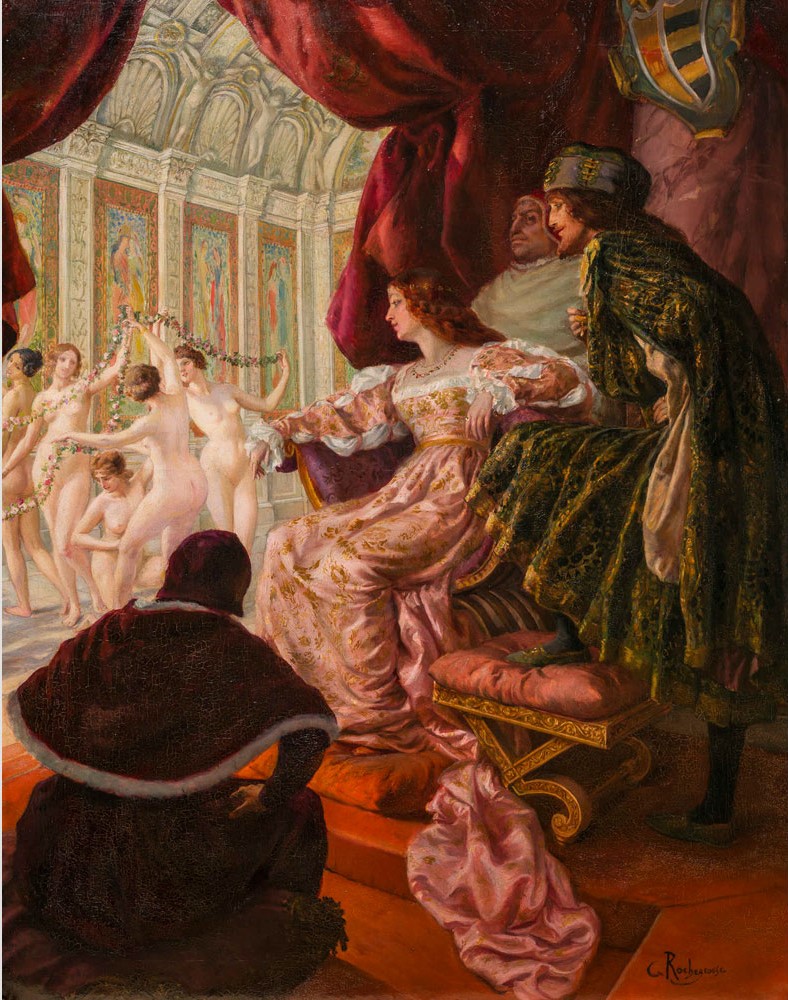
Lucrezia, Cesare, and Alexander VI at the Papal Court; illustration by Georges Antoine Rochegrosse.
A chronicler from Pesaro reported: «One evening, Giacomino, a valet for Mr. Giovanni – then in Rome – was in Donna Lucrezia’s room, Cesare entered. At the young lady’s order, Giacomino was crouching behind an armchair. Cesare, believing himself alone with his sister, spoke freely. The order had been given to kill her husband, Giovanni Sforza. Lucrezia cried and begged. Cesare left, shrugging his shoulders. When he had gone away, the young woman said to Giacomino: “You heard, go and tell him…”. The valet obeyed immediately. Without even saying goodbye to his wife, Giovanni threw himself on a horse and, belly to the ground, in 24 hours he arrived in Pesaro where the noble animal, exhausted, fell dead».
Giovanni Sforza asked in vain for help from Ludovico il Moro, patriarch of the family, and from Cardinal Ascanio Sforza, his long-time protector, but no one did anything for him and, after the arrival of Charles VIII, no one dared to go against the very powerful Borgia.
It must be said, however, that even if Alexander VI ever thought of having his son-in-law, the Count of Pesaro, killed, he actually hesitated to do so.
Instead, he sent an emissary, Friar Mariano di Genazzano, a bitter enemy of Savonarola and Father General of the Augustinians, famous for his eloquence and great ability to persuade.
We did not know the arguments with which the skilled messenger convinced Giovanni, we only know that he obtained from him what he wanted, a declaration that he had not consummated the marriage.
The Borgias were thus be able to begin the annulment procedure and propose a “virgo intacta” to the good matches who would present themselves.
In fact, Giovanni, whose previous wife died in childbirth, told Ludovico that the marriage had been consummated “more than a thousand times”, but Ludovico laughed at his misadventure and even suggested that he publicly demonstrate his virility, which Giovanni refused without hesitation.
Lucrezia herself, when her brother Cesare told her the reason that would be given to obtain the annulment, burst into nervous laughter.
The divorce of Lucrezia and Giovanni da Pesaro was the beginning of the legend of Lucrezia Borgia, the greatest courtesan that Rome had ever had, defined by the Romans themselves as the “gonfalonier of the courtesans of Rome.”
Giovanni, full of hatred and resentment, unable to harm his wife’s powerful family in any other way, had no qualms about spreading slanders so defamatory that they would echo for centuries and centuries: “… Indeed, I have known her countless times, but the Pope has not taken her away from me for anything other than to use her….”.
A phrase that, while not stating anything, implied monstrous things. And it was always from Pesaro, the city of her ex-husband, that all the insinuations regarding Lucrezia’s love affairs with her brothers also originated: “…Here insults are uttered in public against the Supreme Pontiff of such gravity that in Ferrara no one would dare hurl even against Torta (a famous traitor)“ so wrote Beltrando Costabili, ambassador of the Este family at the court of Ludovico il Moro.
Later, perhaps overcome by remorse, Giovanni Sforza retracted the serious calumnies but, by then, they had crossed the borders of his land and sadly become part of the history of the Borgias.
During this period, Lucrezia, tired of the arguments and intolerant of the serious decisions of her family, wanted to show her father that she could foil his plans by withdrawing from public life. She therefore took refuge in the convent of San Sisto where, as a teenager, she had studied religion.
Eight days later, terrible news: her brother Giovanni had been murdered.
The body, with its throat slit and pierced by nine stab wounds, had been found in the Tiber river with its hands tied behind its back and his bag intact.
A night watchman, a certain Schiavone, said that he had seen four men throw a human body into the Tiber, a fifth man was present who the others addressed as “messere” (Sir). He also said that he had not said anything because he had seen more than a hundred corpses thrown into the river without anyone having cared in the slightest.
Alexander VI was mad with grief: his beloved son, the one who had taken the place of the hitherto favored Cesare, had been murdered, thrown “like garbage” into the river. He was also furious because he believed that there were those who mocked his grief to besmirch the name of the Borgias.
The Neapolitan Sannazzaro wrote to him: “To show us that you are a fisherman of men, behold, you have fished your own son with nets”.
Bracci, a chronicler of the time, commented as follows: “The man who carried out the crime is equipped with intelligence and audacity. This is the work of a master hand”.
The Pope knew who the culprit was, but did not say it.
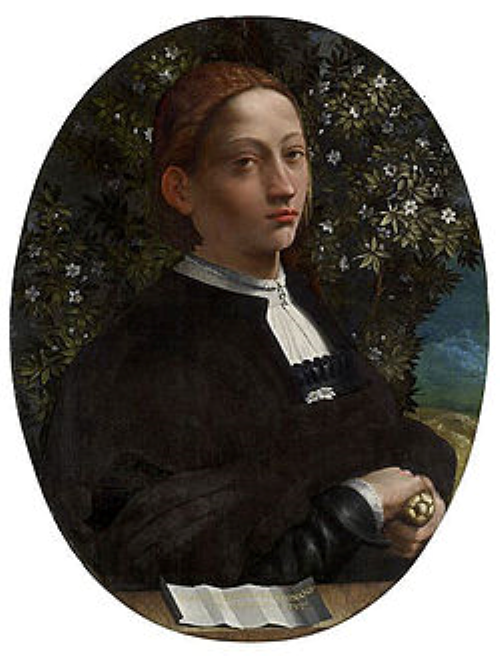
Portrait of Lucrezia Borgia; Dosso and Battista Dossi, around 1518.
Giovanni’s body was recovered from the river by a certain Battistino del Taglia, cleaned of mud, he appeared disfigured by nine wounds, one of which was very deep in the throat, he had not been robbed because he still had with him a bag with thirty ducats. It was clear that he had been stabbed treacherously because he still had a dagger and gloves tucked into his belt.
Was Caesar’s one the murderous hand? He was the one who would have benefited from his brother’s death. Several chroniclers accused him without being silenced.
In Rome it was said that he had his brother killed out of jealousy…
During this period, Lucrezia, still a guest of the Sisters of San Sisto, met and fell in love with a boy her age, a young Spanish messenger, Pedro Caldes or Calderon, with whom she began a love affair despite knowing full well that this union with a servant was destined to end.
Pedro, in fact, was fished out of the Tiber on February 14, 1498.
Alongside the unfortunate waiter, the body of Pentesilea, a young maid of honor of Lucrezia Borgia, was also discovered.
Cesare was accused of being the instigator of the double murder: Pedro Caldes’ relationship with Lucrezia could have hindered his plans to remarry his sister and Pentesilea, the maid of honor, could have revealed Lucrezia’s pregnancy. On March 18, 1498, the chroniclers wrote: “…from Rome it is reported that the Pope’s daughter has given birth…”. No one ever spoke of this child again, taken from his mother at birth, and known as the “Roman infant”. Only three years later, with two papal bulls, one of which claimed paternity from Cesare and a married woman, and a subsequent one that was supposed to remain secret in which Alexander VI, in person, claimed paternity of the child and attributed maternity to a separated woman (soluta mulier), the child obtained the status of legitimate child and was provided with an income: the power over ten castles, thirty-six places, and the title of Duke of Nepi. Giovanni Borgia, this was his name, died twenty-seven years after his mother.
Meanwhile, Savonarola, excommunicated, tried and condemned to the stake, climbed onto the scaffold accusing the church of scandal and corruption.
This climate full of wickedness, however, did not prevent Lucrezia’s suitors from coming forward even if among the nobility there was someone who did not want as a daughter-in-law “the one who notoriously slept with her brothers” and some others avoided the opportunity by rushing to marry their sons before the Borgia could propose them Lucrezia. In the end, the undisputed power of this family and the beauty of their graceful representative caused Alfonso of Aragon, Duke of Biscay, to marry Lucrezia: a political and love marriage at the same time.
Alfonso, seventeen years old, a year younger than Lucrezia, was a true Prince Charming. He was “the most beautiful adolescent ever seen in Rome” said a contemporary of him and another stated: “he has so much charm and intelligence that he does not seem aware of his own beauty”. Alfonso, before meeting her was quite worried… his future bride was said to be as beautiful as she was corrupt and he doubted whether he had been sacrificed to reasons of State.
But meeting Lucrezia and falling in love with her was one and the same: Alfonso found her splendid, fascinating, surrounded by a court of beautiful Roman women and he was immediately won over. His doubts no longer existed because love had dispelled all shadows.
The wedding was celebrated on 21 July 1498 in a festive but relatively intimate atmosphere.
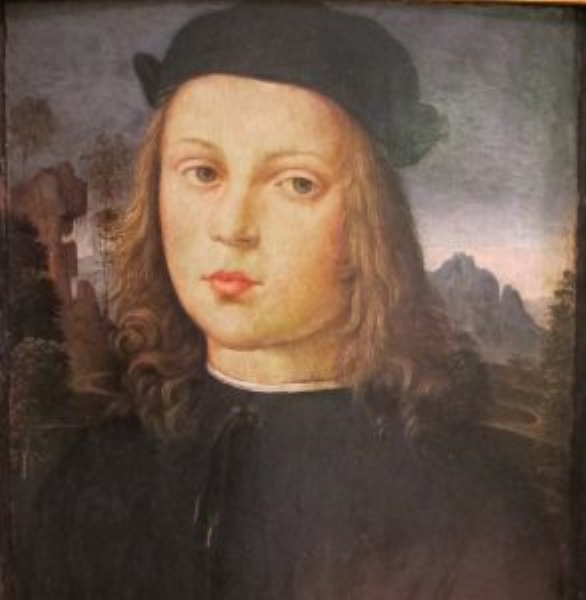
Alfonso of Aragon; Pinturicchio, 1488.
The spouses lived in Rome, Lucrezia was happy next to a husband who adored her and with whom she shared the same tastes for art, music, painting, singing.
In the meantime, the most famous artists, the cream of the culture of the time, people whose names and works would remain in the history of the centuries, had come and had followed one other in the halls of Santa Maria in Portico.
Pinturicchio took Lucrezia as a model, not only for the famous fresco where the face of the beautiful young woman would be that of Saint Catherine, but for many other paintings in the papal apartments. In one of these paintings, in the Church of Santa Lucia, he painted the Pope in an ascetic attitude, surrounded by his children. Bramante, who had recently arrived in Rome to begin the construction of Saint Peter’s and to design the Vatican courtyard, assiduously frequented Lucrezia’s salons. Michelangelo had her as a spectator when she went to contemplate the Pietà on which the artist had been working for two years.
Meanwhile, Cesare Borgia, acquitted of his cardinal vows, on 12 and 13 May 1499, by marrying Charlotte d’Albret of Navarre, in Blois, France, became the cousin of Louis XII, king of France who named him Duke of Valentinois.
From this union a legitimate daughter was born, Luisa, wife of Louis de la Trémouille and, upon his death, of Philip of Bourbon, Viscount of Busset.
Shortly after, Cesare, alongside the French king, invaded Italy, keeping faith with his commitment to the monarch to support him in the reconquest of the kingdom of Naples in exchange for military and economic aid for his conquest of Romagna.
At the beginning of August, the young Alfonso, fearing for his life, left the Vatican and sought protection in Genazzano with the Colonna: the Pope was an ally of the French, the D’Aragona were not, better to move away.
Lucrezia, who at the beginning of the year, two months pregnant, had lost her baby after fainting, remained alone in Rome.
She was again six months pregnant.
Her husband wrote her urgent letters asking her to join him, but the Pope, who wanted to keep her with him, intercepted the messengers and, to flatter her, appointed her Governor of Spoleto and Foligno, a position until then reserved for prelates, almost always cardinals.
Alexander VI, thus wanted to protect his daughter and Goffredo who accompanied her on the journey to her new governorships: six pages watched over them so that they followed the road indicated by the Pope.
After a stop in Terni, on August 14, the splendid procession made up of forty-three wagons, one of which carried a crimson litter for Lucrezia, arrived at the fortress of Spoleto already restored by Cardinal Alvarez Carrillo de Albornoz, another Spaniard.
Here she was, at nineteen years old, Governor of Spoleto. The population acclaimed her. Upon her arrival, banners, flowers, speeches from notables, homages from servants, joy from the jesters and actors sent by the Pope to cheer up his children; but while Goffredo spent his time hunting, Lucrezia was going through a difficult period in her life… in two months she would have a child, her husband whom she loved was far away and she feared never seeing him again.
She then returned to faith in God and prayed: in her room there was a Virgin with all the Saints of Spain. She read the “Mystical Loves” of Saint Francis, her favorite reading.
Meanwhile, the Pope, with paternal love, asked and obtained from the King of Naples that Alfonso could join his wife and guaranteed him immunity.
Alfonso then arrived in Spoleto. Lucrezia was radiant. The Pope with an edict gave them the city of Nepi and, after spending a short time there, they returned to Rome. The birth was near.
On November 1st a male child was born and the baptism was celebrated immediately.
The Pope’s nephew was given the same name: Rodrigo.
.
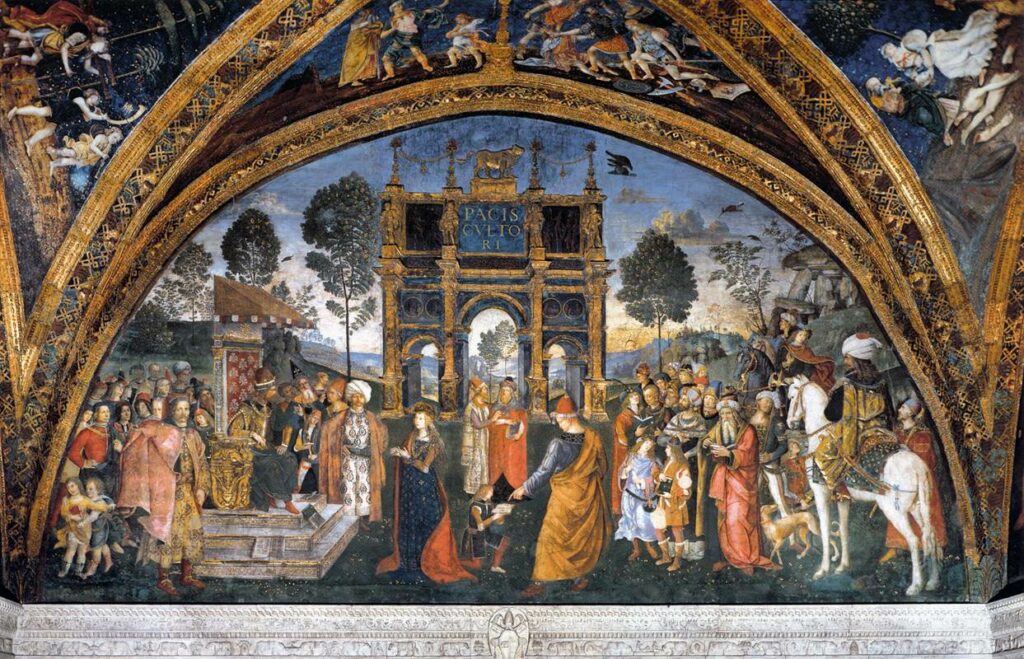
Dispute of Saint Catherine of Alexandria; Pinturicchio, 1492-1494. Vatican Museums, Borgia Apartments.
.
In 1500, a jubilee year, Cesare Borgia returned to Rome. The King of France, amazed and admired by the warrior valor of this former cardinal who had won numerous victories, awarded him the order of Saint Michael, the most respected in all of Christianity, a decoration that Cesare wore around his neck when he returned to the Eternal City on February 26th 1500.
In addition to his manners, Cesare was sober and refined even in dressing. His banner, the Borgia bull and the lily of France, flew on the bridge of Castel Sant’Angelo and marked the power and splendor of the Pope’s son.
In Rome they said: “Either Cesare or nothing”. He was the famous “Prince” of Machiavelli.
Quickly, Cesare, famous, rich, ruthless and feared, became master of the Vatican.
Thus began a period of terror in the sixteenth century. Cesare knew what he wanted and nothing and no one could stop him.
The Pope, who was seventy years old, was subject to depressive crises, burst into tears for trivial reasons and was struck by fainting spells more and more often. The doctors diagnosed a veiled epilepsy, but it could have been a brain alteration of syphilitic origin.
Anxiety, certainly, did not help him and the arrival of Cesare agitated him… the glorious son of the Pope had realized his father’s dreams, but the latter, although he loved him, feared him, awaited him with apprehension, was afraid of him… too many deaths, too many disappearances, too many corpses fished out of the Tiber… In Rome a satire was published with an eloquent title: “Dialogue of the Pope with Death”. Alexander VI was increasingly restless, but if a Borgia had to die it was not him but his son-in-law: Alfonso, Lucrezia’s husband.
Cesare hated competition, he had unscrupulously eliminated his brother Giovanni and did not hesitate to decide to suppress Alfonso, guilty only, according to him, of enjoying the benevolence of the Pope, thanks to the latter’s love for his daughter Lucrezia.
The opportunity arised when a storm caused the collapse of a ceiling of the papal palace in which three people were killed. The Pope, who was sitting on the throne, almost miraculously remained unharmed despite a beam having hit the canopy and shattered his chair. He was only slightly wounded on the forehead and was taken to bed, washed and cared for. His convalescence was prolonged, Lucrezia was always close to him, sleeping in the Vatican to constantly assist him, Alfonso, however, remained in their palace and, one evening, after having visited the Pope and his wife, while he was returning home accompanied by a squire and a waiter he was attacked by a group of fake beggars. He was saved only thanks to his courage, his sword, and the help of the two servants who carried him, wounded, to the papal palace where Lucrezia, as soon as she saw him, believing him dead, fainted.
The Pope was shocked by horror. He suspected Cesare. A witness reported that as soon as he came to his senses Alfonso “said that he had been wounded and by whom”. In fact the entire papal court suspected Cesare Borgia and without evading the question Catanei said that this attack “Valentino (Cesare) did it out of jealousy”.
In Rome it was in fact not uncommon to hear that Cesare was his sister’s lover.
Meanwhile, either because Cesare was a master in the art of persuasion, or because the Pope feared him, the fact was that he managed to convince Alexander VI that Alfonso, like all the Aragoneses, was against the Borgias and that in the papal palace he was therefore hosting an enemy.
After a month of treatment, Alfonso, recovered, got up and took a few steps into his room, the Hall of the Sibyls that Pinturicchio had just finished decorating.
On August 15, 1500, the drama had its epilogue: Alfonso was killed. Cesare’s squire, Michelotto Corella, stabbed Alfonso in his room, under the eyes of his master. Cesare had ordered his sister to leave and she, submissive, had obeyed. In truth, she had run to the Pope to ask him to intervene, but upon her return, the squire Corella calmly announced: “The Duke has suffered a hemorrhage”. Lucrezia did not even see the body of her young husband, innocent, killed at 19 by his brother-in-law.
The funeral was celebrated in a hurry, that same evening and with great discretion, twenty monks accompanied the coffin of the Duke of Biscay to the Church of Santa Maria delle Febbri where the young man was buried in an uninscribed tomb.
Lucrezia was left alone with her grief. Her father did not understand how a twenty-year-old woman could mourn for so long a husband who wasn’t even such a good match. Cesare then, two days after the funeral, burst into the palace of Santa Maria with a hundred halberdiers: the pretext was to visit her, but in reality it was an inelegant way of showing off his power and telling her that she had to submit to the will of the family. In response, Lucrezia threw in his face a phrase from Horace with which she clearly indicated him as the murderer of her young, beloved husband: “From you, nothing surprises me”.
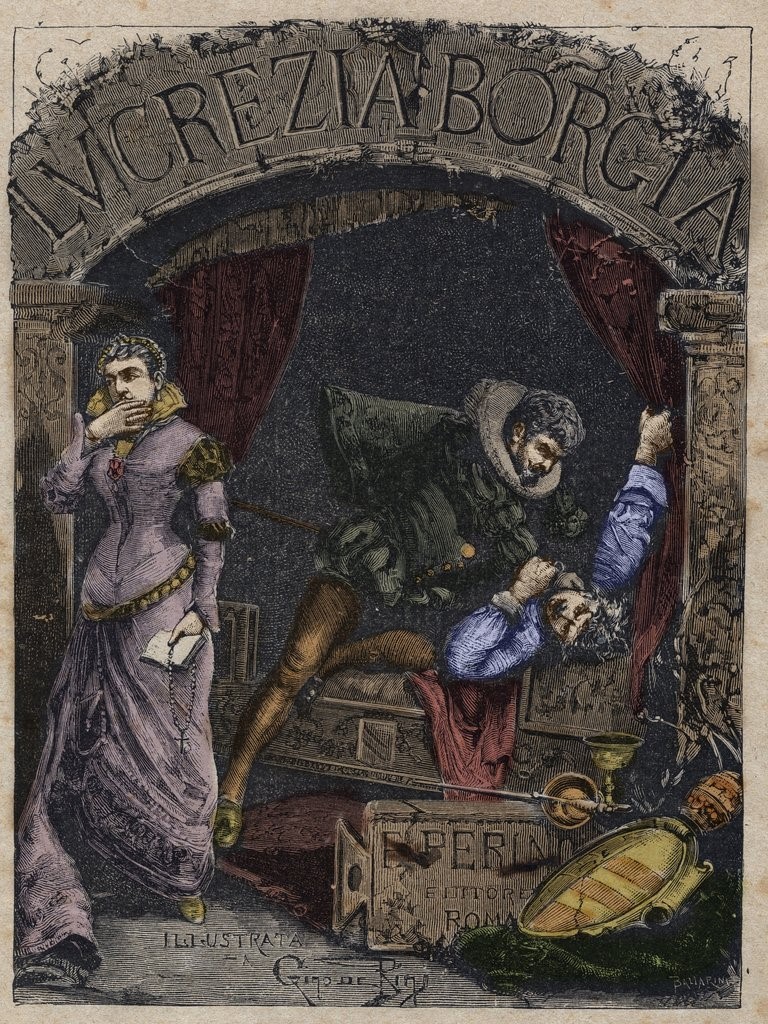
Michelotto Corella Kills Alfonso of Aragon; illustration by Edoardo Perino, Rome, 1880.
.
.
.
PART THREE
.
.
.
.
.
Following what happened and to find some peace of mind, Lucrezia took refuge in Nepi with little Rodrigo.
Time, a good doctor, slowly helped her to heal from the pain and in the autumn of the same year, still in 1500, she returned to Rome.
Cesare, engaged in battle against the House of Aragon, was not there.
Meanwhile, the Pope was thinking of a new marriage for his daughter: after all she was free, there were no legal difficulties, no impediments to a possible wedding.
But Lucrezia, disturbed by the way in which she was made a widow in such a violent and disastrous way, resentful towards the entire court, refused the matches that were proposed to her and, to the question of her exasperated father: “Why these refusals?” she answered dryly “Because my husbands are not lucky”.
The Pope, in fact, liked this new attitude of his daughter, indeed he trusted her and, even if only for matters concerning the Church, it was to her that in 1501, during one of his trips, he entrusted the papal administration, naming her Vicaress as reported by the astonished Burckardt, a chronicler.
This was a way to confer on his beloved daughter the stature of a political figure, capable of rendering important services to the city.
Lucrezia was a cultured and refined woman, she spoke Spanish, Greek, Italian, French and excellent Latin and was able to write in all these languages as reported by Baiardo.
With the advice of Giorgio Costa, Cardinal of Lisbon, who always remained her friend, she succeeded admirably in the prestigious task entrusted to her.
The period of terror, which began in 1500, continued in 1501 with mysterious deaths and disappearances. Renaissance Italy was the home of poison. In Rome, one died easily and for various reasons: political reasons, romantic rivalries, financial reasons… Cesare Borgia’s return to Rome had significantly increased the work of the gravediggers. “Having drunk” meant having been poisoned by the Borgias.
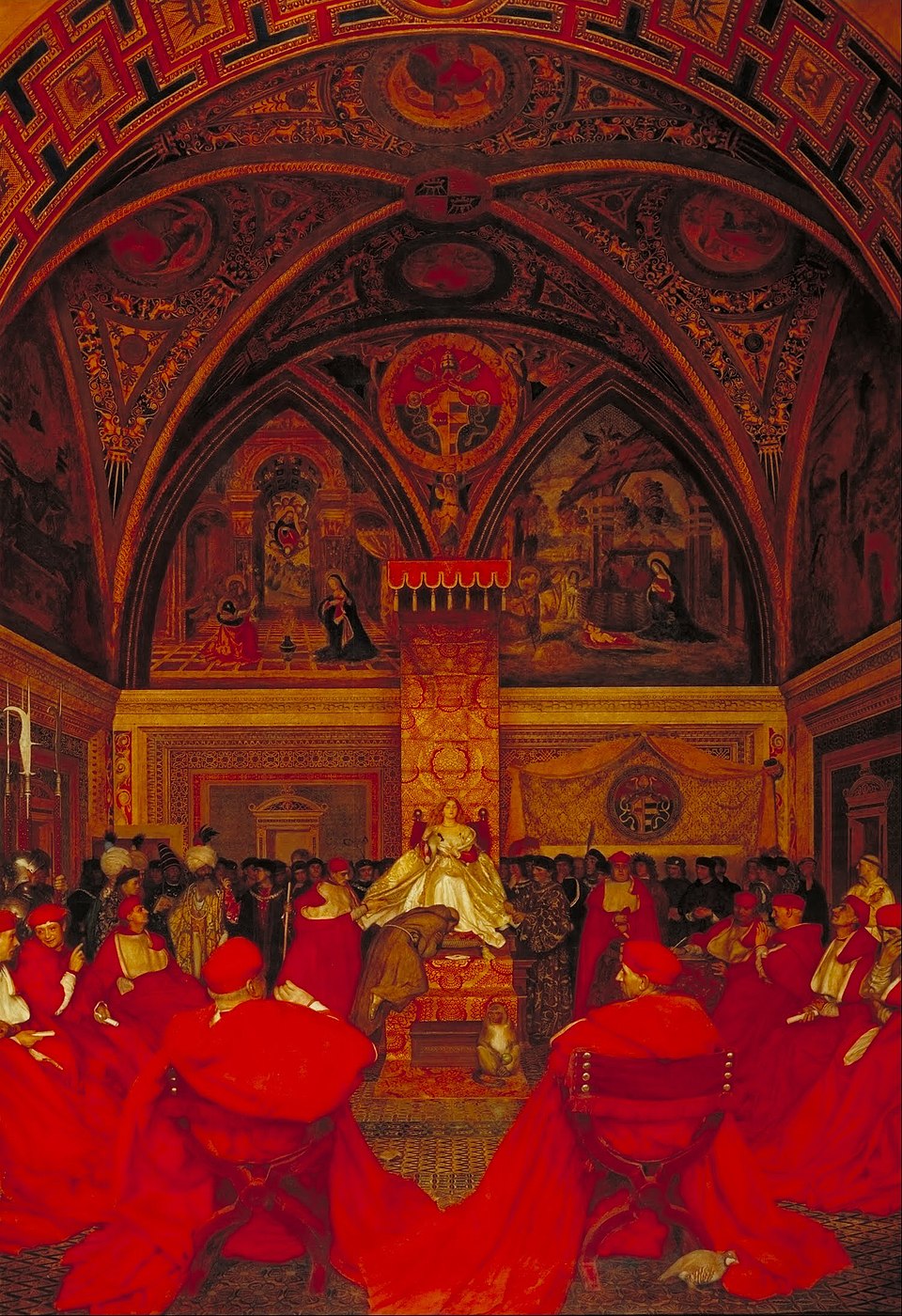
Lucrezia Borgia Reigns in the Vatican in the Absence of Pope Alexander VI; Frank Cadogan Cowper, 1910.
.
It was said that Lucrezia herself always carried with her a pin or a hollow ring containing a powerful poison and that could therefore, with a single caress or by dipping the setting in any drink, get rid of any potential enemy.
Many people lived off the art of preparing mysterious and poisonous potions. The “waters of widowhood” and the “powders of eternity” were famous, whose main element was the cantarella, an arsenic-based poison, a whitish powder very similar to sugar that, mixed with food, did not alter its flavor but caused certain death. The “venenum atterminatum” instead came from Asia, based on dried eggs, ashes and other powders from that distant continent. The cantarella was however the Borgias’ favourite method for sending unwanted people “to hell”.
In the meantime, Alexander VI, seventy years old, tired of Giulia Farnese, visited other ladies of the court, but his favourite was a brunette Andalusian procured for him by his son Giovanni before his death. All this only contributed to the criticism against the Borgias whose corruption has exceeded all limits.
From Naples, in a letter to Mr. Silvio Savelli, fiery words were written against the Borgias: “the plague born in the bosom of this State (the Vatican) for its ruin”.
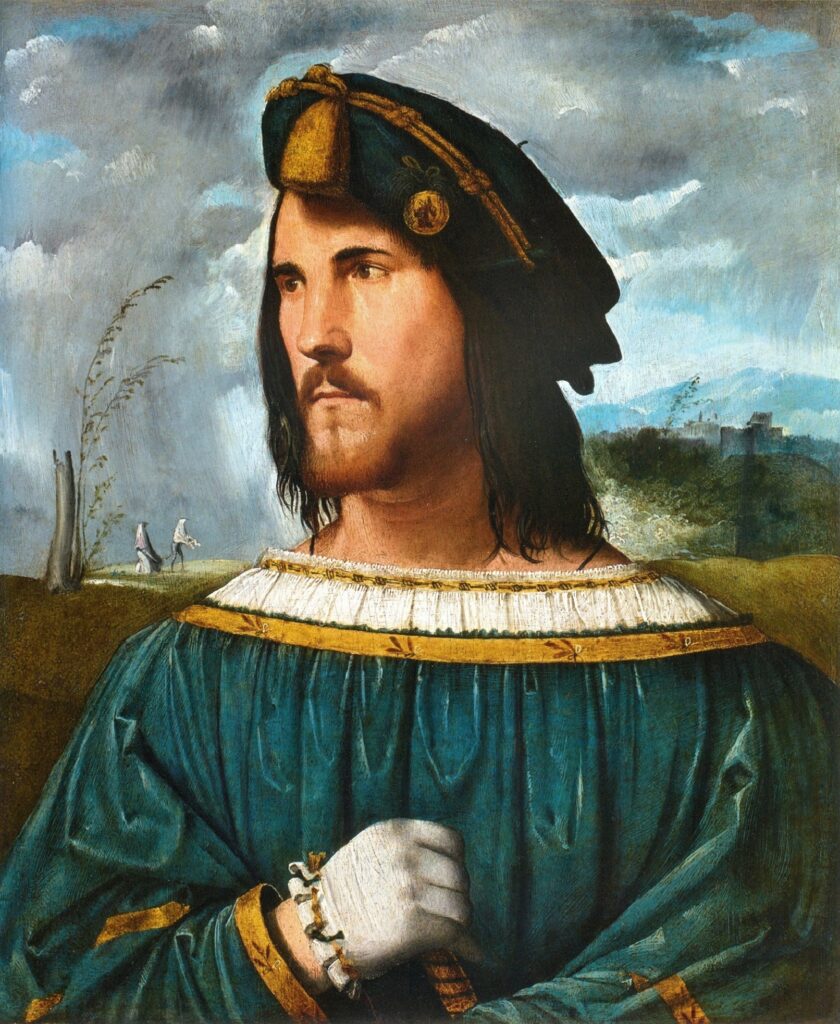
Portrait of a Gentleman (traditionally believed to be Cesare Borgia); Altobello Melone, cm.58.1x 48.2, oil on panel, 1513. Accademia di Belle Arti “Giacomo Carrara”, Bergamo, Italy.
Alexander VI however thought of future alliances thanks to his daughter’s new marriage. After carefully evaluating all the possible candidates for marriage, he decided that Lucrezia would marry Alfonso of Este, son of Duke Ercole I of Ferrara, godson of the Pope, cousin of the deceased Duke of Biscay on his mother’s side, Eleonora of Aragona, belonging to the powerful Este family whose origins were lost in the mists of time.
At twenty-five, Alfonso was already a widower of Anna Sforza, who had died two years earlier without leaving him any children.
The geographical position of his possessions interested the Borgias much more than the personality of the young man who, in addition to Ferrara, owned Ancona, Reggio and Modena. His dominion, located between the Serenissima Republic of Venice and Romagna, where Cesare Borgia governed, meant that the Pope wanted him as a son-in-law.
In reality, Alfonso of Este did not want to marry Lucrezia at all, and was already engaged to the beautiful Luisa d’Angoulême, but the usual games of power, “reasons of State”, and money ensured that the wedding contract was drawn up.
After months of negotiations, concessions, and tax reductions, the first celebrations began in Rome on September 4, while in Ferrara there was no enthusiasm for this mismatched marriage that had to be agreed to under the pressure of intrigue.
On November 15, the escort, commanded by Alfonso’s brother, Cardinal Ippolito of Este, left for Rome. It is said that no less than five hundred people, in a deliberately slow cavalcade, arrived in Rome on December 23.
In Rome, nineteen cardinals, the governor, the senators and two thousand nobles, went to welcome the procession. Afterwards, Cesare Borgia, superbly dressed, black velvet jacket, black hat with a white feather, in stark contrast to the eccentric and slightly oriental luxury of his brothers, brought the Pope’s welcome. The cannons of Castel Sant’Angelo fired thunderously and Lucrezia herself received the guests with all the honors, descending from the grand staircase on the arm of Pedro de Guillèn Lançol, husband of Juana Borgia, dressed in black, adorned only with the Burgundian honor, the collar of the Golden Fleece.
The contrast with Lucrezia was incredibly effective: she wore a white brocade dress woven with gold threads with embroidered silk sleeves, on her shoulders she had a bolero of brown-purple laminated satin lined with sable and her blond hair was covered by a very light green veil embroidered with precious stones, around her neck she wore a necklace of pearls and rubies.
She was so refined and modest and received guests with such elegance and affability that the reports, sent to Ferrara that same evening, praised her.
The receptions continued more sumptuous than ever and the people of Ferrara were left speechless in front of such a display of wealth and elegance.
From a report by the Duke of Este’s envoys we read: “Just one dress of Donna Lucrezia is worth almost 20,000 ducats, just one of her hats 10,000. In six months the jewelers of Rome and Naples have worked more gold than they do in two years in normal times.”
On the afternoon of December 30, the wedding ceremony took place in the Vatican by proxy.
On January 6, 1502, while snow fell on St. Peter’s, Lucrezia dressed in brocade and covered in a precious gold cloak, after having greeted her father for an hour, left Rome on her mule also adorned with gold and silver and, as set out in the marriage agreements, also left her little Rodrigo, entrusting him to the Pope.
Lucrezia and her father, Alexander VI, never saw each other again.
The procession’s route to Ferrara passed through many places that Lucrezia had travelled through seven years earlier to go to Pesaro for her first wedding: Civita Castellana, Narni, Spoleto, Foligno, Pesaro, Urbino, Rimini, Bologna. All the cities and villages along their route were required to receive, host and feed the many people accompanying the Pope’s daughter.
Although it was the middle of winter and the temperatures were freezing, the notables of every place welcomed Lucrezia and her escort with the utmost respect erecting triumphal arches in her honor and honoring her and the noble procession that accompanied her with wonderful receptions.
In Spoleto she was received with great celebrations. In Foligno, which had been one of her possessions, she stopped a little longer. In Pesaro, she made yet another stop. Now the town belonged to her brother Cesare who had forcibly chased away her first husband Giovanni Sforza.

A Glass of Wine with Cesare Borgia (Cesare offering wine to a guest. Beside him are Lucretia and Alexander VI); John Collier.
Here she was welcomed with all the honors and, while the ladies of her entourage enjoyed themselves with receptions and balls, Lucrezia isolated herself, she was melancholic, she thought about her future far from Rome and her powerful family. She was sad, and, with the excuse of the long journey on horseback, tiring both for her and for the ladies of her court, she insisted that they did not arrive in Ferrara too early.
The Este family belonged to a dynasty of high lineage, it was a strong, aristocratic and rigorous family where everything would have been different from the libertine pleasures of papal Rome.
At the end of January, the long procession arrived at the border between Bologna and Ferrara.
Lucrezia prepared herself to enter her new home, she arranged her things and washed her hair drying it in front of a large wood fire, she was without makeup, her hair loose on her shoulders. At a certain point she heard shouts in the corridors and listened worriedly: her first husband Giovanni Sforza had threatened an attack….
The door opened slowly, a man of robust build appeared, with a thick black beard and an unmistakable nose: it was Alfonso of Este who advanced towards the bride, looked her over carefully from head to toe, took off his hat and bowed. His father, faced with the exorbitant sum offered as a dowry by the Pope, had to force him into this marriage with the threat that, if he did not marry Lucrezia, he would do it himself, leaving her heir to all the assets of the Este family.
She, who had never seen him before, recognized him immediately even before he spoke. The conversation lasted two hours. No one attended.
Was it curiosity? Or a gallant visit? Or was it just a gesture of courtesy that pushed the young groom to meet her?
The fact was that Alfonso of Este discovered a woman different from the one he feared to meet, full of grace and charm, sweet and submissive. Lucrezia was not only beautiful but also intelligent, she did not forget that her father had paid, and a lot, for this husband.
The following day she met her father-in-law, Ercole I.
The Duke, imposing and solemn, when Lucrezia bowed, lifted her up, took her by the hand and kissed her paternally.
The solemn reception that followed was worthy of the Este and Borgia families.
Lucrezia showed off all her beauty and grace and left everyone speechless. The next day the chroniclers of the time, describing the party, would speak only of her: “adorable eyes, full of life and joy”, “how sweet and graceful she is!”, “in the opinion of all she brings back the palm of beauty”.
The following day the Duke wrote to the Pope: “Don Alfonso, our son, and Donna Lucrezia spent the night together and we believe that they were both satisfied”.
The celebrations lasted eight days during which the young bride won over many people but also aroused envy and enmity: Isabella of Este, wife of the Marquis of Mantua, and until then the first lady of Ferrara, had not forgiven the new arrival for having taken her place, she would therefore have been her enemy and only the intelligence and savoir faire of Lucrezia succeeded later in making the two noblewomen become like sisters.
Once the celebrations were over, they thought about the counts.
The marriage was to be a profitable affair for the Este family and the bride had to adapt. Lucrezia was therefore forced to reduce expenses… even to send most of the ladies of her entourage back to Rome. The young woman even had to negotiate her allowance and, only thanks to the powerful intervention of her father, she obtained an adequate sum, even if less than that requested.
In the Castelvecchio manor, a massive and imposing quadrangular fortress, with reddish towers, surrounded by water, in the center of Ferrara, the servants had not done the housework for a long time, the sheets were full of holes and there was no one to mend them, the furniture and tapestries were missing…
Lucrezia put a lot of effort into arranging her apartments in this dusty building, with large, cold and unwelcoming rooms that she, with exquisite taste, made appropriate to her person and the lineage of her new family.
Alfonso, busy with cannon foundries, games, the art of weapons and taken by the lovers he had kept since his widowhood, arrived only in the evening.
His wife, who was trying to organize a court life and gather painters, sculptors and men of letters around her, did not care.
The 1500s, a century of geniuses such as Michelangelo, Leonardo da Vinci, Raphael… saw Italian women, unique in Europe, receive an education: it was in their salons that princes, prelates, men of letters, artists and even men of arms gathered and it was around them that the arts flourished that would make the Italian Renaissance great throughout the world.
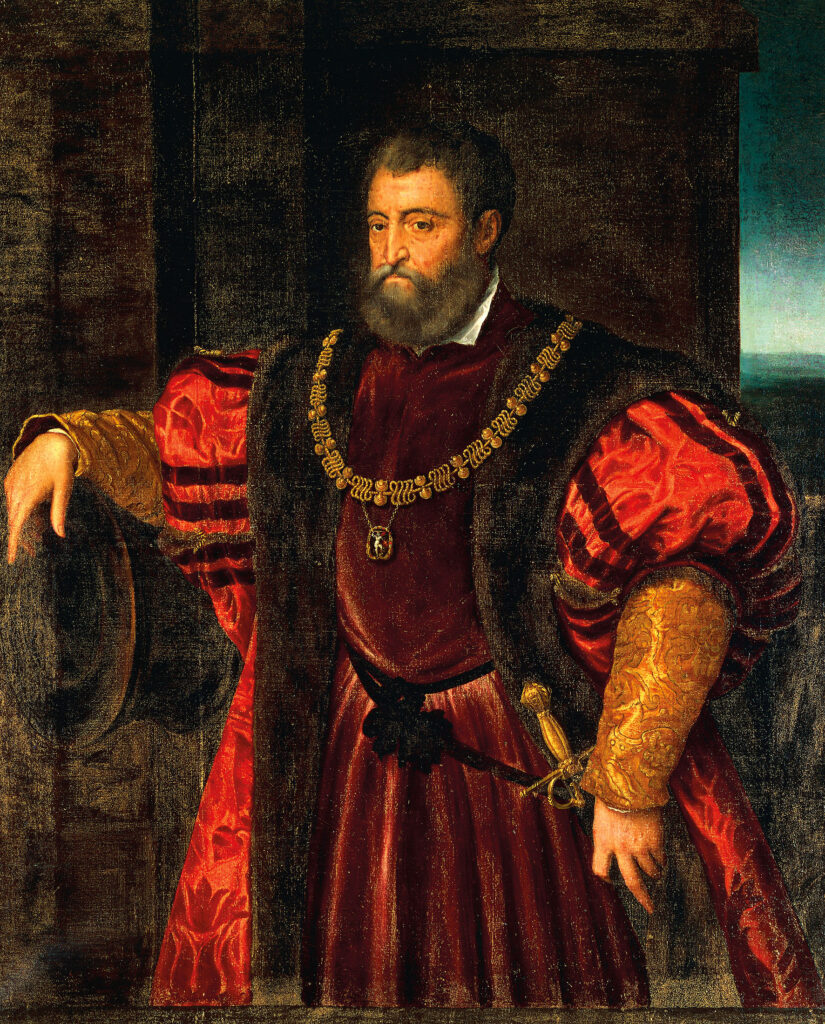
Portrait of Alfonso with his Cannon; attributed to Sebastiano Filippi, 16th century.
Niccolò da Correggio was the arbiter of elegance and defender of the Theater, the twenty-four year old Tito Strozzi composed verses in honor of the young Roman noblewoman and, in spite of Isabella of Este and to show her power, Lucrezia took away her secretary Tebaldo, a highly cultured man and a great expert in medicine.
Another character at Lucrezia’s court was Ercole Strozzi, lame from birth, famous for his refined literary works, a man the Duchess trusted blindly and who had free access to the lady’s rooms at any hour of the day. The Duchess appreciated Ercole’s intelligence and profound culture and particularly shared his almost feminine taste which he expressed both in his clothing and in his choice of valuable objects. He was undoubtedly the noblewoman’s most intimate confidant.
During Holy Week in 1502, Lucrezia, who was pregnant, retired to the convent of the Poor Clares. Cesare, her brother, at the height of his power, was passing through Ferrara and went to visit her.
The next day, Lucrezia was very ill. There was talk of poison and the news reached Rome. The Pope, worried, immediately sent one of his personal doctors. The Este family truly committed themselves to the care of their Lady: her life was precious and her presence prevented Ferrara from being conquered by Cesare as he had already done with Urbino.
During this period, Alfonso showed that he truly loved his wife, he constantly assisted her and watched over her. Lucrezia had entered the hearts of all the people of Ferrara who were worried about her health and offered her numerous proofs of their sympathy, starting from the nobles to the magistrates, from the bourgeoisie of the city to the peasants, all hoping that their Duchess would regain her health as soon as possible.
At the end of September, Lucrezia gave birth to a stillborn baby girl and, still ill, received a visit from Cesare who stayed at her bedside for two days taking care of his sister. At the end of the month, as if by a miracle, she recovered and in thanksgiving to God she retired again to the convent of the Poor Clares.
After a few weeks, in mid-October, in a golden carriage, she returned to Ferrara. The people, who had adopted her, welcomed her joyfully. Thus began a new period in Lucrezia’s life amidst the joys of the arts and love.
She met Pietro Bembo, spiritual son of the Patriarch of Venice; Lucrezia’s father-in-law had invited him to Ferrara in the hope of cheering up his daughter-in-law, not foreseeing that he would soon become her lover.
Lucrezia was fond of Alfonso who had shown her dedication and tenderness during her illness but her husband paled in comparison to the culture, gentle manners and authority of this refined Venetian who dedicated “Gli Asolani” to her.
With the complicity of Tito Strozzi, his son and some Roman women in her entourage who acted as messengers to the two lovers, a relationship began between the two.
Lucrezia signed her love messages “FF” which certainly meant “Faithful Ferrarese”.
When Bembo was forced to leave for Venice where his brother was dying, the Duke of Este, who had had some suspicions of his daughter-in-law’s guilty loves, arranged for Bembo to move to Rome as secretary to the Pope.
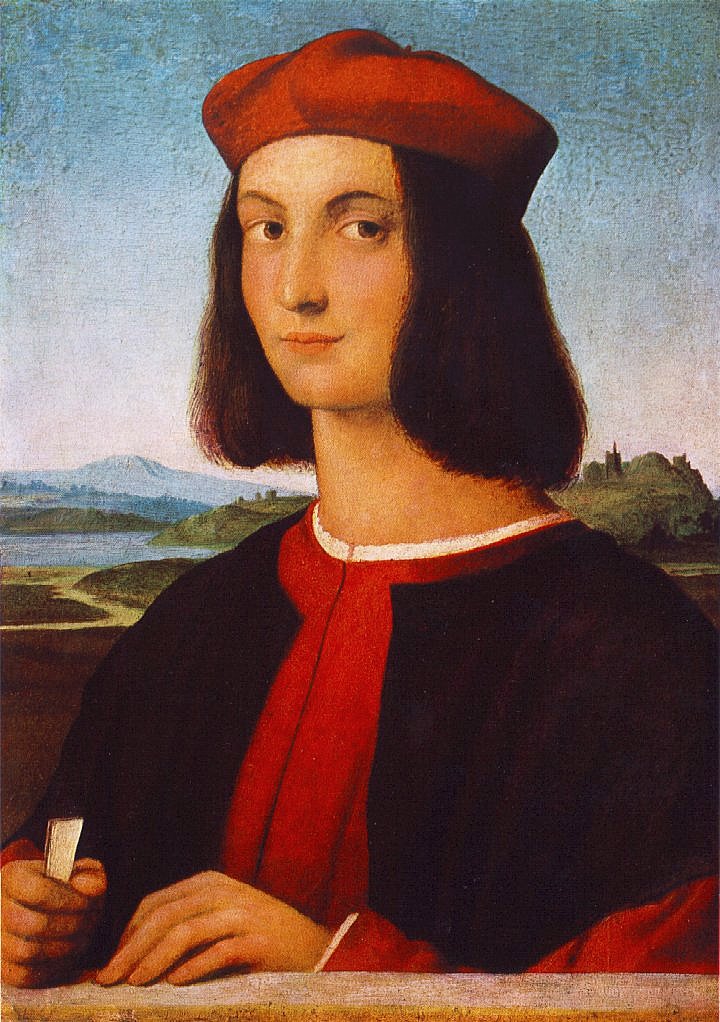
Portrait of a Young Man (presumed portrait of Pietro Bembo); Raffaello Sanzio, 1504. Museum of Fine Arts, Budapest, Hungary.
In the meantime, Alexander VI Borgia, old, alone and dominated by his son Cesare, had reached the end of his life. Feeling death approaching, he rediscovered his faith, prayed to the Virgin, while his enemies continued to spread the worst news about him.
On August 11, 1503, a Saturday, at eight o’clock in the evening, the Pope suddenly felt unwell. The next day, Cesare also started vomiting. Both had attended a banquet at Monte Mario, in the vineyard of Cardinal Adriano of Corneto. Most of the other guests also had a fever.
The chroniclers of the time wrote that nothing leaked out about the affair but that all of Rome was convinced that the Pope had been poisoned, perhaps involuntarily, by his son or by Cardinal Corneto.
In fact, Cesare, wanting to take possession of the Cardinal’s properties, had decided to kill him with the fastest and safest method used at the time. He had thus sent a poisoned wine as a gift that a paid servant was supposed to serve only to Cardinal Corneto.
It was August and, either because the Pope, arriving early and thirsty, asked to taste the wine, or because Cardinal Corneto, suspecting something, had his son’s wine served to him, the fact remains that Alexander VI Borgia, on August 18, 1503, died of poisoning. And that it was poisoning is confirmed by the stories of Burchard and Antonio Giustinian.
Cesare was saved because at the first symptoms he used an antidote, the other guests because they knew that when eating with the Borgias you had to be careful and eat in great moderation…
The Pope’s funeral was officiated with simplicity and discretion.
Alexander VI’s body was horribly swollen, his face became “black and ugly”, “the tongue so swollen, the nose fetid, the mouth completely widened that it was horrible and frightening”. The gravediggers were forced to press the Pope’s body to fit it into the coffin.
For a few hours the body of Alexander Borgia was exposed, then his face was covered because it was unwatchable.
“…the most monstrous and horrible corpse ever seen”.
The Romans did not mourn the death of this Pontiff who led the Church to the lowest point in its history and who, except for a devotion, by the way only apparent and conventional for the Virgin, had never shown any interest other than for power, for his lovers and for his children.
Burchard wrote in the “Book of Ceremonies”: “I, Alexander VI, lie here, rejoice liberated Rome, for my death means your life”. This was the final epigram of Alexander Borgia.
Meanwhile, Cesare’s men, led by Michelotto, made a clean sweep of the Pope’s treasure, threatening death to any prelates who opposed them. The safes were emptied, not even the Pope’s shoes with a gold cross or his ring were to be found.
Lucrezia, upon hearing the news of her father’s death, was deeply saddened, cried and lamented for several days. Those close to her did not understand her grief: to be so prostrate over the death of a man like that. Ercole I, her father-in-law, was even satisfied with the death of the Pope and hoped for the election of a true pastor and the disappearance of all scandal from the Church as he clearly wrote in a letter to Gian Giorgio Seregni.
.
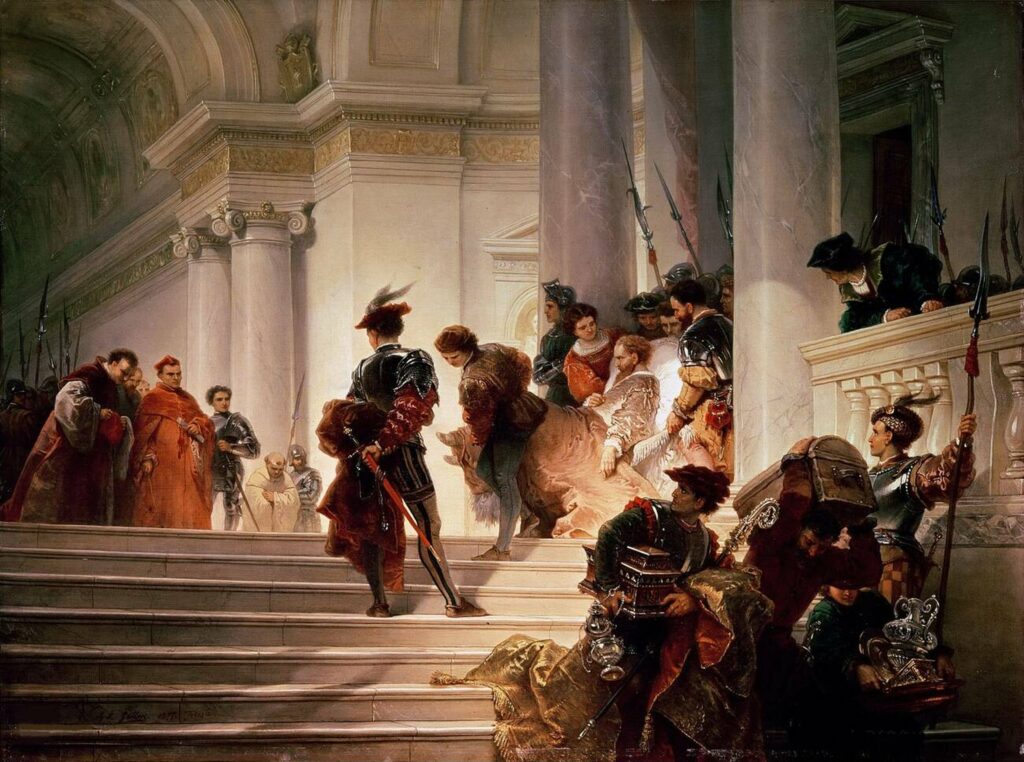
Cesare Borgia Leaves the Holy See on the Death of His Father; Giuseppe Lorenzo Gatteri, 1877.
.
It was the beginning of the end of the Borgias.
Luckily, Lucrezia had entered the hearts of the people of Ferrara: the death of her father and the imminent fall of her brother did not affect the affection that her subjects had for her.
In the meantime, Cesare, still powerful, barricaded himself after the death of his father in Castel Sant’Angelo, managed to have Cardinal Piccolomini elected Pope who took the name of Pius III. The new Pope, with a bull confirmed Caesar’s power over the States, appointed him Gonfaloniere of the Church, but, already old and ill, died after only twenty-six days of pontificate.
It was all about over starting again! This time Cesare found an old enemy on his path: Cardinal Giuliano della Rovere who, with the same weapons used fifteen years earlier by Alexander VI, managed to ascend the papal throne with the name of Julius II.
Without too many scruples, he bought both the votes of those who followed him and those of the Borgia followers, a doubly profitable deal that allowed him to be elected and to ensure that the votes of his enemies were neutralized.
Julius II was no better than his predecessor, in fact, he had an additional fault: he drank and the Romans who did not mince their words caustically stated: “We only have the Pope until midday. After this hour His Holiness is in the vineyards of the Lord”.
Cesare was reconfirmed as Gonfaloniere of the Church but certainly did not suspect that Julius II intended to take away all his States.
The opportunity arised when he was forced to go to Romagna threatened by the French and in the conquest plans of the Spanish and the Venetians.
Following the refusal of the Florentines to let him pass through Tuscany, he obtained permission from Julius II to pass through the Mediterranean coast (Ostia, Civitavecchia, Livorno) but in Ostia the Pope asked him to abandon his garrisons and his last strongholds in Romagna. Cesare Borgia then understood Julius II’s tactics, realized his duplicity and went into a rage, but it was too late. Arrested and brought back to Rome, he was imprisoned in the Vatican in the Borgia Tower, where Alfonso of Biscay, Lucrezia’s second husband, had been murdered.
This was the beginning of Cesare’s fall that Machiavelli defined as “slipping towards the tomb”.
One day in 1504, the Pope offered him a chance: he would regain his freedom if he could convince the Spaniard of Naples, Gonzalve da Cordoba, to ally himself with the Pontiff.
But it was another trap. After being welcomed with all the honors, on May 27, invoking the reasons of state, the good of Spain and Italy and the interest of the papacy, Gonzalve had Cesare imprisoned in Ischia from where he was transferred to Valencia.
The deus ex machina was obviously Julius II who thus showed the son of his old antagonist that he was powerful, domineering, violent and despotic and above all that he did not fear him…
From Valencia, Cesare was transferred to the castle of Chinchilla near Albacete, then to the imposing fortress of Medina del Campo from where faithful friends helped him escape, he broke several ribs because the rope was too short but in the end he was free again alongside his brother-in-law Giovanni d’Albert, king of Navarre.
Reduced to the rank of leader, he fought bravely but his enemies, at the hands of two former unfaithful servants, ambushed him near Lorono. Cesare fought bravely, but, in the end, he was killed and cut into nine pieces.
With his limbs scattered, his throat cut, thrown into a ravine, Cesare Borgia, Duke of Romagna and Valenza, Gonfaloniere of the Church, ended his life at only thirty years of age. On his tomb, in the church of Santa Maria de Viana, the Spaniard Soria wrote, in his language, this epitaph: “Here lies in a small land he whom all feared he who in his hand brought peace and war. Oh you, who go seeking things worthy of praise! Stop your path here; do not bother to continue.”
Lucrezia learnt with great sorrow of her brother’s death, even though freed from the dark and oppressive presence of Cesare, she forgot all the tragedies of which he was the architect, she mourned him sincerely, without rancor, remembering only the good received from him and arousing the admiration of Ercole Strozzi who shared her mourning by composing a hymn dedicated to her.
She had even gone to Spain to plead his cause with King Ferdinand, but when she arrived in Catalonia she had learned of his sensational escape and in November 1506 a letter with Cesare’s coat of arms announced his arrival in Pamplona and asked if there were any hopes for his return to the throne of Romagna. But only a few days later came the news of his death…
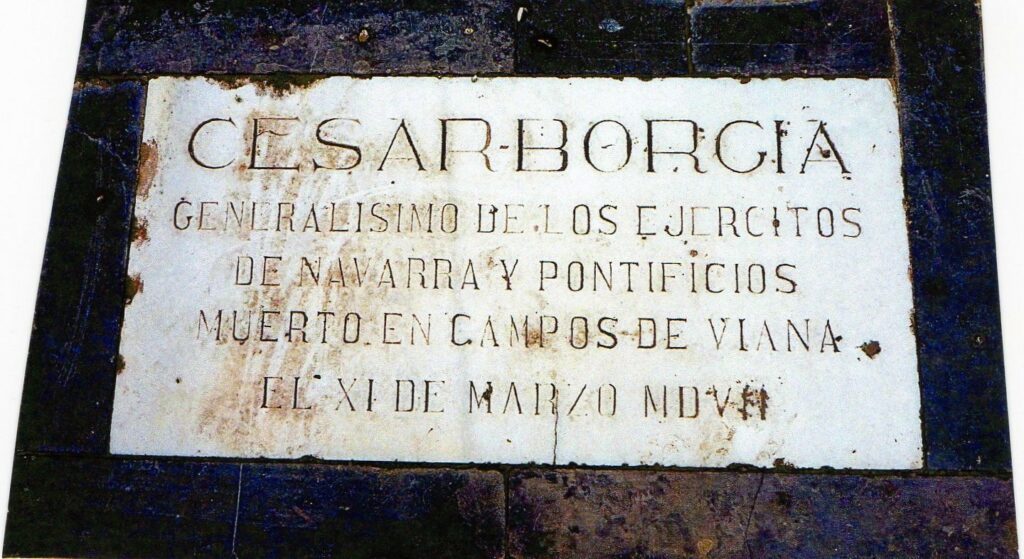
Tomb of Cesare Borgia; Churchyard of the Church of Santa Maria in Viana, Spain.
Under the guidance of Friar Raphael, Lucrezia rediscovered her faith: she dressed soberly, wore barely any makeup, banned low-cut dresses from the court and had blasphemers punished.
But at thirty-six, still beautiful and full of charm, she soon became bored with the monk’s moralizing atmosphere and therefore resumed court life.
In the meantime, she increasingly won the favor of her subjects: she was graceful and cultured, her amorous adventures remained secret and her reputation as a faithful wife was stronger than ever. An artist wrote under her profile: “for virtue and beauty the most precious asset is modesty…”.
After Pietro Bembo left the scene, the Marquis of Mantua, Francesco Gonzaga, husband of Isabella, made his appearance. It all began in April 1504. The Marquis was actually hesitant, but in the end, with the complicity of Strozzi, a faithful messenger, a love affair began between the two. The two exchanged correspondence that Lucrezia signed with the pseudonym of “Zilio”.
One morning, Strozzi’s body, pierced by twenty-two stab wounds, his hair torn out and scattered around his tortured body, was found at the corner of the building.
No one talked about it but it was a warning to lovers. Even the most secret relationship ended up being known in the small Italian capitals and in Ferrara people chatted and gossiped like everywhere else.
Alfonso of Este, who succeeded Ercole I in January 1505, was famous for his cruelty. The young duke showed off his ferocity on several occasions: he even gouged out an eye with his own hands from a man suspected of plotting against him, another was torn to pieces in the public square and his head was stuck on a pole above the tower of the Palace of Justice, yet another was suspended for seven days in a cage exposed to the sun, then strangled and his body thrown into the Po River.
In 1507, Lucrezia spent the summer with her son Rodrigo. The seven-year-old boy had arrived in Ferrara with the other boy they called “the Roman infant”. But as soon as the summer was over, Alfonso demanded that the children, whom he could not stand, should return to Rome.
In 1508, Lucrezia gave birth to a very ugly boy, who would reign under the name of Ercole II. Alfonso, a happy father, went to visit the King of France and Lucrezia intensified the ardour of her letters to Francesco Gonzaga, whom she rarely met.
In 1509, another child was born: Ippolito.
In 1510, things between the two lovers became complicated: Mantua and Ferrara were adversaries aligned for and against the Pope.
In fact, Julius II wanted the lands of the Este family: “Ferrara, Ferrara! Body of God, I will have you!” became his favourite exclamation. He wanted Alfonso to submit and hand over his possessions. Alfonso refused, he was even excommunicated and, with his French allies, defended Ferrara.
On Easter Sunday 1512, Duke Alfonso of Este and Louis XII defeated the papal troops and the Spanish army in Ravenna in the “bloodiest and most terrible” battle of the time.
Throughout the war, Lucrezia continued her relationship with the Duke of Mantua, who at one point had considered taking her prisoner, which would have certainly simplified their love problems.
However, she was skilled in gaining the trust of her husband, who entrusted her with the administration of the duchy and appointed her regent of Ferrara.
During the war, she pawned her silverware and fabulous jewels to obtain a loan to alleviate the hardship of her subjects. This gesture by their Lady further aroused their veneration for her. Even Paolo Giovio, a sworn enemy of the Borgias, expressed his admiration for the Duchess of Ferrara, whom everyone now called “mother of the people”.
A year after the defeat of Ravenna, Julius II died. He was succeeded by Leo X de’ Medici, a lover of peace.
Machiavelli portrayed Europe at the time as follows: “We have a prudent, serious and respected Pope; a frivolous and changeable Emperor; an irritable and fearful King of France; a confused and greedy King of Spain…We have brutal, victorious and insolent Swiss, and as for us Italians, we are poor, ambitious and debased.”
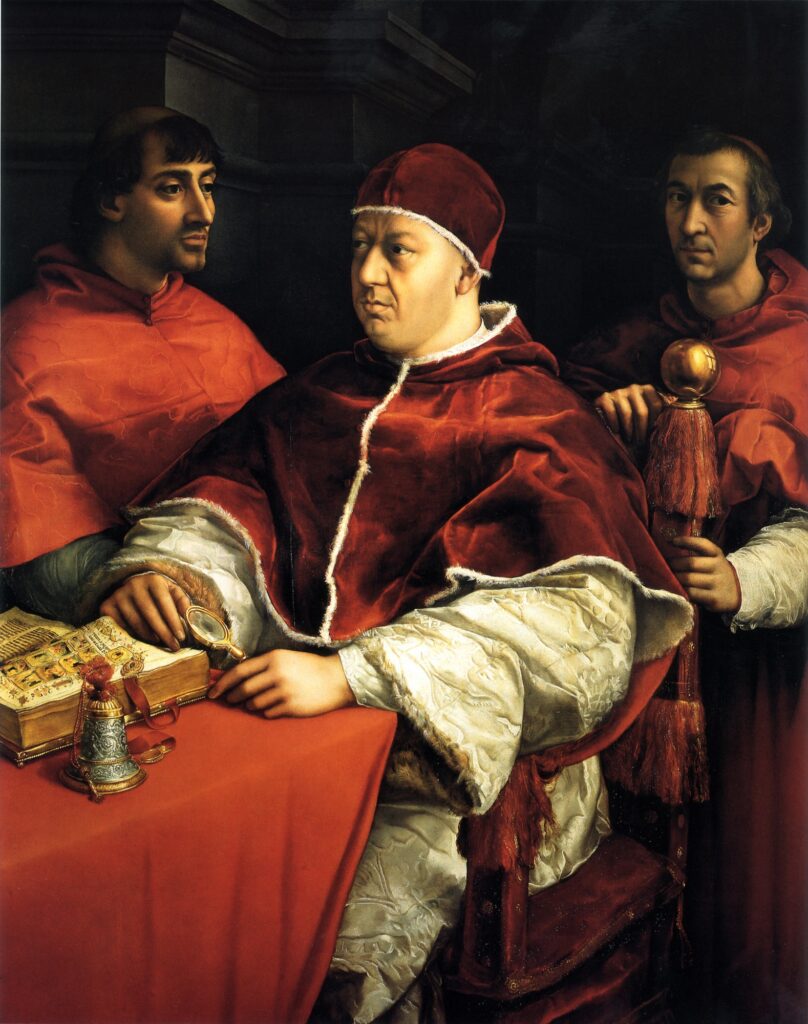
Portrait of Pope Leo X between Cardinals Luigi de Rossi and Giulio de Medici; Raphael, 1518. Uffizi Gallery, Florence, Italy
.
Finally, peace and tranquility reigned in Ferrara.
Lucrezia met Ariosto, to whom she felt gratitude for having supported her husband at the time of the excommunication of Julius II, and the great poet celebrated her in his “Orlando furioso” by placing her in first place in a pantheon erected to celebrate the eight most worthy ladies of his time. She hosted, with her exquisite courtesy, Tiziano Vecellio who had come to Ferrara to decorate the Ducal Palace and for other works. The artist gave Saint Dorothy the face of the amiable Duchess of Ferrara in the “Madonna and Child with Saints Dorothy and Anthony” and depicted her in the “Banquet of the Gods” which, left unfinished, after Tiziano’s death, was later completed by Bellini.
Lucrezia alternated periods of joy with others of deep depression. Parties, dances, joy which were increasingly followed by retreats to the convent of San Bernardino.
It must be said, however, that her rosaries were made of mother-of-pearl, jade or other precious stones, her prayer book was bound in velvet and richly adorned with gold friezes.
Life certainly did not spare her sorrows: all those she loved and were faithful to her left her and painful pregnancies forced her to bed almost every year.
Sancia, her sister-in-law, died and, in 1517, her younger brother Goffredo died.
At only thirteen years old, far away, without her being able to assist him, her son Rodrigo died.
Her mother Vannozza Cattanei, whom she loved tenderly, also died.
Lucrezia was the last of the Borgias.
Only later Francesco, nephew of Pope Alexander, redeemed the family name and was canonized.
In the spring of 1519, in March, Francesco Gonzaga also died, suffering from syphilis.
Pietro Bembo, her former lover, now the Pope’s secretary, once again became Lucrezia’s “amant de la plume”.
Perhaps unconsciously aware of her imminent end, at thirty-nine years of age, she seemed to have lost all lightheartedness, all cheerfulness. Under the guidance of Friar Ludovico della Torre, she pronounced her vows as a Franciscan tertiary and gave the task of drawing up a detailed inventory of her jewels, which were scrupulously listed one by one by Ercole Fideli da Sesso and his son. In all, three thousand seven hundred and seventy pieces of immense artistic value were described.
She was pregnant once again and wanted a blessing from the Pope because she feared that the birth could end badly. She therefore sent a knight to Rome with a plea to the Supreme Pontiff.
Leo X, who would have preferred not to hear the name Borgia again, even if reluctantly, granted his blessing. Lucrezia was ill, she realized that her condition was serious and signed her will, left bequests to churches and monasteries and received extreme unction.
She did not ask to see her children because, perhaps, she did not want them to see her dying, instead she asked to be buried in her religious habit of Franciscan tertiary and that the flowerbed of amaranths, a symbol of immortality, dedicated to the memory of Alfonso of Bisceglie and of his son Rodrigo, be cared for forever.
Her husband, who was always close to her, ordered a procession through the streets of Ferrara.
The entire city prayed for the Duchess to recover but, on the evening of June 24, 1519, Lucrezia Borgia died uttering her last words: “I am God’s forever”.
Giovanni Gonzaga, sent to Ferrara to represent the Marquises of Mantua at the funeral of the Duchess of Ferrara, wrote to his nephew Federico: “The death of the Duchess has caused great mourning, and His Ducal Greatness has above all manifested extreme sorrow. Here everyone sings her praises.”
Her husband at her side wrote: “It has pleased Our Lord to call back to Himself the soul of the Most Illustrious Lady the Duchess, my beloved wife. I cannot write without crying, so cruel is it for me to lose such a dear companion, since she was such for me with her irreproachable conduct and the tender love that reigned between us… And it would be much more precious to me to know that there is someone who wants to mix his tears with mine, rather than try to console me.
Ferrara, 24 June 1519, fifth hour of the night.
Alfonso Duke of Gonzaga”.
.
.

Tomb of Lucrezia Borgia; Este Tombs. Monastery of Corpus Christi, Choir Room or Hall of the Poor Clares, Ferrara, Italy.
.
Bibliography:
The Thunder, perfect mind – Hymn to Isis – Nag Hammadi Codes (NHC VI,2:13,1-21,32) – Egypt, 2nd, 3rd century AD-
Lucrèce et les Borgia – Geneviève Chastenet, prix Monseigneur-Marcel 1993
Wanderjahre in Italien (Pilgrimages in Italy, in five volumes) – Ferdinand Gregorovius, 1856/1877
Geschichte der Stadt Rom im Mittelalter (History of the City of Rome in the Middle Ages)-Ferdinand Gregorovius, 1859–1872
Lucrezia Borgia – Ferdinand Gregorovius, 1874
Lucrezia, Victim of the Borgias? – Frank Chenecchi, – Cremille Editions – Geneva 1971
César Borgia - Paul Rival – Editions Grasset 1931
The life and times of Lucrezia Borgia – Maria Bellonci – A. Mondadori, 1939. Viareggio Prize ex aequo
Illustrations:
Wikipedia
.
.
.
.
.
.
.
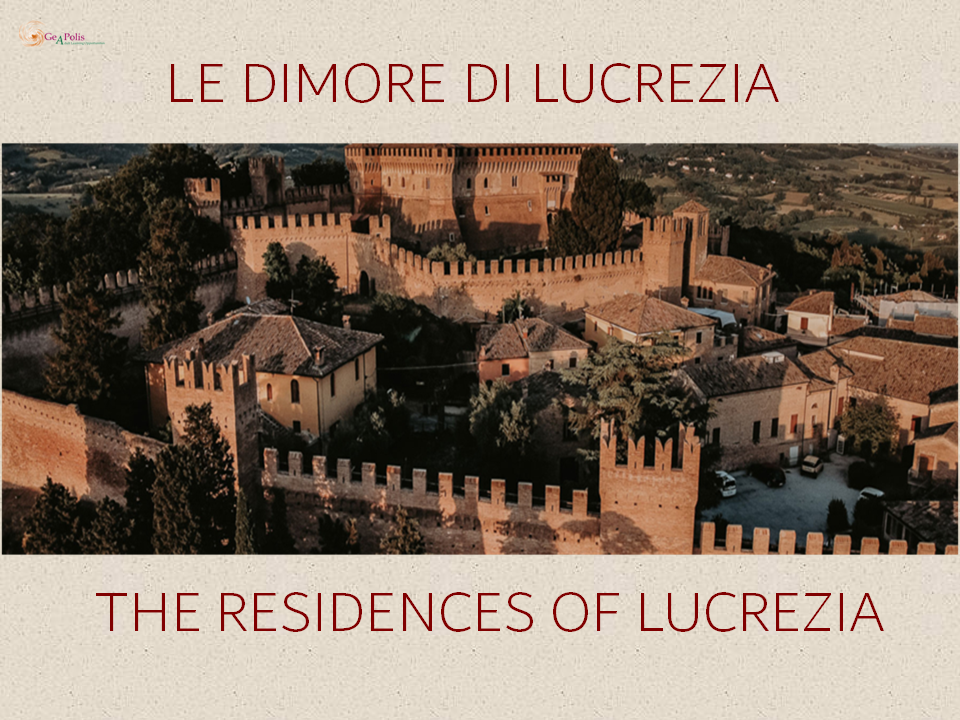
.
.
.
.

