by Ida Renzicchi

Remote conversation with Brandon Cole
Thanks to technology, Ida Renzicchi has met, on behalf of Geapolis, the American writer and screenwriter, Brandon Cole, author of the play.
It has been a pleasure getting to know Brandon Cole.
While reading his biography I was impressed with his life experiences even those in areas outside of his writings. Undoubtedly they, supported by his studies, have been fundamental in the formation of the writer-screenwriter and have contributed very much to widening his knowledge and making the authentic person he is today.
Brandon Cole has studied and speaks Italian very well so that even at a distance he can transmit his passion and create immediately an empathetic relation with his interviewer.

Q: Brandon, you are a writer and screenwriter. Where do you find the inspiration for your stories?
A: Hello, Ida, and many thanks for this opportunity to discuss my work with you and your readers. I hope very much that our discussion will not prove boring for anyone, and especially not for you.
Regarding the beginnings of my stories, I must say that I work from life, always from life, the lives of others who are still living and also, as here in “Imperfect Love”, of historical figures.
And I also work from myself, especially those parts of me that create problems (in the past and also these days) in my mind and with my relations with others, including my dear friends and family members.
In other words, my writings are personal, very personal.
Q: Do you start writing thinking first about the character around which you are going to build the story or vice versa?
A: Usually, though not always, I start any story with the characters. For me the most interesting thing is the human being and if I find a subject, or if a character comes to me suddenly, that is, without my having looked for him, I tend to trust this initial sensation of mine. Then, I have to find a story, a theme, a plot and, sometimes, I have to start looking for a way of life and an environment. This is a time-consuming process, you know. For example, when I started writing the comedy, “Steel on Steel”, later transposed into the film “MAC”, I had to build the story around three brothers, all them carpenters. I wondered, “Who could be interested in the lives of three carpenters?” Personally, I think the life of a carpenter could be interesting. Certainly. But the others? Maybe? In any case, I did research in Italian history, I found Giordano Bruno, Giambattista Vico, and Niccolò Machiavelli and took them as a model.
Q: What are your points of reference? Is there a writer that you prefer?
A: Very many writers, truly very many, the list would be too long to include all the writers that have taught me.
But I can say that Luigi Pirandello is someone I always return to with pleasure. Actually one of my reasons for learning Italian was so I could read his works in his language, especially, “Six Characters in Search of an Author”, “Henry the Fourth”, and “The dead Mattia Pascal”. Sounds fantastic doesn’t it? But it was so.
Regarding Pirandello, I’d like to add that the first time I came to Italy in the seventies, I visited Pirandello’s house in Agrigento, Sicily, a very lovely place above Port Empedocle.
“Indian Nights” by Antonio Tabucchi also impressed me strongly because the writing is simple and direct and also profound, a very rare mix, don’t you think?
Outside of Italy I must point to Samuel Beckett, especially his novels, and the plays of Harold Pinter.
All these writers have influenced me so strongly that it has taken me years, really decades, to reduce their influence. Really though, they still influence me today.
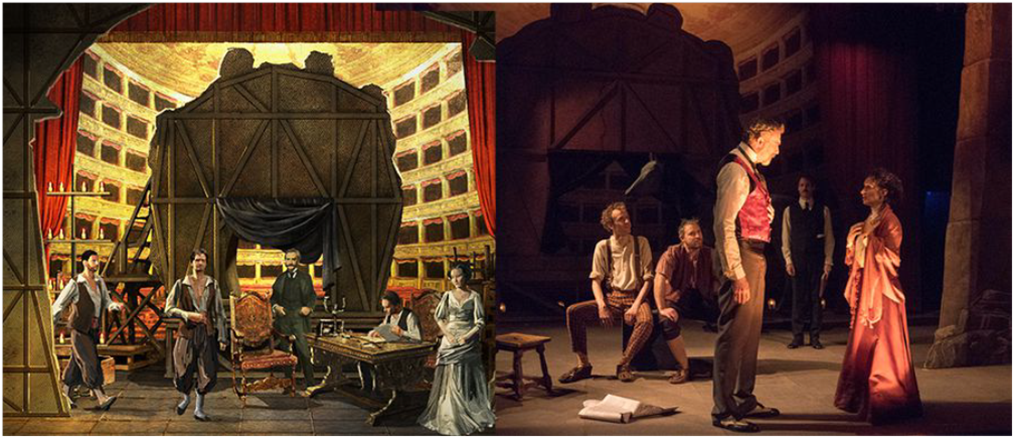
On stage. Imperfect love. (First act)
Q: How real and how much fantasy is there in the events you write about?
A: Well, Ida, I generally like to believe that everything I write is real or based on reality. For example, I wrote “Imperfect Love” (and also “Illuminata”) based, as we know, on the life of Eleonora Duse and her love affair with Gabriele D’Annunzio, a love affair which lasted nine years. Many parts of the play were taken directly from their story but my play takes place over a day. How to compress nine years into one day? Here is one of the challenges. So I had to invent some actions like Sara Bernhardt’s letter in the second act. But it is a historical fact that D’annunzio’s comedies were not very successful in Rome and that he turned to Bernhardt and to Paris. Frankly, I don’t know if the two became lovers but I like to believe they did because D’Annunzio, in my opinion, was a seducer and Bernhardt a woman of easy virtue, unlike Duse who was a remarkable and complex human being.
Q: What is the target audience you plan to address when writing? In your opinion, who are your readers?
A: I like to think I write simply and clearly and with the intention that my plays, screenplays and novels will interest every person who reflects upon life. I can also say that I have received negative reviews, so much so that I understand there are also people who do not appreciate my work at all. The world is rich and complicated, isn’t it? Certainly there are different categories of people as well as of writers. I like the thought that I am proceeding along a path that others have traveled before me, people like Eleonora Duse, for example, and Cekhov, Brecht, and that still today, there are those who admire these artists and the work they have done. This is the audience I want to reach. In other words, those who appreciate the classics.
Q: What is the most congenial role to you: that of the writer or that of screenwriter?
A: Right. I like being alone with my thoughts and characters and I enjoy any form of writing. I can write dialogue quite easily and I am very comfortable writing scripts and plays. As for descriptions, I can write them but I have to work on them a bit, and I find they require a different effort and I need more time. I have written three novels and even my detective story “The Rootless” was written first as a short novel. In the future, I think, I want to take particular care of my activity as a writer, and therefore to become more of a novelist but these days I am working mainly as a screenwriter for cinema and television.

Q: Between cinema, theater and television, which of them do you feel most akin to your sensitivity as a writer? In which area do you feel most comfortable?
A: Since I started in the theater, more or less, I prefer that environment. It was in the theater where I met for the first time people I recognized as being similar to me. That is, irreverent individuals, with a spontaneous cheerfulness, people who looked at the world as a strange, funny and enchanting place all at the same time. And above all, in the theater, since being boring is a form of death, I like the adventure, let’s say the challenge, the serious commandment: “Hold my attention!”. In other words, the cinema is rather impersonal while in a theater it is possible to notice when a scene is wrong. This immediacy attracts me a lot.
Q: From your works one could say that you prefer to write about the past. Do you find your greatest inspiration in past events? Do you intend to write something about contemporary events or people? Who or what could be the future subject of one of your stories?
A: Yes, Ida, sometimes the past lives for me, especially with “Imperfect Love” but this work I would say is an exception. I wrote the film “MAC” with my friend John Turturro (in 1993 it won the Camera d’Or at Cannes), which was based on John’s family, that is his father, Nick, and his uncles. It was necessary that this film take place in the fifties but for me it was a contemporary story, I would say modern, because it is the story of a man trying to do something good for his younger brothers. A timeless story, isn’t it?
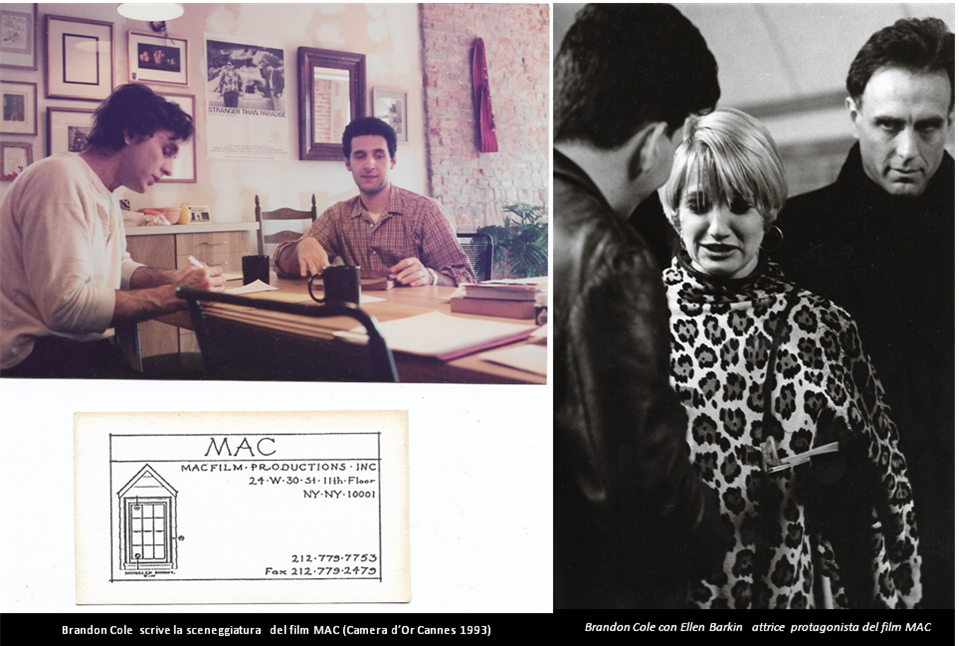
But generally I write in the present if I am writing screenplays, or stage plays, or novels. For example, these days I am developing again with Turturro and my friend, Will Patton, a televisions series, a cop story, titled “The Rootless.” It is a present-day story about a cop in Reno, Nevada, who is falsely accused of murder. Believe it or not, the writing is finished, very finished after many years, and now I’m looking for a production. I would also like my friend Franco Nero to join us, and also my friend Gianni Quaranta. That sounds good, no? Well, we will see what we can do.
Q: Among your writings, is there one in particular that you prefer?
A: Well, Ida, this is a tricky question, don’t you think? I remember when I was a child one of my brothers asked our mother which one of us she preferred. Insane, really. My mother was a sweet soul and she always answered that she loved us all in the same way.
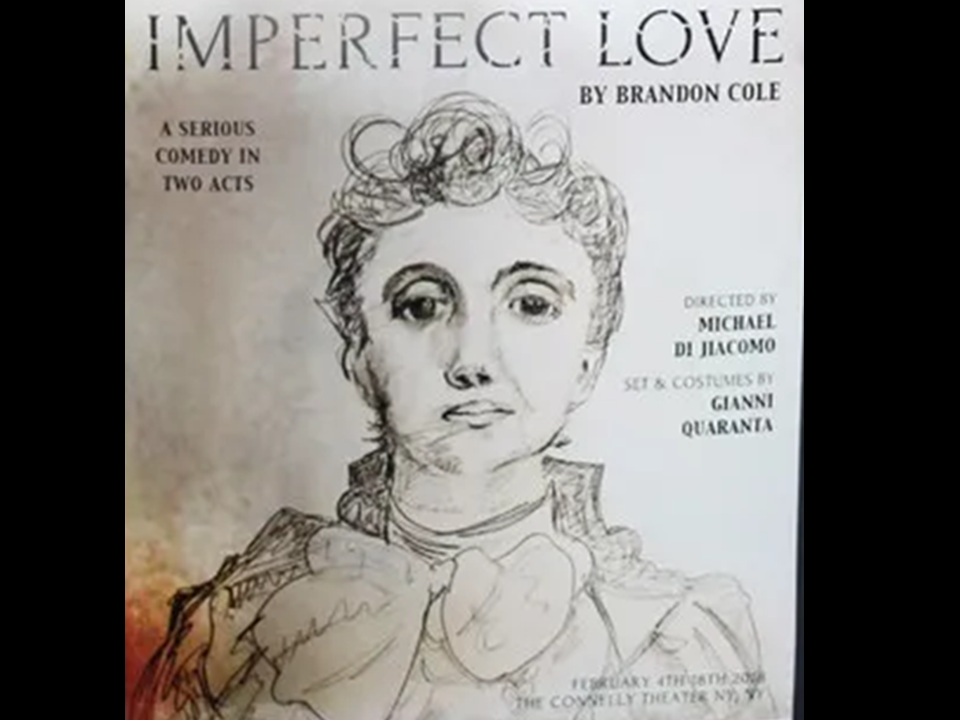
But with my writings I can say that “Imperfect Love” is one if not the only child which I really care about because I have been working on this play for more than thirty years (really!) and even though I have had two successful productions in New York I will not be at peace until I can present it in Italy.
Q: In your work as a screenwriter do you always work on your own material or are you asked to adapt the work of other writers?
A: For the most part, the screenplays that I have written are original, that is they are mine or a collaboration with a director. I wrote two screenplays with Turturro, “MAC” and “Illuminata”, both based on my stage plays, “Steel on Steel” and “Imperfect Love”. I wrote five screenplays with another friend, the American independent film director Alexandre Rockwell. Once I was very fortunate to work on the adaptation of a novel titled, “My Dog Stupid”, by the Italian-American writer John Fante, for Peter Falk. For me, as someone who has enormous respect for the films of John Cassavetes, and for the work of Ben Gazzara and Peter Falk and Gena Rowlands, this meeting, this work that Turturro and I did for Falk was an event, a period, very special and unique. I also know very well all John Fante’s novels and I consider him a very fine writer. But a final word regarding Falk is that Peter came to find John and me after he had seen “MAC”. Unfortunately, very unfortunately, that screenplay was never made. John thinks that the reason was that Falk was becoming sick but I am not so sure. Rather, I must admit that I had not done justice to Fante’s book. Yes, even today after twenty years since our collaboration, I must admit that I failed.
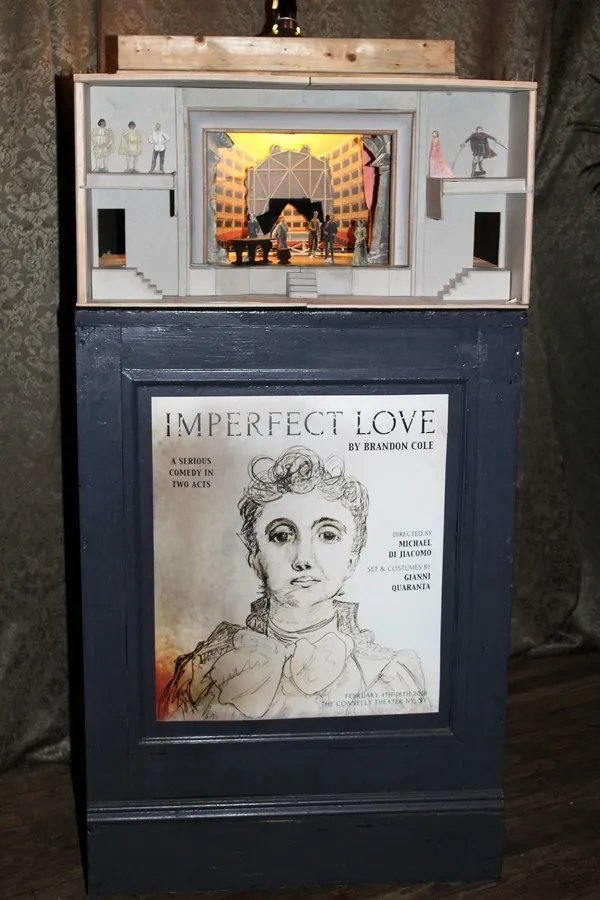
Scale three-dimensional model designed by Gianni Quaranta for the theatrical performance Impefect Love
Q: Eleonora Della Rosa and Gabriele Torrisi, the protagonists of your play, mirror without a doubt two famous Italians: the actress Eleonora Duse and the playwright Gabriele D’Annunzio. In your play your admiration for Duse is obvious and the fact that you have done a lot of research about her. Where did your interest come from for this great artist?
A: I knew nothing about Eleonora Duse not even her name although I had worked in the theater for five years. But in 1984 and by chance I read a paragraph, only a paragraph, by Pirandello in which he had expressed his total admiration for her. I immediately felt ignorant and wanted to learn more about this actress. Fortunately there was and there are today some fine biographies in English, one by William Weaver, perhaps the most famous, another by the American actress, Eve Le Gallienne, and recently another biography by Helen Sheehy.
The more I read about Duse, the more I wanted to read and so I began to learn everything I could about this extraordinary woman and about the times in which she had lived.
Concerning this period there are two pieces of film at the Museum of Modern Art here in New York, one with Duse and the other with Sara Bernhardt.
One can see immediately the difference in their methods.
Despite the fact that these film pieces are very short, I can say that Duse’s performance is vulnerable and modest while Bernhardt’s is physical, that is to say, flashy.
It is correct to say in my opinion, as many say, that Duse is the first modern actress.
I would like to add that it is not an exaggeration to say the Konstantin Stanislavski developed his theories about acting from the work of Duse. An extraordinary compliment, isn’t it?
Q: “Imperfect Love” takes place in Italy, at the Teatro Argentina in Rome. How did you come to this choice? Would you like your work to be staged in Italy, in this theater?
A: I will answer the last question first. Would I like to see “Imperfect Love” at the Teatro Argentina? Yes, very much! For me the Teatro Argentina is one of Duse’s theaters, and if I am not mistaken, it is the theatre where Duse performed many plays.
But beyond this history, the theater is a magnificent structure, as are others in Italy certainly, but here in the United States a theatre like the Argentina is a rare space.
I would call it an enchanting space where, for example, Gianni Quaranta’s set would work very well. Of this, and please excuse me because I don’t want to appear presumptuous, I am absolutely certain.
I think that I read about the Argentina when I was researching Duse and her period but I saw it for the first time when I was in Rome with Turturro and our friend Michael Badalucco.
Roberto Cicutto, who is now (or was) the director at Cinecittà I think, had brought us to Rome for the opening of our film “MAC”.
In those days Turturro and I were already discussing the screenplay for the film “Illuminata” and we wanted to see stages because much of that film takes place in a theater.
Another time, again with Cicutto, we looked at theaters in Rimini, in Umbria, and also in Sicily, but for me the Teatro Argentina is the one that stayed closest to me.
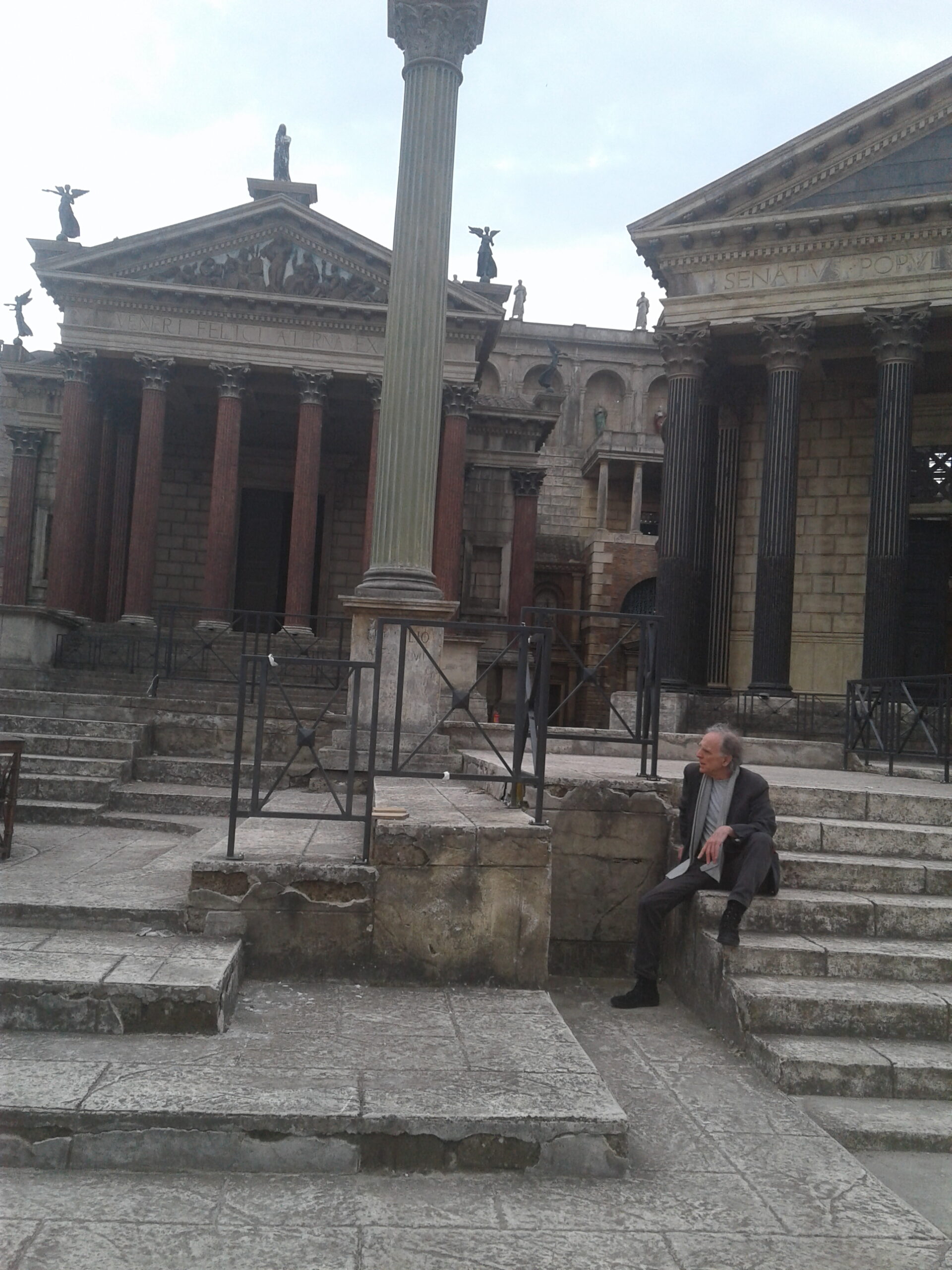
Rome, Brandon Cole in Cinecittà
Q: In your play one sees the protagonists involved in the end of an era, that is to say the beginning of modern theater and the popularity of Ibsen, and one sees also the conflict between two women of that period: Eleonora Duse and Sara Bernhardt. What were the difficulties in underlining such substantial differences in your play?
A: Yes, Ida, this is an important question, thanks for your interest.
I must say that I don’t like very much theater these days (sorry!) because I find the plays too often almost childish.
For me, Duse knew the difference between an important play and one of inferior quality and she believed it was her life’s work to promote writers and their works that spoke to the minds and hearts.
This is why she wanted to represent D’Annunzio’s plays but also, for example, Ibsen’s.
On the other hand, Bernhardt, and I don’t want to be crude but she was, if I may say so, a superficial person who loved an audience and wanted to please the public, almost as if she were a prostitute.
The difference between these two is one of the reasons in “Imperfect” Bernhardt is called a slut.
In any case the difference between these two actresses is absolute and I wanted to show clearly that history has chosen Duse as an artist and as a woman and as an individual to follow if not also to worship.
Q: Italian places, Italian historical figures…where did this evident love for our country come from. What do you like most particularly?
A: Well, Ida, Italy is my second home and sometimes my first.
My mother was Italian (although she was born in the United States) and my first trip to Europe was to Italy.
I can say that during that trip I felt at home, and for me during that period of my life, a feeling like that was extremely important.
What I liked then and I still like are the expressions of so many Italians, certainly not all but many.
I find in Italy very often that the words in conversation are joined clearly with the faces, above all in the eyes and the tones of the voices.
For me such communications are very important even when I buy a coffee or a bottle of milk.
Q: Do you intend to write something else again that has to do with Italy?
A: Always. I wrote a screenplay a few years ago that I would like to film in Italy as soon as possible.
It is called “The Lifeguard” (“Il Bagnino”) and it is the story of the reconciliation between a father and his son.
In 1997 there was a strike of the lifeguards, the beach workers, perhaps this is a memory that still lives in parts of Italy.
In any case, I came to Italy to meet the beach workers especially on the Amalfi coast from Vico Equense to Vietri sul Mare, but also in Naples.
For me this story is a celebration of Italian life where a young man, the son, still rather young, returns to Italy after years away to rediscover that this county is his true country.
Q: For the sets and costumes of your play, you chose the Oscar-winner Gianni Quaranta. We know that the critics in the United States praised the work of this Italian artist who had enchanted the audiences with the accuracy of his costumes and the surprising scenography through which he succeeded to make sure that the spectators had an image of the scenes in three hundred and sixty degrees, by showing in the first act “behind the scenes” and in the second “a scene within a scene” “…Expanding on the metaphor, there’s even a mini theater inside.”. (Alix Cohen) “Costumes, also by Gianni Quaranta couldn’t be better if executed on Broadway scale, representing period and character with taste, authenticity, and originality…“ (Alix Cohen). “Major kudos to Gianni Quaranta, whose sets and costume designs fill the theatre with great ideas and gorgeous execution.” (Bill Crouch). (just to quote some…)
What was the sensation that you felt in seeing for the first time on stage the enormous stone head with a big wide open mouth? Did you expect the audience’s reaction?
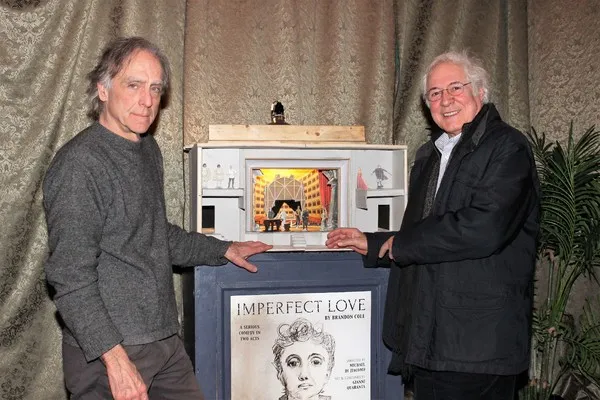
Brandon Cole and the scenographer Gianni Quaranta at the Connelly Theater with a three-dimensional scale model made for the theatrical representation of Impefect Love.
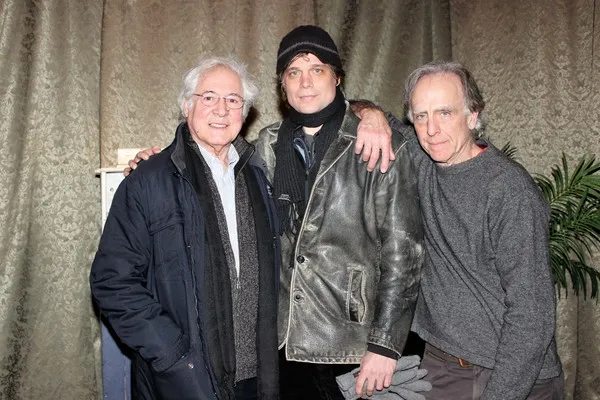
Imperfect love. Brandon Cole, the director Michael Di Jiacomo and the set designer – costume designer Gianni Quaranta (Connelly Theater – New York)
A: Gianni has been a dear friend for years and I always like his work.
We spoke about “Imperfect” for years, perhaps twenty years, so when I had finally found a producer for this production who had a bit of money I immediately contacted Gianni.
I sent him a revised version of the play together with my ideas for the set. Gianni threw everything away and designed a new approach and that is the set that we used.
This set was built in Rome and shipped to New York in a container. For me it was a bit of a fantastic approach but Gianni, as many know, is a master and everything went well.
Concerning my first reaction to the set, I liked very much the first drawings Gianni sent to me.
But certainly to see the design realized on the stage is a very different thing. I had never seen in my work a set so magnificent.
And the audiences were very impressed. More than once there was applause when the curtains opened for the second act.
And on Google photos, the monstrous, huge head created by Gianni has been viewed more than fifty thousand times. Fifty thousand? Yes. It is a set to dream about.
Q: How would you describe your feelings in seeing your works realized, especially what did you feel in staging your “Imperfect Love” after having dedicated to it so many years of study and commitment?
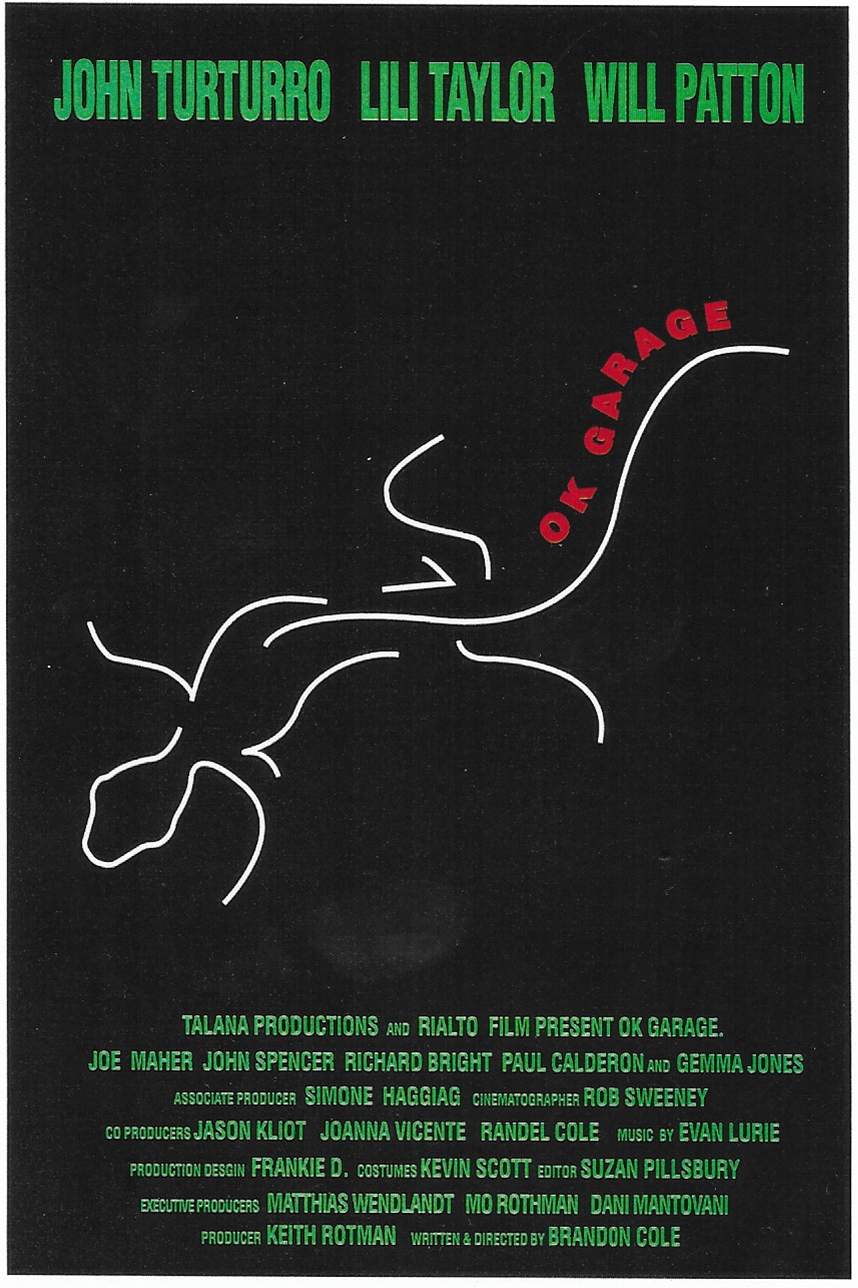
A: All intriguing questions, Ida, right? I must say that, for me, seeing one of my works, especially for the first time, is a moving experience. An important moment was when in Los Angeles, at the Film Festival, where, for the first time in the United States, I presented my film “OK Garage”, I had to say a few words of introduction: without knowing the reason, I felt that that audience would have positively accepted my film and only when I got back to my seat I realized I was crying. Nice, is not it? Sad and beautiful, I think… it’s true.
When in 2001, “Imperfect Love” was performed for the first time, my mother was in the theater. She was ninety years old. That day, I felt all her sincere admiration for my work, and not only for the dialogue but also for the staging and the actors. For many years my mother had worried that my life was “a mess” and she feared I might end up on the street, if not even in jail. After this presentation, I realized that she had calmed down. Perhaps there was still hope for me. Great, isn’t it?
But recently, in 2018, the last time my comedy “Imperfect Love” was staged, the experience was different. We had had financial support and I was working at a very high level with Oscar-winning production designer Gianni Quaranta and Michael Di Jiacomo, director. Also the actors were first-rate, all five. This production has repaid me for many years of work, canceling, as a miracle, every disappointment. For me it was a celebration!
Gianni gave me a gift I rarely received in the past, involving me in a true and intimate collaboration. I will thank him for the rest of my life.
Q: What are you working on these days?
A: As I wrote above I am developing my cop show “The Rootless”, that I wrote as a novel years ago but recently revised in collaboration with Turturro for a television series.
Q: What are your future projects? What would you like to do?
A: I would like first of all to bring “Imperfect” to Italy. Everything is prepared for an Italian production. But I need to find an Italian producer and/or a theater. I have a producer here in America but we need an Italian partner, you know.
Q: Besides the writing, do you have other interests? Do you do other things?
A: Yes, but like Mattia Pascal I am a bit of a bookworm, if I can make such a comparison without insulting the memory of Pirandello. I continue to study Italian and read books that interest me. Recently I read in Italian a book by Alberto Angela titled “A Day in Ancient Rome” that impressed me a lot. And since I worked in construction for years first as a carpenter and then as an electrician and I have the skills and the tools I am fixing up our house. A little.
Q: Will you be collaborating again with the actor, director, and screenwriter of Italian origin, John Turturro with whom you have collaborated over the years?
A: Yes, I have known Turturro since 1979 and we are great friends. We are always looking for a project to work on together.
Once in a while John will send me a book that he thinks might make a good film and generally I appreciate these books. Recently he suggested “Sabbath’s Theater” by Philip Roth because the people who control the rights to Roth’s books wanted John to do something with this one.
I found it amusing although it is a story of non-stop sex, and I’ll say candidly I did not understand why it merited this attention.
But if the project goes forward I am sure that we could work together on it well. I think it would be a good role for John, if not so good for the female characters.
Q: Do you think you’ll return soon to Italy? Is there a place in particular you prefer?
A: Ida, I always want to come to Italy. In each Italian city I like simply to walk the streets and find a café like a lazy bones. Rome is the city I know best but I want to return to Naples and visit the northern cities like Assisi and Spoleto. But I also want to take my wife to Sicily where she has never been. But patience. The next trip will certainly come and soon, I hope.
I thank Brandon Cole for his generous participation and I wish him the very best.
Thanks to you, Ida for your intelligent and elegant ways.
New York – Italy, 14 November 2021