by Ida Renzicchi (Translated by the author)

THE ART OF “IN-FORMING”
“To inform” has Latin linguistic and etymological origins, precisely from the verb informāre which is, in turn, a compound of the preposition in and of the verb formāre. Literally, it meant “to give shape (to something), to model according to a certain shape” and in translation “to form (the mind), to instruct, to educate”.
In his Divine Comedy, Canto XXIII of the Purgatory, Dante Alighieri describes the extreme thinness of the faces and bodies of the gluttonous’ souls whose skin adhered to the bones and took their shape using, at the time imperfect, the term inform in the literal meaning to “take shape”, nowadays obsolete.
The derivative of the verb, the word information, in Latin, had the meaning of idea, representation, later, education, till to assume the current meaning relating to the concept of news, including the system of production, dissemination and sale of the news itself.
Article 21, paragraph 1 of the Italian Constitution, protects the free expression of thought:
“Everyone has the right to freely express their thoughts by word, writing and any other means of dissemination”.
Italy, unlike many other democratic states where anyone is free to practice as a journalist, allows only those who are registered in the appropriate professional register to do so.
It follows that of significant importance is the activity of the journalist, a professional of the information, who, in order to carry out his work, must discover, choose, analyze, communicate the news.
It is not easy to win the favor of the public, especially when it comes to a heterogeneous and physically distant audience of users, ready to change the television programme, in the case of viewers, or to be distracted or enticed by something else.
“…Nelli occhi era ciascuna scura e cava,
Pallida ne la faccia, e tanto scema,
Che dall’ ossa la pelle s’ informava…”
Canto XXIII of Purgatory
.

Luca Signorelli, Portrait of Dante (Chapel of San Brizio- Orvieto)
``... quo etiam gravius judicium in dicendo subimus...``: “... every time we present ourselves to speak in public, we expose ourselves to being judged ...'' (Marco Tullio Cicerone, De oratore).
According to Cicero, there is nothing more noble than having the ability to capture people’s attention with words: the communicator must be an intelligent person, endowed with natural virtues and experience, he must not aim to be a wise man among fools because, in this way, those who listen to him would consider him a pedantic or, while admiring his intellectual gifts and wisdom, would get irritated of passing for ignorant.
Not communicating is practically impossible. As claimed by Paul Watzlawick, Austrian naturalized American psychologist and philosopher, famous scholar of the school of Palo Alto, California, seat of the Mental Research Institute, silence, looks, attitudes or certain expressions and positions of the face are aspects that speak for us and manifest our way of being, the universe of our moods, the darkness of our fears.
In informing, the behaviors with which one communicates, not through the voice but through his body, are important: proxemics, i.e. postures, distance, movements of the head or hands and so on, are all integral part of disclosure signals.
Since what matters is quality, in communicating it is essential to provide information, while, at the same time, but in a hidden way, it is important to win the favor of the interlocutors and excite them. A good communicator must have acumen, technical competence and will and must make use of a repertoire of ideas to draw upon in the knowledge of the customs, models, values and environment of the context to which he refers.
Whoever communicates should pay particular attention to the fact that the listener is convinced by his theses, takes delight and is emotionally involved in them.
Press, publishing, radio, television, computers and mobile phones are powerful means of communication capable of directing the consent of citizens through the control of information. From this it follows that, in order to safeguard democracy, information must be free, clear, pluralistic, diversified and accessible to everybody.
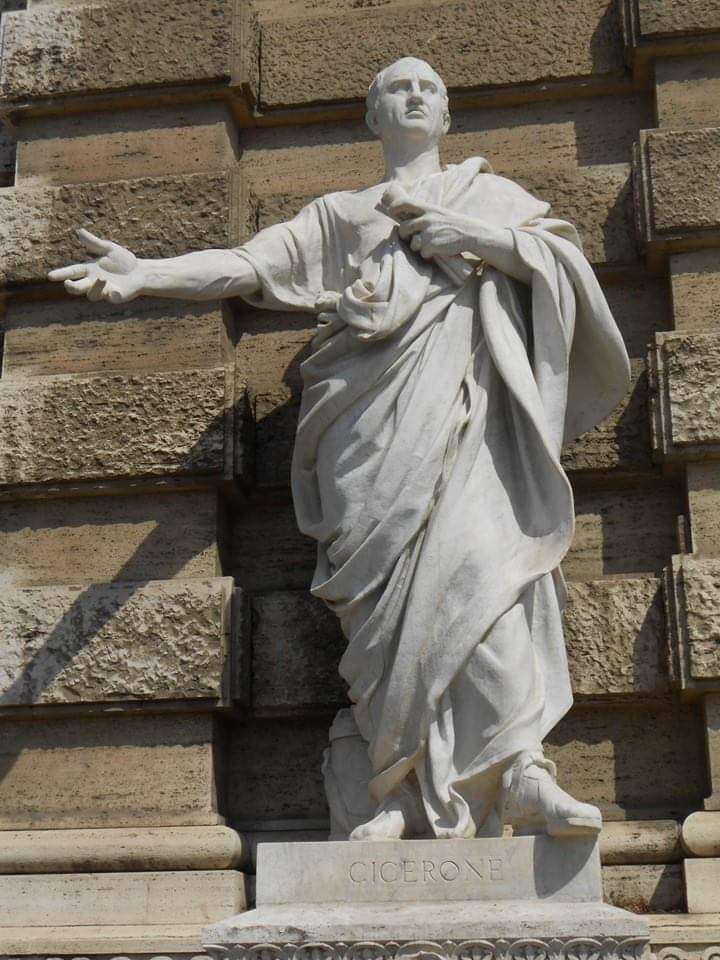
Statue of Cicero from the facade of the Palace of Justice in Rome
In the art of Informing, communication must arouse feelings while the informant, that is, the journalist, should always remain strictly impartial so that the user of the news is given the full faculty of his own personal opinion.
If, according to the Greek etymology, the word Art means technique, craft, also informing through communication is a form of Art as it requires competence and preparation and, since knowledge is transmitted through it, one must never ignore from correctness and style.

ln the ART OF INFORMING, the unmistakable, kind and refined style of the journalist, politician and writer Jas Gawronski, whom Ida Renzicchi had the honor and pleasure of meeting in a telephone interview, should be taken as a model.
Our collaborator willingly shares with the web-users of Geapolis the experience which resulted in a conversation that reflects the inimitable class of the personage who, with great generosity, defined our column interesting. (read more click here)