.
IDA’S STORIES. VIRTUAL READING CIRCLE
.

.
IDA’S STORIES. VIRTUAL READING CIRCLE
.

SEBASTIAN… the jus exilii by Ida Renzicchi (Written and translated from Italian by the author)
All rights are reserved to the author. Reproduction and any other use, even partial, not authorized by the author is prohibited. The publication of the text is permitted for non-profit educational and cultural purposes with the permission of the author. For any contacts with the author: idarenzicchi@katamail.com or: idarenzicchi@gmail.com
ASCOLTA il racconto su file audio o su Youtube.
Voce narrante Giuliana Poleggi Quaranta
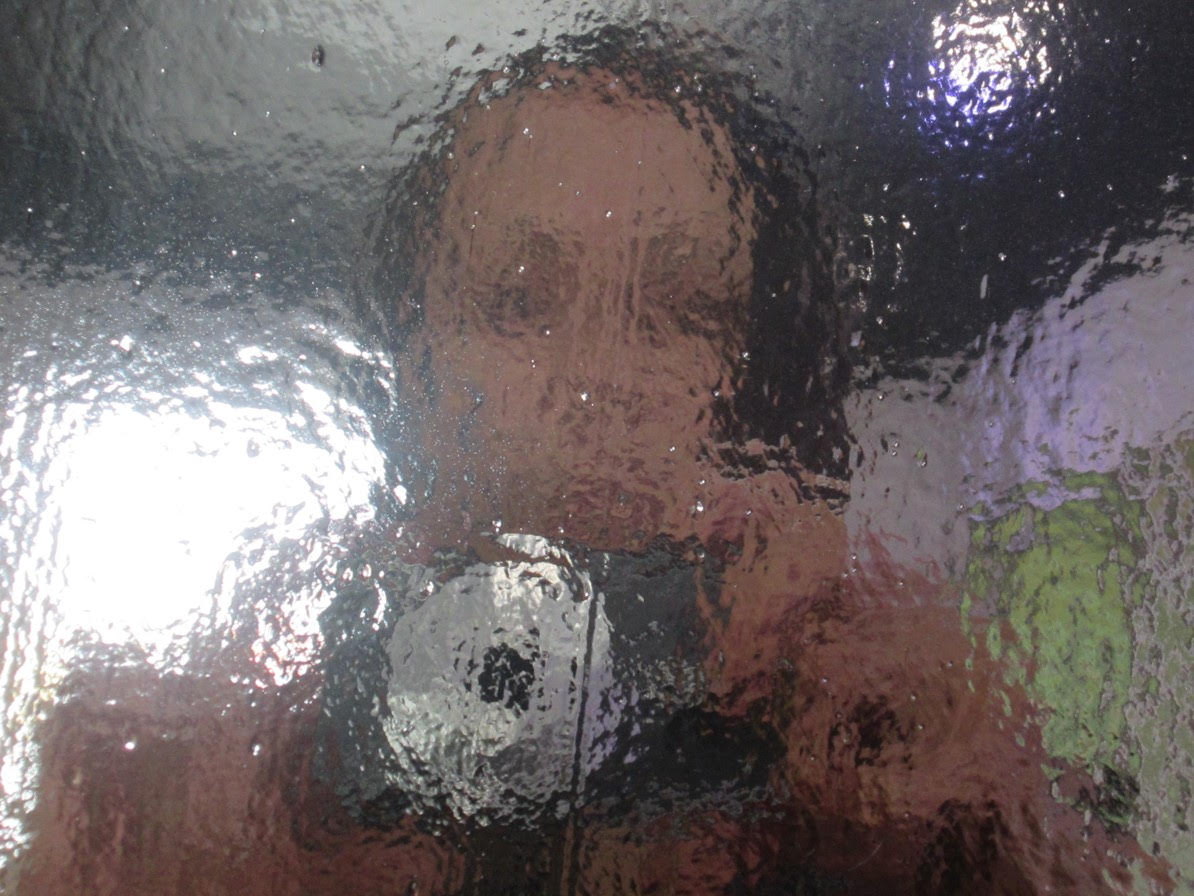
Regina Kirillov, Afraid to show the face
I get out of the taxi with the key already in my hand.
The driver, who hasn’t even turned off the engine, immediately sets off leaving me, with my luggage on the ground, in front of the iron gate that gives access to my house.
There isn’t a living soul around.
On the surface, it seems that there is never anyone in this desert area where, in the summer, the scorching heat takes your breath away. Yet the entire territory is dotted with luxurious villas inhabited by established artists who have chosen to live in this strange arid place. The mastery of famous architects in building these houses making them part of the surrounding environment, has made this surreal place famous all over the world.
Silence reigns almost absolute. The only noise is the creak: that of the wheels of the trolley that I’m dragging up to the door of the house, and that of the screeching metal on the rusty hinges. The strong thermal shock, between the burning days and the nights, where the temperatures drop significantly, causes the humidity of the early morning hours to facilitate the formation of rust on all the iron parts due to the effect of that dew, at the same time precious, to allow the survival of the characteristic desert plants that name the locality where I live.
The mailbox is crammed with correspondence. I open the heavy front door and, immediately, a beam of light illuminates the whole room. On the floor, just on the right, a pile of envelopes that had come out of the lower internal part of the mailbox which must certainly have broken under the pressure exerted by the postman to forcefully insert all that paper.
I open the windows and shutters of the large French window that overlooks the rear garden and close the door of the house. I look around. Everything has remained unchanged, still and silent.
I free my shoulders from the weight of the backpack which I make room for on the cushions of a small bench. I straighten up on my sore back placing my hands on the back of my hips and breathe deeply… then I start to reactivate all the utilities: I turn the water knob, the gas knob and lift the main electricity switch. I open the kitchen faucet from which, noisily, as if it were struggling to get out of the pipes, a stream of brown water gushes out. I let it flow until it is clear and limpid, then I drink a glass in one gulp and, with my wet hands, I refresh my temples, the nape of my neck and the lobes of my ears.
I drag my bags and place them in a corner of the bedroom. I’m too tired, I have absolutely no desire to unpack… I will, of course I will… but not now… not today.
My home! Our house! It looks bigger to me! Everything looks clean and tidy. Someone, perhaps the same company in charge of cleaning, has placed an air freshener on the table: a beautiful transparent glass vase from which a dozen incense sticks sprout. The air is saturated with the penetrating perfume, but despite the fragrance and the time that has passed I can perceive the smell of disinfectant and bleach used to wash the floors and all the rest.
I look around and observe the walls covered with paintings. Each of them the memory of a journey, an exhibition, a new artist we met. Everything, every smallest object has its own story.
Each person’s passage on earth is a unique and unrepeatable event… but when I think of our life I tell myself that there really can’t be many people who have lived a singular existence like ours.
We came into the world at a time when, in the country where we were born, under a totalitarian and despotic regime, it was easy to vanish into thin air. Friends, relatives, acquaintances, neighbors who, overnight, you no longer saw, as if they had never existed. Ordinary people forcibly taken, usually at night, from their homes and taken to prisons or labor camps in the northernmost, cold and uninhabited areas of the country, from where, no one that I had known, had ever returned.
I, already physically fragile due to the difficult living conditions, and continually anxious that one of us could disappear like this, was always in pain. I feared for my mother, for her partner, for my relatives, my friends … for everyone …
Ever since, hidden in the darkness, behind the small window of my bedroom, I had witnessed by chance the removal of our neighbor, as if I had an alarm clock in my brain, I woke up every night at the same time, and spent hours and hours in the dark, in front of the windows, waiting for the first light of dawn when I heard my mother enter the kitchen and prepare something to eat for breakfast before going to work. So, I joined her and started a new day.
That night, in the dim light of a street lamp, I had seen six men in dark suits enter the back entrance of the house opposite ours and leave after half an hour literally dragging this forty-five years man, tall over six feet, strong and sturdy, reduced to an inanimate rag puppet. All in absolute silence: not a cry, not a word, not the slightest noise.
The following morning, I had not even had time to mention what had happened when my mother’s companion, sitting down to breakfast with a small cup of tea and a slice of bread and butter, had jumped up and, pretending to avoid something that was spilling onto the table, from behind my shoulders, had immediately pressed his hand to my face, also covering my nose with the risk of suffocating me, while my mother, seated, approaching me so much that she could be covered by the silhouette of her partner, with her eyes wide open and her index finger in front of her closed mouth, she motioned for me to shut up. They had seen too. “Thank goodness you haven’t stained your pants… the others aren’t dry yet…”. She had said while he pretended to check that he hadn’t gotten dirty.
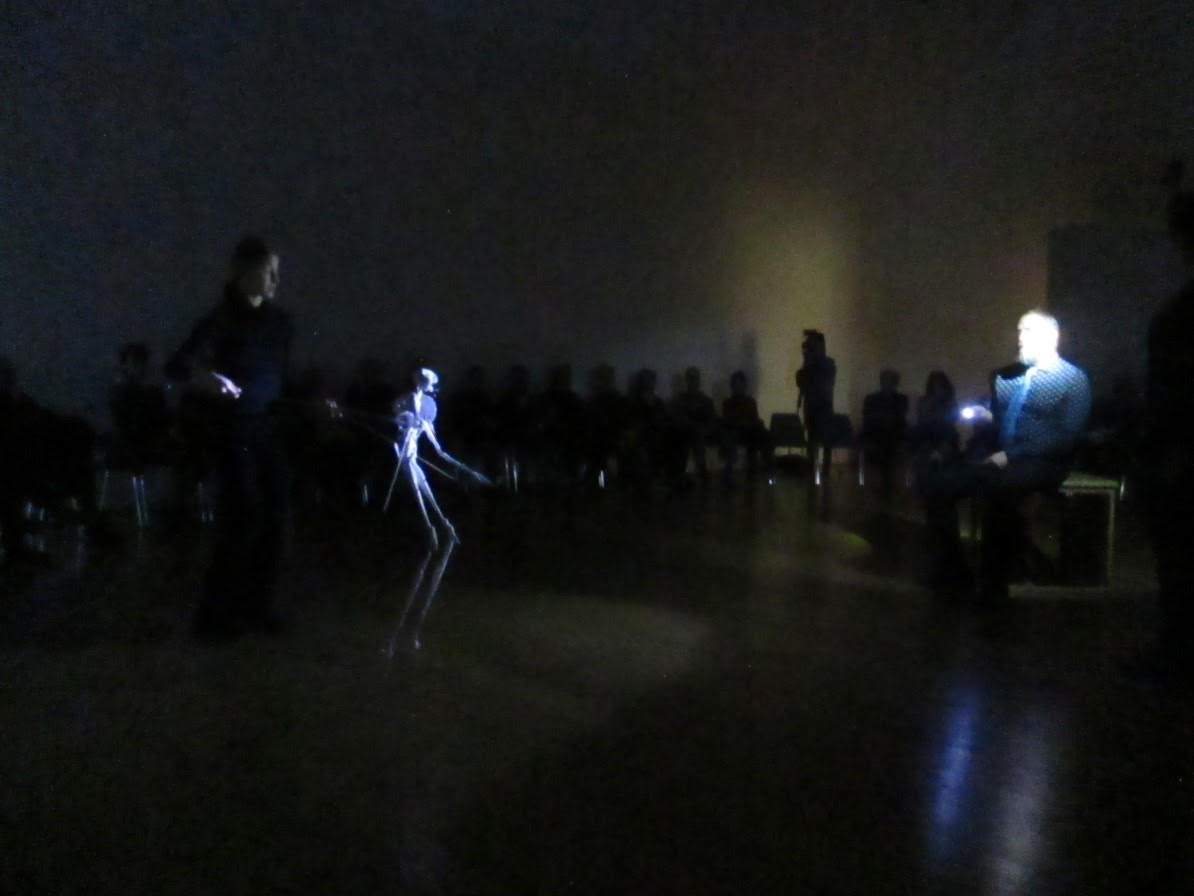
Regina Kirillov, Puppets in the dark
We were spied on. We shouldn’t have forgotten that! Always and constantly supervised. There were hidden microphones and cameras in the houses, we all knew it but no one would have dared to remove them or tell others about them. Every now and then, without anyone having indicated the existence of a problem, someone who claimed to be a gas, electricity or water system technician showed up at the house. The times were always different, sometimes, really absurd. We all knew that these sudden inspections had nothing to do with domestic utilities but that their task was only to check the efficiency of the surveillance system and verify that nothing had been removed or tampered with. Even an insignificant change in the environment or a minimal change in daily life were suspect and were immediately detected.
Shortly before, after having studied the position from which it would have been more difficult to film us and having discussed it in an open park, my mother and her partner had moved the kitchen table from the center of the room, positioning it against a wall. The morning of the following day, the worker, who declared he had come to detect a leak… non-existent… had carefully observed the new arrangement. It was one never seen before. “You have changed the arrangement of the furniture, madam.” His was not a question. “Changed? No, we haven’t changed the furniture… and who can afford it… maybe!… it’s still the same…” My mother had pretended to have understood quite the opposite. The man had remained silent and she, continuing her fiction, had added: “We just moved the table against the wall… this way I have more space both in front of the stove and the sink and it’s also easier for me to clean the floor. The room looks bigger, doesn’t it?” Again the man had said nothing, he had only jotted down something in a notebook.
A few days later, fortunately after the episode that happened at breakfast, another technician had come to fix something concerning the electrical system, at least that was what the man had told my mother when she had the door for him. By now many of these “workers”, who were nothing more than controllers and technicians of surveillance systems, did not even bother to make excuses or give explanations. The occupants, of the houses where they presented themselves, had the obligation to let them enter and, by law, they were allowed to remain inside the houses and finish the task for which they had come undisturbed, even when the tenants of the same were forced to leave to go to work.
I would have kept the habit of always being cautious for a long time, of speaking in a whisper and, in the case of confidential things, of doing it only outdoors… even when I was now living in a completely different situation.

Regina Kirillov, Who Cut Your Wings
“Excuse me.” My mother’s boyfriend had told me as we were leaving the house. His voice, already low, muffled and made almost incomprehensible by the scarf pulled over his mouth and his head bowed as he walked straight without turning towards me. “You were about to get us into a big mess… you have to think about it… al-ways.” To underline its importance, he had spelled out the two syllables of the last word well. I hadn’t turned to him either, I knew I couldn’t do it, they shouldn’t believe we were waiting to go outside to talk. Cameras and microphones could be everywhere. I kept walking without looking up from the ground, to the bus stop and, as he turned right, I waved at him, as I did every morning.
My mother taught at the University. She adored her job as a teacher even if she was obviously limited by government programs which did not include personal initiatives of any kind, let alone the expression of judgments or opinions.
For me, a Literature student, she had strongly wanted access to the study of the English language, privilege reserved for very few students, and she had obtained it with difficulty and only thanks to her close friendship with an influential official of the regime who, in turn, had had to justify this request by declaring the student’s desire to study international Literature in order to later be able to translate and disseminate our great authors in other languages.
In reality, my mother only wanted me to be free and, like a spider spinning its web, she stubbornly organized and prepared me for such an eventuality!
It was precisely the University environment, indeed the classroom where the exclusive English course was held, the place where I had met him. What had struck me about a thin, lanky, average-height boy? What made me madly fall in love with Sebastian was his brain: I had never met such a calm, reserved and serious person, but above all so intelligent.
Séba, as his friends called him, although three years younger than me, had recently graduated in Physics with honors and was considered by all to be a genius. Award-winning for his exceptional results, although the University had already offered him a professorship, he certainly would not have become a teacher because the Government, in constant competition with the equivalent program of another nation, was counting a lot on his inclusion in the National Space Project which financed without limitation of funds.
I too had recently graduated in Literature discussing my thesis on the great writers of our country and had obtained a medal of merit. This recognition was highly coveted because in the future, with the same educational qualification, it would have meant a more prestigious job.
Recently married to a same age high school mate, I was immediately aware of the fact that it wasn’t my husband I was going to live my life with but the young English student.
There were very few of us who attended those lessons: apart from the two of us, five other boys were part of the small group: three sons of prominent members of the government and two belonging to wealthy families also linked to the party. I was the only woman admitted.
I must say that I liked English very much. And perhaps the reason was precisely the possibility of meeting him.
When I got married, I had gone to live at my husband’s mother’s house. There were seven of us in a miserable and cramped house where the normal epilogue of anything was continuous discussions, with everyone. The food was scarce, no privacy… and my husband pretending to make me believe he had taken me who knows where… as if I weren’t intelligent enough to realize that, if it wasn’t good at my mother’s house, it was certainly worse there. Even though we all lived a life made up of renunciations to which we were by now so accustomed that we didn’t even realize that there could have been a different existence, that situation literally suffocated me. It was as if within those four walls, in addition to everything else, I also lacked air.
ASCOLTA il racconto su file audio o su Youtube.
Voce narrante Giuliana Poleggi Quaranta
click icons