.
IDA’S STORIES. VIRTUAL READING CIRCLE
.

.
IDA’S STORIES. VIRTUAL READING CIRCLE
.

All rights are reserved to the author. Reproduction and any other use, even partial, not authorized by the author is prohibited. The publication of the text is permitted for non-profit educational and cultural purposes with the permission of the author. For any contacts with the author: idarenzicchi@katamail.com or: idarenzicchi@gmail.com
ASCOLTA il racconto su file audio o su Youtube.
Voce narrante Giuliana Poleggi Quaranta
I thanked my mother a thousand times and her stubbornness in demanding that I study English. It wasn’t Italy. But we had been welcomed.
A new life!
We were registered at the immigration office but the problem arose when it came to inserting our educational qualifications. In order to prevent us from returning home, the government had indeed allowed us to leave but had not allowed us to leave the country with the documents of our university degrees in our pockets. A perverse and subtle blackmail, of which we were aware, but which we had suffered in the awareness that contesting the abuse, as well as precluding us the possibility of leaving, would have meant opposing the regime and the serious consequences that could have ensued.
“Gentlemen, we take your word for it, but our system requires a certification that certifies your assertions. For now and until we find a solution, you will be employed in community service work so that you can fend for yourself.”
The official in charge, a man in his sixties with longsighted glasses worn on the tip of his nose, after having scrupulously checked the documents, looking over the lenses at us, after having expressed his regret, gave us the task of cleaning the park which surrounded the university campus.
We started at the first light of dawn by sweeping the paths, cleaning the fountains, collecting paper and rubbish of all kinds and we continued taking care of the flower beds, flowers, grass and trees. All in all, we liked that work in the open air.
In the hours that remained at our disposal, since no one controlled the entrance, mixed with the students, we infiltrated the classrooms to listen to all the lessons we could attend. We were sponges, ready to absorb everything.
Thus it was that Sebastian obtained his degree in Literature and the assignment of a professorship at the same University. I too graduated with no effort discussing the same thesis on the authors already presented at home and was hired as a librarian in the same University.
We were forced to face many difficulties: being foreigners exposed us to prejudices and the condition of political refugees, as well as envy for the small privileges that were granted to us, was also the cause of resentment on the part of those who saw us usurping a job that, they believed, perhaps, in our absence, would have been theirs.
Even as simple cleaners of the University park we had received threats, insults and provocations not to mention the eloquent glances and malicious jokes when, once we obtained the degrees in that country, we were offered better positions, appropriate to our qualifications. In silence, aware that we were foreigners in a foreign land and that the hostility between our homeland and the country that hosted us was a further cause of hatred and distrust towards us, we had chosen to remain silent while remaining humble. Despite the low profile we had decided to maintain, we were constantly under observation: where we lived, what we did, who we frequented, how much we earned and how we spent our money… Even our clothing was under scrutiny.
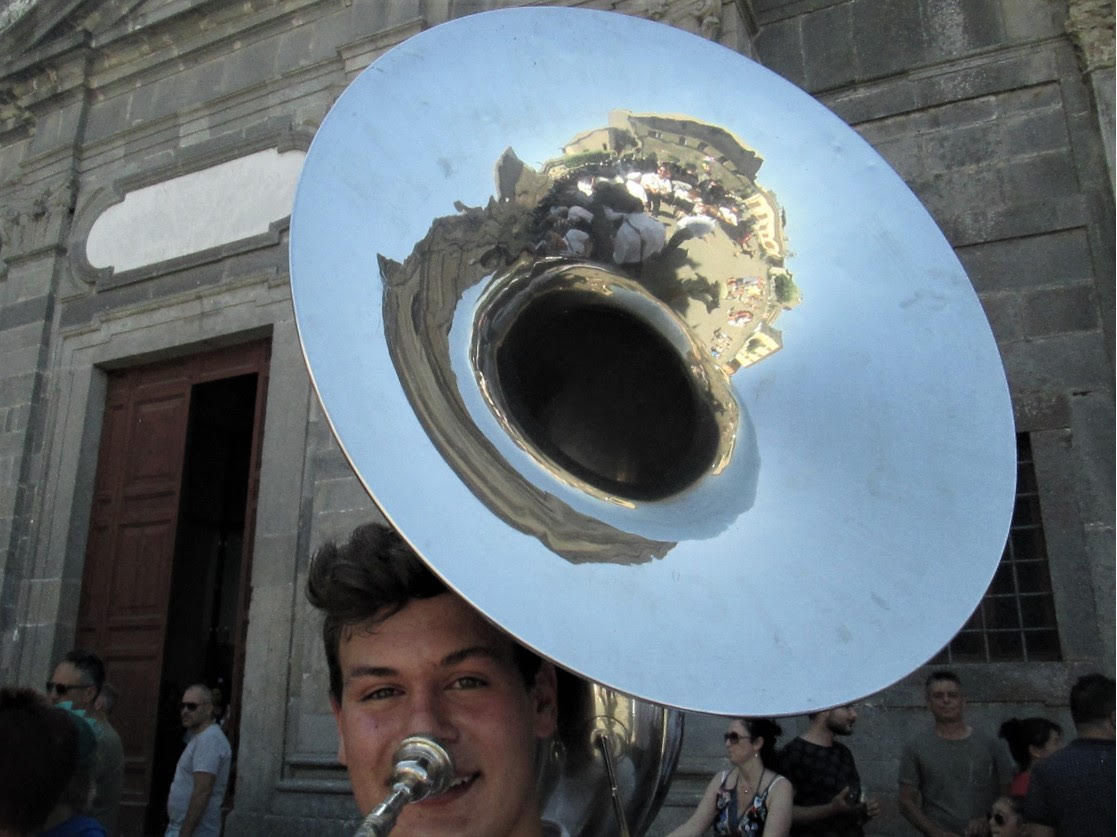
Regina Kirillov, Happy and Merry
Our situation, over time, had in any case stabilized and, apart from a few small slights, the position we occupied in the university environment had no longer been questioned also because, in the meantime, there had been a turnover of teachers and administrative staff and, to newcomers who had found a state of affairs, cared much less about us.
When, a few years later, we gathered at a luncheon reserved for all teachers, our status as political refugees, of which many of those present were clearly aware, became a topic of conversation and we were the subject of questions. It was on that occasion that we expressed our regret for not having been able to demonstrate the qualifications obtained at home. “But are you sure you have nothing at all to testify to?” A young engineer had asked us. “No, unfortunately, no. By now we don’t even need it anymore… even if we’re sorry… it’s a part of our life…”.
In the meantime it had gotten late and the Rector, about to leave the room, after putting on his coat, seemed to be looking for something: “Has anyone seen my hat?”
“THE HAT! MY HAT!” All those present had turned towards me, especially the Headmaster who, having put on his hat found in the meantime under a lady’s scarf, looked at me astonished, almost embarrassed, while he took it off again to make sure he hadn’t wrong and that that one was really his.
“THE MEDALS!” When I finally calmed down, I was able to explain to the amazed bystanders the story of the medals that, the day before my departure, I had sewn one by one, forming many small hidden pockets in the fur lining of my hat, then paying the utmost attention to wear it well up to my eyes, and never to take it off before we managed to expatriate. It was winter and it was very cold: everyone was muffled up and wearing heavy winter clothes and perhaps that was the reason why I, with my fur collar turned up, woolen gloves and hat on my head, had not been noticed… or perhaps it had been the carelessness of the control officer, certainly less diligent and luckily distracted right at that moment by the arrival of a nice cup of steaming black tea accompanied by two thin slices of buttered dark bread.
They were the Institutes’ medals of merit, with our names and dates engraved, received first during high school and then during University for the brilliant scholastic results obtained. Valuable things? Depends. No economic value but, for us, precious objects that would have been the only link with our motherland that we were abandoning forever. I had hidden them on me only because I didn’t want others to touch them or for someone to unduly appropriate them…without knowing that, after so many vicissitudes, they would have been our qualification, the passport with which my husband, as a brilliant scientist, with a degree in Physics, would have been part of the National Agency for Space and Aeronautical Activities and I, hired as a librarian, would have been offered a chair of Literature at the University of the same city to which he would have moved for the new prestigious assignment.
Then that cold, silent and terrible hostility between our nation and our host nation was over.
Somehow we learned that my mother, miraculously returned home after seven years from the confinement to which she had been sentenced to life, perhaps because of her unjustly suffered suffering, she had died. The night that followed our departure, she too had vanished into thin air only to reappear years later, like she had resurrected, and die a few days after being freed. The same thing had happened to the government official who, risking his own life, had generously helped her. Nothing more had been heard of him after he had been taken from the residence in the known manner during the night because, it was said, of two students recommended by him, who had expatriated for study purposes and had never returned. It was said that he too was dead. It had been the denunciation of one of his superiors, the bureaucrat who had come in person to deliver us the documents, to sentence him and my mother to death: annoyed by her refusal to give him his daughter as well, the man had denounced my mother immediately after she, suspecting his move, and fearing that at the last minute our permit to expatriate might be withdrawn, she hastened to anticipate our departure before the established date. Despite knowing very well the outcome that his cowardly gesture would have had, without any scruple, the man had also involved in his wicked report to the secret services the official with whom, in front of us, he had declared himself being a friend…
Sebastian’s sister, unjustly accused of being hostile to authority and believed likely complicit in her brother’s decision not to return to his homeland, was also dead. She was engaged to a government official, with whom she had moved in, after our departure, she had effectively been promoted to manager in charge of the research unit in the pharmaceutical industry where she worked. However, a few years later, when their union fell apart, the man, whose political position at that time had become dangerously shaky, certainly out of revenge, and perhaps in the hope of thus being able to regain credibility within the party, he had cowardly denounced her to possess copies of some books banned by the regime*, volumes which he himself, some time before, fortified by the immunity deriving from his political position at the time, which had saved him from the usual controls upon returning home, had obtained by buying them during a trip abroad. Obviously the girl had declared her “innocence” to everyone, but the fact, amply emphasized by her ex-partner, that she was the sister of the one who had betrayed his homeland by asking for political asylum abroad, had played a dominant role in that game whose stakes were very high: live or die. Passed off as insane, she was locked up in an asylum, where she died.
My mother’s partner was the only survivor: after returning and finding the house empty, after only one week, he had been transferred, again and permanently, to the most remote location of his company.
Sebastian and I, who had made use of the jus exilii *, never returned to our homeland. Even when our “voluntary” confinement could have been said to be over, we no longer had the strength to reset our lives again: the events that had occurred had also changed the landscape of our souls.
Like others, unaware, we had imposed on ourselves, after millennia of history, the same condemnation in force in ancient Rome, because time passes but certain situations keep recurring.
Every now and then someone asks us if we have ever felt homesick. We never answered this question…
We missed it all! Our homes, our loved ones… not having been able to defend them… not even being able to greet them as we would have liked… not having buried them… We missed the homeland we loved… not the power that governed it, but its beauty, the traditions, culture, religion… that land which, despite everything, we felt ours, but which we would never see again… We had swore it.
I remember my mother who, before my departure, hugged me and kissed me while whispering in my ear: “Don’t come back! Whatever happens, don’t come back! Swear to me that you won’t go back…”, she hurriedly pushed me out of the door where, before I crossed the threshold of the house forever, she had pronounced, loudly, so as to be heard by those who were surely listening to us: “Don’t forget my love … have a good trip… behave well… and study eh… I’ll wait for you… see you soon!”. I had replied: “Yes, yes!” Yes to what? That I would never come back or that I would have sense, that I would have studied… that I would have had a good trip? I didn’t know either. My heart and brain were in turmoil. All that pretending to be a normal situation, when nothing was normal at all…
I think back to Sebastian’s sister who had hastened to pack his bags and, reluctantly, because she would have gladly come with us, but aware that she would never have been allowed and that she would never see her brother again, making herself strong, she had wished us, also she loudly and for the same reason: “Have a good trip!… come back soon… Séba, please, bring me a little present from Italy… don’t forget!” That shrill tone of voice was not hers… nor that superficial way of saying goodbye… All of us had held back the tears, the words and the gestures that this circumstance would have required by pretending to say goodbye for a brief departure, which would not have been such. I said yes to her too. Even Sebastian had said that obligatory yes.

Regina Kirillov, We Remember Our Loved Ones
Over time, accustomed to the distance, we had been assimilated, absorbed by that new and so different society. It had been forced. What else could we have done? Someone told us we didn’t look happy. It was true. And how could we have been? If, on the one hand, economic well-being, our new social position, not having to undertake a battle for survival every day, but above all feeling free, had played an important role in our integration, on the other, they were precisely those differences with the situation we had left behind to never leave our minds: the thought that all this was denied to our relatives, our friends, our compatriots, combined with the well-founded fear that we would never see them again.
And it was the lack of information that further lacerated our souls. Not a letter, a phone call… nothing at all… to fulfill the oath I swore to my mother who, in the constant fear that somehow we could be traced, had expressly asked us and made us promise never to reveal to anyone, or under any circumstances way, our presence.
When, after restless years and years… waiting to know… we were told the fate of our loved ones, the knowledge of having lost our loved ones forever and the news of the events that my mother and my sister-in-law had been forced to experience before to die, they tore our souls and our hearts…
But now at least we knew, we were aware… now we would no longer hold our breath in the hope of who knows what and, over time, the pain would have somehow, sooner or later, asphalted its spires made sharp by anguish and would have filled the precipices of despair flattening that suffering that was now a component element of our lives. Over time…maybe…
Forgetting would not have been possible, just as it would have been difficult to loosen that oppressive sense of insecurity which, despite everything, gripped us: we have never been able to feel completely at home again.
Over the years, surrounded by the esteem of those who knew us and also thanks to the economic well-being achieved with our work, we now felt that we had been fully accepted by that world that had welcomed us and of which we felt part, however, that subtle feeling of precariousness would never have left us: as if, at any moment, something or someone could come to subvert the order of things and we could lose what we had sacrificed everything for.
That afternoon, after lunch, as soon as politeness had allowed us, we got up and hurriedly said goodbye to our colleagues and ran home. Like two thieves we had thrown away and rummaged frantically everywhere in search of the “precious” hat which, we caught up in the many tasks and various transfers, had ended up neglected in a chest found in the modest furnished apartment we rented.
With our hearts pounding and full of pride, prompt, we had immediately taken them, still sewn in the fur lining, to the official who, having finished his working hours, was preparing to leave the office. We weren’t sure they would be enough to back up our claims, but they were a tangible sign of truthfulness nonetheless.
We had recognized him immediately: he was the same one we had talked to years before, but older, thin and hunched over, certainly close to retirement. The man who walked with small steps, as old people do for fear of stumbling, at first did not understand, but, after looking at us carefully and listening to our excited sentences, he told us to remember us.
Incredulous and moved, the clerk retraced his steps, helped us to free them, took note of them, photographed them front to back, one by one, and recorded our statement finally endorsed by their silent testimony.
Sitting on the sofa, I lean forward, observing them. As if they too are waiting for my return, they are here, on display under the glass top of the showcase table where we had carefully placed them when, after the years, once we retired, we finally managed to buy our house in the desert.
We had no children. We didn’t even look for them. Desired, yes… but, without even telling us clearly, in a tacit agreement, suffocated by the uncertainty of our suspended lives, we had also given up that joy.
Friends, yes. Especially in Italy. We have always felt that people akin to our culture and our feelings. Even in that nation, which has always remained in our hearts, we had bought a house where we went every year during the summer.
This year I went there alone, not the usual abundant four months during which we filled our eyes and minds getting drunk with Beauty, Art and Culture, but two scarce months, spent quickly and dedicated, for most of the time, to take care of very boring and complicated paperwork. Alone… I’ll have to get used to it…
The return journey was long… and I am old.
I straighten up, leaning back on the sofa. I close my eyes. So many memories… a thousand thoughts… and… that barely perceptible smell of bleach in the air.
*”COURSES AND RECOURSES”
In May 2022, once again in history, a nation placed on the index, banning their printing and withdrawing them from sale, comprising online sales, some literary works including two dystopian novels: the famous masterpiece “1984” by the British writer George Orwell and Olgerd Bakharevich’s “Dogs of Europe”.
For people who have already lived the experience of repression and intellectual censorship, the news brings to mind excruciating memories of a period believed to have passed, when the lack of freedom caused death and despair: then, under the aegis of rights and equality, a regime, after having subverted the previous power considered liberticidal, had ended up in the complete negation of those same ideals of which it had proclaimed itself a champion.
Preventing knowledge is a serious crime, detrimental to the freedoms of others.
(Ida Renzicchi)
ASCOLTA il racconto su file audio o su Youtube.
Voce narrante Giuliana Poleggi Quaranta
Video work in progress