by Ida Renzicchi

PHOTOGRAPHY, EIGHTH ART


Photography, fully considered Eighth Art, is an image production technique: a set of Art and Technology since, in parallel with creative genius, it requires technical instrumentation.
The term photography which derives from the union of two words of Greek origin: light (φçῶς, phṑs) and handwriting (γραφή, graphḕ), can be correctly translated into “writing of light”: in fact, a photo is an image created by light falling on a photosensitive surface, usually photographic film or an electronic sensor.
Already thirteen years before the official birth date of photography, Joseph Nicéphore Niépce had made his heliography on a tin plate and in an earlier period he had fixed images on Judean bitumen (a type of asphalt).
In 1829 Niépce began collaborating with Louis Daguerre and Augustin François Lemaître, photographers who became collaborators with him. Unfortunately Niépce died four years after their partnership and Daguerre continued the improvement of the technique alone, which was then officially presented, on Monday 19 August 1839, at the Academy of Sciences and Arts in Paris. Daguerre is therefore considered by most to be the father of photography or rather of the daguerreotype, which took its name from him, a procedure which involved fixing images on metal plates (daguerreotypes), usually in copper.
However, already during that period, in England, William Henry Fox Talbot was making photos on paper, called calotypes or talbotypes, much closer to contemporary photos, before the era of digital images.
In the same years, other inventors experimented with various approaches to photography. Evidently in the mid-nineteenth century the time was mature for this invention, even if more time was required to perfect both the instrumentation and the technique and a long period still passed before it could become accessible to all the people.
Since, by irrefutably witnessing a moment, it crystallizes it by accurately capturing all its framed details, photography can be defined as a document in all senses and as such it is still considered even in the juridical/legal field.
The episode, which took place in 1872, which marked the birth of the invention of movement, is sensational, a crucial turning point, fundamental for the evolution of photographic technique which also influenced painting and sculpture, to the point of anticipating the birth of Cinema.
The British photographer Eadweard Muybridge, prompted by the governor of California, who had bet with some wealthy friends that the horse would remain totally suspended at a time other than that of maximum extension, studied how to look for irrefutable proof of the true dynamics of a running horse for verify if in the gallop, all four legs of the horse were raised off the ground at the same time, as was the common belief and as portrayed by the paintings of the time. Thanks to the use of twenty-four cameras, connected to as many wires along the way, Muybridge obtained a sequence of images that documented the movement of the horse with absolute precision.
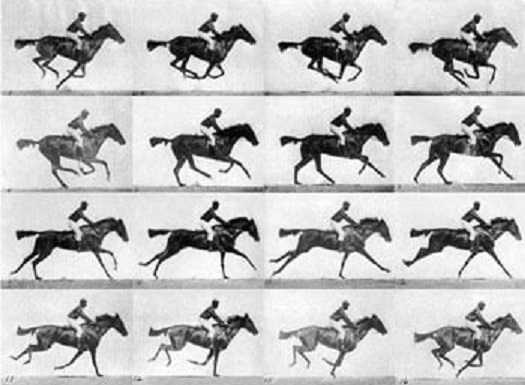
Eadweard Muybridge – The Horse in Motion
On the one hand, those shots confirmed that for a few moments the entire body of the galloping animal was lifted off the ground, but they also indicated that the extension of the legs appeared completely different from that imagined by the artists. The photos of him demonstrated the error of judgment that had persisted until then: the hooves of the horse lift off the ground at the same time only in the moment of compression.
It is easy to understand how, considered, at its inception, a technological devilry, photography, immediately after the first inevitable amazement, entered into competition with painting, above all with that of family portraits despite the fact that the first photos could certainly not compete with the paintings. Posing for a photo took time, but its duration was still less than that required for a painting.
In any case, painting was no longer the only way to represent reality and more and more artistic movements, precisely between the second half of the nineteenth century and later throughout the twentieth century, began to experiment with everything and the opposite of everything in painting. Perhaps, without photography, some of these new experiences, including the avant-garde, would not have existed or would have been perceived as less urgent.
Making a drawing or painting takes time and special skills that aren’t required to take a photo. But, since there is so much even behind the taking of a shot, for the execution of a well-studied photo, the light, the focus, the framing, the choice of the moment and the subject require, albeit different, skills specifications as required for professional painting.
Today, with a point of view to mutual enrichment, perhaps the time has come for these two creative expressions to meet and dialogue.
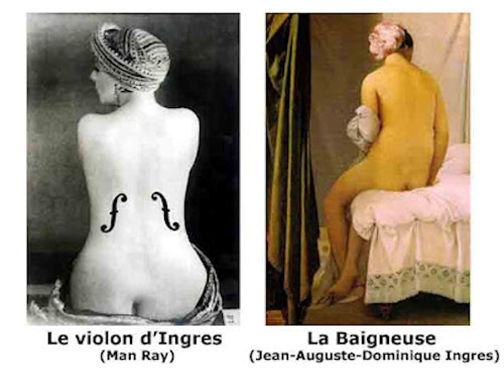
Photography is a recent Art but, despite the obvious difference that lies in its genesis, today it is considered by most historians and critics on a par with the pictorial disciplines and boasts illustrious names supported by considerable values: from Man Ray, (stage name of Emmanuel Radnitzky) whose photo “Le violon d’Ingres” has an estimated value of about seven million dollars.
Photography has been evolving and there are many artists, from Andreas Gursky, to Cindy Sherman to Hendrik Kerstens, Hiroshi Sugimoto, Steve Mc Curry, Sebastiao Ribeiro Salgado Junior, just to name a few.

Hendrik Kerstens, from the left Bubble Wrap (2008), Book (2017) – Bag (2007)
Click on the icons

